Keep Knitting Fresh and Interesting – Learn New Skills

Feeling in a rut? Do you find yourself knitting the same patterns over and over again? It’s time to switch things up! 

If you’re like me, you have several “go to” patterns you can do in your sleep…or certainly while watching your favorite show on TV. You know exactly how many stitches to cast on, how much yarn the project will take, and which size needles to use. But you may also have umpteen of this finished project – with too many blankets, shawls, pullover sweaters, or whatever this “go to” project is – filling up closets or going unused. 

If this is you, it might be time to learn a new knitting skill. Yes, it will be hard at first. Yes, you will make mistakes and will likely have to frog the thing at least once. But the upside is that you’ll have a new technique in your toolkit of knitting designs and skills. You might even have a new favorite project on your hands.

The best way to learn a new project, at least for me, is to purchase a kit that includes an understandable pattern and exactly the amount and type of yarn you’ll need to complete the project. I had been reluctant to buy kits in the past, scarred by memories of paint-by-number art kits in childhood that never had enough paint to finish the project. But happily, the knitting projects I’ve bought in the last several years have had more than enough yarn to complete projects.  (And I’ve bought numerous knitting kits from a wide variety of companies, especially during the pandemic).
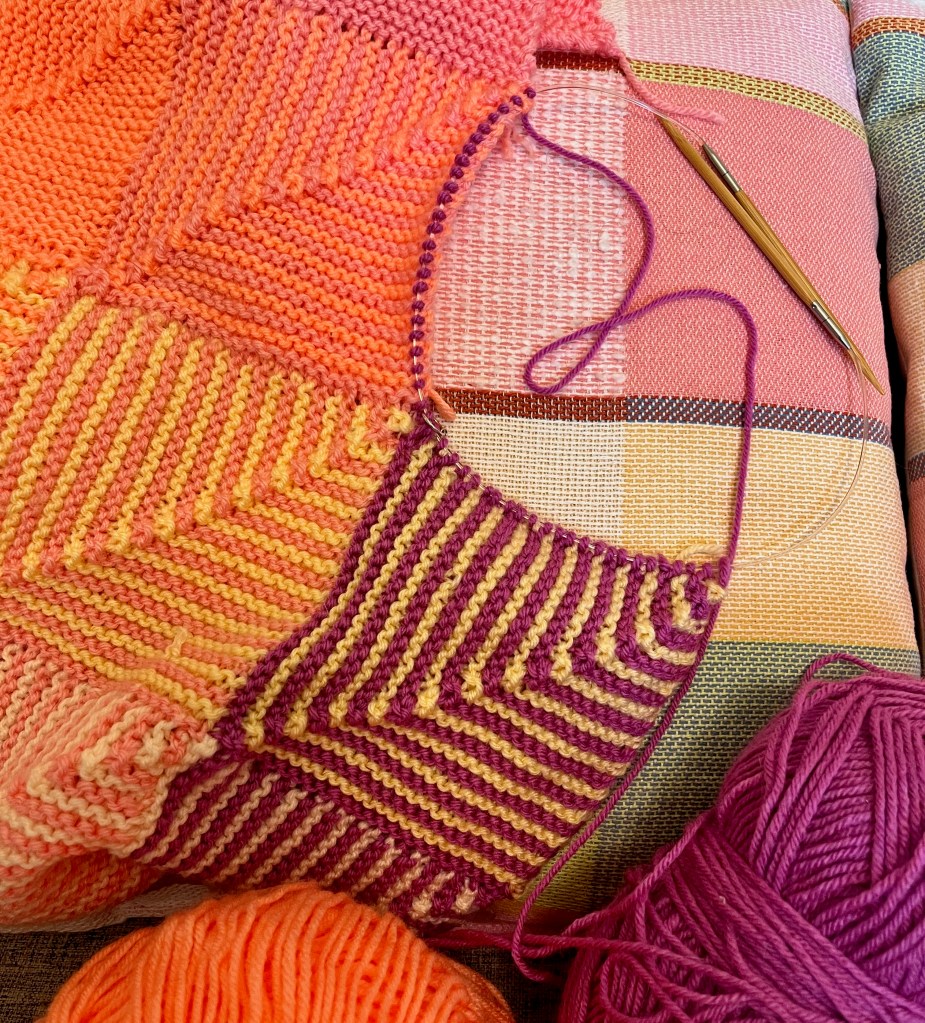
My latest new-to-me knitting skill is the mitered square technique. I found the technique a little trippy – you start with a straight line, and by decreasing in the middle of the row, you end up with a square. Who comes up with this stuff??? I’ve enjoyed making a blanket using this stitch, with some simple colorwork to mix it up as well. Yes, it took me a couple of tries to get it right, but I can now do it like a pro. I’ll definitely use the technique again to make placemats, bath rugs and other household items requiring a fairly sturdy fabric.

Of course, some kits I’ve tried have ended up as “never again” projects. One cardigan sweater kit I bought required me to flip the project around six times and use short rows for some purpose I could not discern. But even the “never again” projects keep knitting interesting and my brain continuing to learn. 

As much as I enjoy simple, meditative knitting projects, I always enjoy a new challenge, too. We all need to keep our minds and souls fresh, active, and open to new experiences!

Knitting Blessings, Cindy

Cynthia Coe is the author of The Prayer Shawl Chronicles, a series of fictional stories woven together by the theme of human connections made through prayer shawls and the craft of knitting. Her newest book is her first historical novel, Knitting Through Time: Stories of How We Learned to Knit. Learn more by visiting her Author Page at this link

Patterns in Nature, Patterns in Fiber Arts

Why do some knitting patterns just “look right”? Where could you find inspiration for designing your next fiber arts project?

Look no further than Mother Nature herself! Certain patterns are found time and time again in nature. Intuitively, we are already hard-wired and attuned to recognizing these patterns. So if you find yourself stumped for design ideas or a pattern that’s sure to please, here are design elements found in nature and their knitting or other fiber arts equivalents.

The Wave: This pattern lends itself easily to the inherently linear nature of knitting. Most knitting patterns are done in rows, and rows are akin to long, thin waves. These waves can have crests and dips, interruptions and smooth sections – just like many knitting or crochet rows.  If you’re knitting in any kind of garter stitch pattern or with other repetitive lines, you’ve got your wave.

A pattern in nature related to the Wave includes the Meander pattern. Think a pathway, river, or snake. Though our finished products in knitting and other fiber arts usually no longer meander, our yarns certainly meander from our skeins to our needles as we’re working!

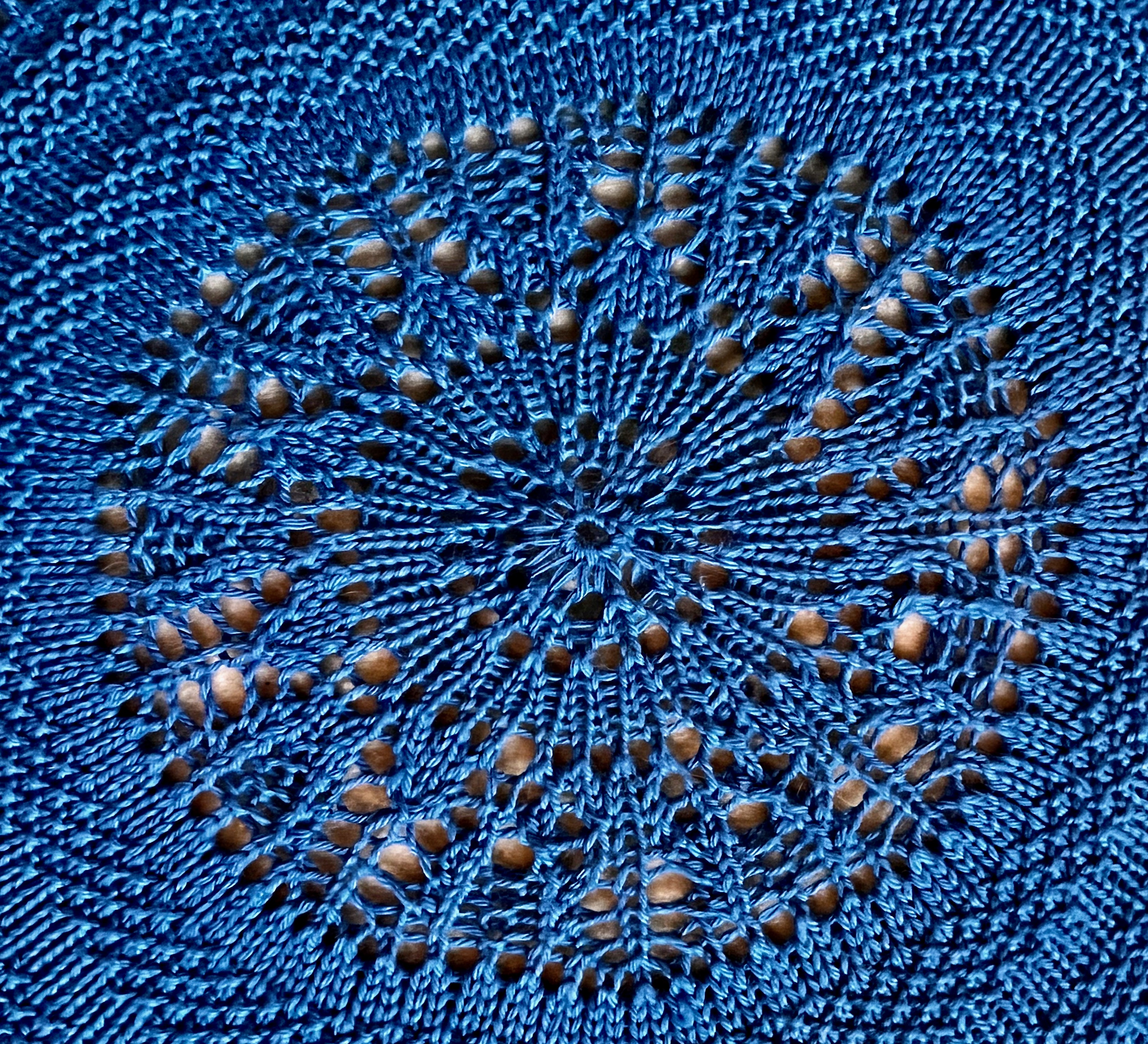
The Burst: Think of the iconic photograph of a drop of milk making a round, crown shaped pattern. Or the shape of a daisy or other flowers or plants “bursting” with a central point. This circular pattern is a bit trickier for knitters. Making a circular pattern with double pointed needles can be fiddly and, in my opinion, is a rather advanced skill. But if you want to knit to impress, this would be your “wow” pattern. This pattern is much easier in crochet, and many crochet patterns feature increasing numbers of stitches starting from a small space. 

The Spiral pattern is similar to the Burst pattern. Both are round patterns, with the spiral meandering around and around instead of making a round burst from a central point. Spirals are more often found in crochet patterns than knitting. 

Fractals: Think branches of a tree or other plant, fractals branch out from a central line, just as tree limbs or leaves branch out from a stem or trunk. We see a lot of fractals in embroidery and other fiber arts using decorative stitches. Many more advanced knitting stitches do feature fractals that mimic plant leaves. These are sure to give your design a nod to nature.

Cells and Bubbles: Cells are the building block of nature, so cell-like designs are often found in all finds of knitting, crochet, and other fiber arts. They may take the form of holes or spaces in our stitches, or we may make block-like patterns in our colorwork or stitching. Think moss stitch in knitting or even basketweave. Bubbles are similar to cell patterns and can give a pattern the feel of fun and joy. 

These patterns are all around us – in our own bodies, in plants, and in the heavens. We know these patterns; we recognize these patterns. Take a look at your favorite fiber arts patterns some time. What do you recognize from the natural world?

Enjoy Your Fiber Arts Designing…and Time in Nature! Cindy

Cynthia Coe is the author of The Prayer Shawl Chronicles, a collection of interrelated short stories about knitters and those they meet through knitting and sharing prayer shawls. 

Be sure to check out my newly published A Prayer Shawl Handbook: Inspiration and Resources for Your Prayer Shawl Ministry, now available in paperback and e-book editions and included in Kindle Unlimited.

Beginner, Intermediate, and Advanced in Knitting Patterns – What the Definitions Should Mean!

Spoiler Alert: “Advanced” is reserved for “I couldn’t possibly knit that while watching TV”

Do you ever check the “Level of Difficulty” on a knitting pattern? Have you ever picked up a “beginner” level pattern, only to find it way, way, way beyond your skill level? Or found that an “intermediate” pattern required you to count each and every movement of the yarn you made, and it still didn’t come out right?

Friends, I’ve been there. I would consider myself a fairly experienced knitter, but I enjoy fairly mindless “meditative” knitting, especially while I’m watching TV or listening to an audio book. Recently, I grimaced in annoyance at a pattern that was labeled for “beginners.” This pattern required yarn-overs, yarn-overs on the purl side that required an extra loop that the pattern failed to mention, and slip stitches that were supposed to go over all that. And at beginner level knitter was supposed to navigate all that??? Really???

So here’s my own definitions of what “beginner,” “intermediate,” and “advanced” should mean in patterns for those of us who knit for pleasure:

Beginner means knits and purls only!!! Nothing else! I mean it! Most beginners are still trying to make consistent stitches that don’t look like something the cat got ahold of. The beginner knitter wants to begin and end with the same number stitches on the needle. If you’re a pattern designer and call your pattern “beginner” level, don’t throw in slip stitches, yarnovers, or anything else that needs explaining. Think stockinette stitch and garter stitches, maybe a moss stitch. There’s a lot you can do with these.

Intermediate means a few tricks that don’t require excessive brain power. Intermediate means you’ve mastered the basic knit and purl stitches and can make a piece of fabric you’re not embarrassed to show other people. You’re now ready to throw in a few fancy stitches that will add texture and impress the heck out of your friends, but you do not have to count beyond the number 4.  For pattern designers, this means stuff like increases, decreases, slip stitches if you explain them properly, and yarnovers. If it’s a sweater pattern, you may ask the knitter to pick up stitches for the button band, but you better provide a video.

Advanced means the knitter will need to turn off the TV, mute the phone, and tell everyone to leave her alone for the next hour. For pattern designers, bring it. You may ask the knitter to count in sets of twelve if you want. You may ask the knitter to knit 9 tog with yarn so thin you have to squint to see it. You may include German short rows, whatever those things are. You may ask your knitter to turn the fabric upside down and flip it over twice every two rows. It’s fine. This knitter has been forewarned and is game for anything. 

Pattern designers, take note and proceed accordingly! Tell us what we’re getting into! And in plain English, please!

Love and kisses to designers who think I knit better than I do, Cindy

Cynthia Coe is the author of The Prayer Shawl Chronicles, a collection of interrelated short stories about knitters and those they meet through knitting and sharing prayer shawls. 

Be sure to check out my newly published A Prayer Shawl Handbook: Inspiration and Resources for Your Prayer Shawl Ministry, now available in paperback and e-book editions and included in Kindle Unlimited.

Confessions of a Hand Knitter: I Still Wear Store-Bought Sweaters

“Did you make that?” Someone asked me recently, admiring a new cardigan with intricate cable work, made of tiny laceweight yarn. “Uh, no,” I replied sheepishly. My admirer gasped. “YOU bought a sweater at a STORE?!”

Yes. I, an avid knitter and maker of pullover and cardigan sweaters, still buy sweaters at stores. 

It all goes down to eyesight. I’ve worn glasses since I was seven years old, moving from nearsightedness as a nerdy child with her head in a book, to a middle-aged woman needing “progressives” to see up close. Knitting with the fine weight yarns I prefer to wear has never been a good fit for me. 

Then there’s the time factor. In my experience, knitting a large garment using fingerling or lace weight yarn takes FOREVER. Between the frustration of squinting to see stitches and the difficulty of correcting mistakes while using threadlike yarn, I’m usually done with dealing with such yarns as the project extends beyond several weeks. 

But I do admire fine weight knitted fabrics, intricate patterns, and complicated cable work. I admire buttons sewn on just-so with an abundance of sturdy thread, ribbon backings on the button bands and perfect pockets. Could I make these garments with such advanced techniques myself? Maybe not. There’s a reason people started manufacturing sweaters, right?

Just last week, I bought a cardigan sweater at a well-known retailer while traveling to New Haven, Connecticut for my son’s wedding. I spied a cream-colored cardigan with abundant bobbles along the sides of the button bands, crisp ribbon facings, elegant gold buttons, and cables that would make me pull my hair out if I attempted to knit them myself. It fit perfectly and felt oh-so-luscious on my arms. So heck yeah, I bought it! 

As a knitter, I confess I am primarily a meditative knitter. I knit to zone out, to find a place and space of calm and peacefulness. I knit to keep my fingers from fidgeting when I want to think or pray or just take a break from the busy-ness of real life.

And I also confess to buying great knit pieces at the store…especially when they’re on sale and look terrific on me!

Peace, Cindy

Cynthia Coe is the author of The Prayer Shawl Chronicles, interrelated stories about knitters and those for whom they knit and love. The sequel to this book, The Knitting Guild of All Saints, has been released! Available in paperback and on Kindle, included in Kindle Unlimited. 

RIP Knit Club Kits – But I’m Still Enjoying You Lots

Back in a different time and place  – 2018 – I discovered Knitting kits. These high quality knitting kits opened a whole new world of knitting for me. I started using real wool and other “luxury” all-natural fibers for the first time, and my knitting skill increased by leaps and bounds. 

My late husband gifted me my first kit for Christmas at the end of 2018 (after a helpful nudge from me, of course). I blogged about this kit in 2019, “Knitting Kits – Worth the Money?” I learned a new and previously-unknown-to-me technique, mosaic knitting, along with several other more advanced techniques.

Reader, I fell in love. I went on to purchase several more kits from Kitterly and learned to make Raglan sweaters, additional mosaic colorwork techniques, and even German short rows (gasp!). Having achieved at least an “advanced intermediate” level of knitting, I proceeded on, discovering kits and videos on Bluprint and monthly subscription kits with Knitcrate. Oh my, did my knitting skills level up! 

Then 2020 happened. The bottom fell out of all these lovely knitting kit companies. Kitterly quietly went out of business – or at least they quit sending out ads and emails. Bluprint’s more publicized demise suddenly put me in the position of “buy them now or not at all,” and I quickly purchased a number of high quality kits at pennies on the dollar. My stash went from one basket to three baskets to a situation of wondering where I would even store all these kits I knew I wouldn’t get to for a long time.

Knitcrate hung in until just last month. I think most of its customers saw the handwriting on the wall, with an astonishing 80% clearance sale in late 2022 signaling that the end was nigh. Like with Bluprint, I recognized this was crunch time. I could get terrific deals on gorgeous alpaca, wool, and even silk-blend yarns. Then, it would all be gone.

So here I am, in early 2023, finally getting to one of those Bluprint kits I bought for next-to-nothing over two years ago. I’m still learning lots and increasing my skills, making an oversized Raglan sweater with complicated cables and a shawl collar. It’s sad, seeing references to “online resources” through my former Bluprint account. Those online resources just aren’t there anymore. I’m really, really glad I bought so many kits when I did and even more glad I have the print copies of the patterns in my hands. 

Meanwhile, I’ve got an entire cabinet of yarns I’ve purchased through Knitcrate over the last couple of years. While those yarn purchases seemed extravagant at the time, I rationalized that I was getting high quality products at terrific deals. Yes, I was. That fact is truer now than when I made the purchases in the first place.

RIP Kitterly, Bluprint, and especially Knitcrate, with its monthly surprise packages and friendly online community of crafters. I’m still enjoying your kits. I’m still enjoying your yarns. And with a mammoth stash of clearance sale kits stocked up, I will continue to enjoy and learn from you for several years to come. 

Cynthia Coe is the author of The Prayer Shawl Chronicles, interrelated stories about knitters and those for whom they knit and love. The sequel to this book, The Knitting Guild of All Saints, has been released! Available in paperback and on Kindle, included in Kindle Unlimited. 

Are you using a kit subscription or other knitting kit you love? Feel free to give them a shout-out in the comments. I have no dog in the hunt, and I’m happy to help out knit companies who need the business! 

How Do You Knit Socks?

When I knitted my first socks two years ago, the entire process of making socks was a mystery. What’s a gusset? What’s a heel turn or a heel flap, and are those two different things? What’s this Kitchener stitch everyone talks about with reverence and awe but can never seem to remember?

My first pair of socks found me, as I signed up for a subscription service that sent a sock kit as the new subscriber freebie. I had pondered trying to knit a pair of socks for some time, but even as an experienced knitter, I couldn’t figure out how in the world the process worked. But I gamely got myself an outrageously small set of circular needles and dove in.

This first pattern I tackled featured an “afterthought” heel. You make the body of the sock and go back and knit the heel afterwards. This process includes putting in a lifeline and the terrifying act of pulling the lifeline out on this project you’ve toiled over for a week, trying to get the thing back on your toothpick sized needles. I survived the experience, presented my husband with the cozy wool socks he had asked for years ago, but pondered whether I would have the nerve to knit another pair.

A month later, I gathered myself and tried another sock pattern. This time, mercifully, there were no afterthought heels or any other high wire acts involving life lines. As I got to the heel flap (whatever that was), I slavishly followed the instructions through a mystifying process of slip stitches, picked up stitches around a tiny rectangle, and a series of decreases that somehow looked like an increasingly larger triangle. But finally, I successfully rounded the corner of the heel and ended up with a piece of knitting that actually looked like the embryo of a sock. I even mastered the Kitchener stitch and sewed up the toe neat and pretty.

Was this steep learning curve worth the effort? Oh yes. Hand-knitted socks are a luxury on par with hot chocolate made with real cream and topped with high-end marshmallows. On a cold day, nothing compares.

I admit I have not tried any more afterthought heels. Life seems too short to deal with lifelines when you don’t have to. But who knows what the future holds? Live dangerously once in a while. I do like the color contrasts you get when you make the heel a different color, so I might give it another go one of these days.

Want to learn to make socks?

  • This is my go to resource for sock knitting – a classic, in my opinion: Getting Started Knitting Socks by Ann Budd. It includes everything you need to know about knitting socks. Invaluable is an extensive stitch dictionary for adding pizzaz to your socks. You can make them as plain or fancy as you want.
  • Want to try a new method? A new book with a new and innovative method is coming out soon, Knit 2 Socks in 1 by Safiyyah Talley. I’ve gotten a pre-publication peek at this book. You basically make one long tube, then make a cuff, a toe, and afterthought heels later.

Will I try afterthought heels and the dreaded lifelines again? Maybe. The beauty of trying and succeeding something challenging is that you gain both mastery and a new sense of confidence in your work. Worth it? Oh yes.

Blessing to those trying new knitting techniques! Cindy

Cynthia Coe is the author of The Prayer Shawl Chronicles, a collection of interrelated short stories about knitters and those they meet through knitting and sharing prayer shawls. 

As an Amazon Associate and Author, I provide links to products (including books I have written) and earn a very small fee if you click on the links and buy something. There is no additional charge to you!

Knitted Socks – The New Luxury Accessories?

I’m always amused by what the New York City media discovers as new, hip, and exciting – pleasures the rest of have experienced for years. I’ve rolled my eyes in the recent past as the New York media has discovered Krispy Kreme doughnuts, heirloom tomatoes, the joys of shopping at Target, and the saintliness and cultural significance of Dolly Parton. 

So I shouldn’t have been a bit surprised when I opened the weekend edition of a major New York publication this past Saturday to see that “fancy socks” are the new fashion hot ticket. The subtitle of the article of the publication’s fashion page speaks of “fashion hosiery” as the next best thing which will – gasp – even rival your fab “five-figure handbag.” (What universe does this writer live in?)

I sighed, gazing at the lovely ankle socks featured on the newsprint in front of me. Those bright green socks on the end, I thought, look like a pair I knitted just a couple of months ago. I had no idea I was so hip, so fashion forward. 

Despite my eye rolls, I have to agree with the assessment of socks as high luxury. I knitted my first socks about two years ago. Socks are not easy, they take a while to knit, and do a number on your eyesight. But I decided right then and there that handknitted, custom made socks were the most luxurious things I had ever put on my body. As I slipped on my first pair of all-wool, handknit socks, I audibly groaned in pleasure. And they fit perfectly…because they were made to measure for my very own feet. 

But we knitters knew this all along, didn’t we? Bold, bright colors – we’ve already got that yarn in our stashes. Sparkles and intricate patterns – heck, we use those design elements as a matter of course. 

We’re just glad the New York media is finally getting a clue.

*Update! I tried to publish this blog post twice, but I found it “trashed” and blocked on my social media platforms. Hmmm…some really large publisher doesn’t like anything even close to criticism???

Happy Sock Knitting, Cindy

P. S. There’s a new sock knitting book coming out soon, Knit 2 Socks in 1, by Safiyyah Talley. Publication date is March 1. 

This method of knitting socks is an interesting concept is you’re a fairly accomplished knitter and want to try something new and different. The concept is to knit one long tube with some safety lines, then put a toe, a cuff, and “afterthought” heels onto your set of socks later. Highly recommended for hand knitted sock aficionados who grow weary of “second sock syndrome.”

Cynthia Coe is the author of The Prayer Shawl Chronicles, a collection of interrelated short stories about knitters and those they meet through knitting and sharing prayer shawls. 

As an Amazon Associate and Author, I provide links to products (including books I have written) and earn a very small fee if you click on the links and buy something. There is no additional charge to you!

Knitting Through Times of Crisis

I’ve never understood why anyone would willingly work on a tedious, difficult, and mentally taxing knitting project. Until now. 

Since my teen years, I’ve always been a “meditative knitter.” Give me a project that’s easy to memorize, not too difficult, and lets me zone out. I love to make prayer shawls, easy pullovers, and straightforward yoke cardigans. 

As I’ve tried to up my knitting game, I’ve tried more difficult patterns and techniques. This past fall, I took a course in double knitting at the Vogue Knitting Convention in Ohio. Double knitting took every bit of concentration I could muster. I found myself thinking, “if I’m ever in a situation where I want to block out every single thought in my head, I’ll do this kind of knitting.”

Well, here we are. On the evening of March 12, the school system closed for the year. By the next afternoon, the shelves of my local grocery store were cleared by panic buyers. Then, six weeks later, my husband was diagnosed with a rare and aggressive form of cancer and given only months to live. 

Needless to say, I’ve spent a lot of time knitting my way through these crises. During the worst moments, I’ve sat in my home office, working on an extremely intricate pattern with tiny needles and ultra-thin yarn, blocking out every single thought and emotion running through my body. I still work on a meditative project each and every day as my personal self-care and spiritual discipline. But I’ve also added a half hour of knitting that vanquishes thoughts of everything else going on my life, if only for a few minutes. And this has helped me simply get through each day, taking me away from the huge responsibilities suddenly placed on my shoulders.

So now I know why knitters work on all those difficult, intricate patterns and stitches. For me, it’s a more hard-core form of the meditative knitting I’ve always done. At times like these, I value my knitting for giving me peace, for giving me something tangible and constructive to do, and for helping me keep my sanity in a time of crisis. 

Blessings to all my fellow knitters facing times of crisis, Cindy

Cynthia Coe is the author of The Prayer Shawl Chronicles, a collection of interrelated short stories about knitters and those they meet through knitting and sharing prayer shawls. 

My Season of Knitting Cardigan Sweaters

I wear cardigan sweaters all the time. Here in the Smoky Mountains of East Tennessee, we rarely have bitter cold weather. But in the pastel beauty of the Appalachian spring and among the yellow and orange leaves of autumn, we have cool mornings and crisp evenings perfect for a light sweater. During the heat of the summers, cardigans are perfect for peeling off by midmorning or to cope with excessive air conditioning indoors.

This year, I pledged to learn to knit my own cardigans. My closet is full of fairly inexpensive, store-bought cardigans, but I didn’t have a single cardigan sweater I had made myself. As a longtime knitter, I found this situation embarrassing and unacceptable. I admit, I found all the shaping, button bands, and tricky necklines highly intimidating. 

But I resolved to learn the skills needed and become a Cardigan Queen. Two months into the year, I’m pleased to say I’ve completed two cardigans and have another well under way. I started with a yoke-neck cardi. Much to my surprise, my first cardigan took less than two weeks to complete, fit perfectly, and is now a “go-to” part of my wardrobe. 

The verdict is still out on the “saddle” neck cardi I’m making, using a kit from Kitterly. It’s complicated, using German short rows, make-one-lefts and rights, cable cast-ons, and some other techniques I hadn’t used before. But I followed the directions and somehow got several indescribable shapes onto one set of needles to form a corset shaped garment that is starting to look like a sweater. 

Will my season of cardigans come to a successful conclusion? Probably. Though my season of cardis is not yet in full bloom and I still have a lot to learn, the seeds of a fruitful harvest of all new cardis is firmly planted, taking root, and in a promising growing season. 

Here’s What I’m Using to Make Cardigans

Margaret Hubert, One-Piece Knits: Essential Designs in Multiple Sizes and Gauges for Sweaters Knit Top Down, Side Over, and Back to Front (This book of charts proved easier than it initially looks. I’ve easily adjusted the charts slightly to fit me. Several techniques are included. Highly recommended.)

Yarn: Knitcrate offers very high-quality yarns at very affordable costs. If you subscribe to the “member crate,” you’ll get enough yarn for a small project (patterns included). At the end of the month, you can get fantastic deals on the featured yarns (and get enough yarn for a sweater). Buy early – they sell out! Click this link to get a crate for only $5.

Kits: I’m using kits from Kitterly. These kits are pricey but include high quality yarn and well-designed but complicated patterns. They work, but you’ll need to pay close attention to the directions. 

Blessings on you own season of knitting, 

Cindy

Cynthia Coe is the author of The Prayer Shawl Chronicles, a collection of interrelated short stories about knitters and those they meet through knitting and sharing prayer shawls.