Knitting for Daily Delight: The Joy of a Daily Shawl Practice

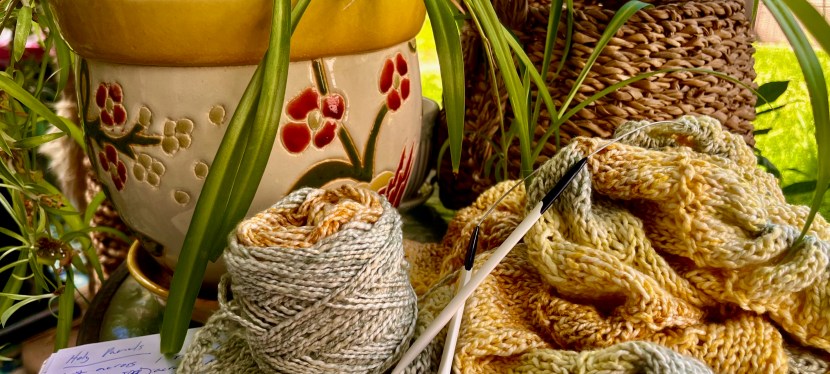
We all know that knitting can be a relaxing and enjoyable hobby. It’s not just about creating beautiful garments for others; you can also knit something special for yourself. Imagine the joy of making a shawl just for you, without any specific spiritual practice in mind. Self-care and taking a little time for yourself are essential for a happy life. With a daily shawl practice, you can weave a touch of delight into your daily routine.

The Daily Shawl Ritual

This practice is all about having fun and adding a daily dose of creativity to your life. You can decide to set aside some time each day to knit a few rows or a specific pattern repetition. It’s a simple way to make time for yourself and celebrate your love for knitting.

You might want a little structure for this daily knitting practice. In recent years, many knitters have embraced personal knitting challenges, like “temperature blankets” that represent each day’s temperature with a unique color. Others have created blankets that track train delays, their daily moods, or noteworthy events. These creative projects become a delightful daily ritual, a moment to reflect on different aspects of life.

Feel free to choose colors based on your mood, the season, or even random picks. You can switch things up and create a pattern that’s uniquely yours, without any strict rules.

Creating a Comfortable Space

As a dedicated knitter, you can choose to create a cozy knitting nook that makes you feel happy and relaxed. Maybe you have a favorite chair or a spot with a great view. You can add some scented candles, colorful decorations, or anything that brings you joy. It’s your personal knitting paradise!

As you look up from your knitting, you’ll be reminded of the joy and creativity that knitting brings into your life. It’s a way to stay focused on enjoying your knitting time, instead of worrying about everyday chores.

The Real Joy

The real joy here is the daily act of knitting, not just the end product. It’s about embracing a fun and lighthearted daily ritual that brings joy. You’ll find yourself looking forward to this special knitting time, and it can even become a delightful part of your daily routine.

Blessings, Cindy

Cynthia Coe is the author of The Prayer Shawl Chronicles, interrelated stories about knitters and those for whom they knit and love. The sequel to this book, The Knitting Guild of All Saints, has been released! Available in paperback and on Kindle, included in Kindle Unlimited. 
Be sure to follow me for an upcoming announcement of a new book for makers of Prayer Shawls!

Confessions of a Hand Knitter: I Still Wear Store-Bought Sweaters

“Did you make that?” Someone asked me recently, admiring a new cardigan with intricate cable work, made of tiny laceweight yarn. “Uh, no,” I replied sheepishly. My admirer gasped. “YOU bought a sweater at a STORE?!”

Yes. I, an avid knitter and maker of pullover and cardigan sweaters, still buy sweaters at stores. 

It all goes down to eyesight. I’ve worn glasses since I was seven years old, moving from nearsightedness as a nerdy child with her head in a book, to a middle-aged woman needing “progressives” to see up close. Knitting with the fine weight yarns I prefer to wear has never been a good fit for me. 

Then there’s the time factor. In my experience, knitting a large garment using fingerling or lace weight yarn takes FOREVER. Between the frustration of squinting to see stitches and the difficulty of correcting mistakes while using threadlike yarn, I’m usually done with dealing with such yarns as the project extends beyond several weeks. 

But I do admire fine weight knitted fabrics, intricate patterns, and complicated cable work. I admire buttons sewn on just-so with an abundance of sturdy thread, ribbon backings on the button bands and perfect pockets. Could I make these garments with such advanced techniques myself? Maybe not. There’s a reason people started manufacturing sweaters, right?

Just last week, I bought a cardigan sweater at a well-known retailer while traveling to New Haven, Connecticut for my son’s wedding. I spied a cream-colored cardigan with abundant bobbles along the sides of the button bands, crisp ribbon facings, elegant gold buttons, and cables that would make me pull my hair out if I attempted to knit them myself. It fit perfectly and felt oh-so-luscious on my arms. So heck yeah, I bought it! 

As a knitter, I confess I am primarily a meditative knitter. I knit to zone out, to find a place and space of calm and peacefulness. I knit to keep my fingers from fidgeting when I want to think or pray or just take a break from the busy-ness of real life.

And I also confess to buying great knit pieces at the store…especially when they’re on sale and look terrific on me!

Peace, Cindy

Cynthia Coe is the author of The Prayer Shawl Chronicles, interrelated stories about knitters and those for whom they knit and love. The sequel to this book, The Knitting Guild of All Saints, has been released! Available in paperback and on Kindle, included in Kindle Unlimited. 

That Liberating Feeling of Ripping Out Your Knitting Project

We’ve all been there. You start a knitting or crochet project. You’re well underway with it. And you hate it. What do you do? Soldier on, or rip it out and start over?

I found myself in this place with a knitted sweater recently. I had designed it myself, using expensive alpaca and wool yarn, in a deep red color. Since the yarn was a delicate fingerling weight using tiny needles, I had put hours upon hours of work into it. But I could tell it would be way, way too small for me.  What to do? 

Reader, I ripped out the entire project. All of it. And I felt liberated. Instead of keeping myself in a rut I couldn’t get out of, I got to re-think and start an entirely new project. 

When I ripped out my former sweater, I honestly did not regret the time I spent on it. As with all knitting projects, I enjoyed pleasant, restorative quiet time while making this sweater. I enjoyed knitting along while watching and listening to my favorite shows. Was this wasted time? Absolutely not. In fact, I considered the ripping out process as getting double the value for the money spent on this particular yarn. 

My former knitted sweater is now in the process of becoming a crocheted prayer shawl I’m making as a prototype for a new book. I have no regrets. Instead of suffering through a project I would never wear, I’m making something that will wrap around someone’s shoulders and fit perfectly, no matter the size of the person. 

Other crafters – woodworkers, painters, metal workers – may have to throw away or destroy projects that don’t work. I imagine that must hurt and be costly. As knitters and crocheters, we get to do something most people can’t do. We get a do-over. If a project isn’t working for us – for whatever reason – all we have to do is pull that piece of yarn and keep pulling until the project literally doesn’t exist anymore. Our flexible yarns give us the possibility of release from our mistakes and the possibility of a brand new start. 

Blessing for all the do-overs in your life, Cindy

Cynthia Coe is the author of The Prayer Shawl Chronicles, interrelated stories about knitters and those for whom they knit and love. The sequel to this book, The Knitting Guild of All Saints, has been released! Available in paperback and on Kindle, included in Kindle Unlimited. 

Writing Knitting Patterns – Is There Hope for a Creative “Pantser” Like Me?

Do you write knitting patterns? Do you love the process or – like me – feel your soul enter a state of utter dread when you even ponder such a thing?

As I prepare the final draft of a new book, I know I need to include at least a few knitting patterns in this book (it’s a non-fiction how-to book). I know this, but I have yet to put pattern to paper. And yes, this is supposed to be a “final” draft.

In writing terms, I’m a total “pantser.” This means I generally fly by the seat of my pants when I work on creative projects. This process works beautifully for some of us.( Just start typing and feel awe and wonder at what appears on the screen!!!) Other writers are “plotters.” They plan out every single step of their writing projects, complete with detailed outline (or so I’m told). 

As a knitting designer, I’m a “pantser” as well. People ask what I’m making, and I say, “a prayer shawl, I hope.” I cast on a hundred or so stitches and see what happens. I usually come up with an interesting pattern with texture, contrasting elements, whimsy – all that stuff. But if asked to duplicate what I’ve done…that’s a problem.

I’ve discerned that pattern writing and “pantsing” are not compatible. And yet, I really need to share my prayer shawl patterns. As I’ve recruited fellow church members to knit or crochet prayer shawls for our parish ministry, they inevitably ask, “got a pattern for me?” 

I got my hands on a soon-to-be published pattern writing handbook and eagerly jumped in, hoping for some inspiration. I felt filled with growing confidence for a couple of chapters. Then, the authors tell me I need to find “beta testers” and “tech editors.” Really???? Just for a simple prayer shawl pattern I could do in my sleep?

As I begin to work on my new book, I hear a song playing in the background. “Don’t worry about a thing,” the lyrics tell me. I proceed in hope.

Do you write knitting patterns? Tips or tricks? Feel free to drop them in the comments!

Be sure to check out The Knitting Pattern Writing Handbook, scheduled for publication on October 31 and available for pre-order. A great resource, especially for newbies and pattern-writing wanna be’s like me. 

Blessings, Cindy

Cynthia Coe is the author of The Prayer Shawl Chronicles, interrelated stories about knitters and those for whom they knit and love. The sequel to this book, The Knitting Guild of All Saints, has been released! Available in paperback and on Kindle, included in Kindle Unlimited. 

As an Amazon Associate and Author, I provide links to products (including books I have written) and earn a very small fee if you click on the links and buy something. There is no additional charge to you!

What Knitting Taught Me About Writing

When I tell people I write about knitting, they tend to giggle or smirk. Yes, I’m a writer, and I’m a knitter. For me, knitting and writing involve similar processes. Both take a long time and can’t be rushed. Both can produce something intricate or something simple. Most importantly, both are crafts. You practice, you continually get better. You learn new skills and develop your own personal style and ways of doing things.

Here’s what I’ve learned about Writing from my Knitting:

  • Projects take a long time to complete. You handle them one stitch at a time. You pick up the needles every day and do some work on your project. Same with writing – you sit down and write a page or two every day. Eventually, you have a book length manuscript.
  • Ripping out is sometimes necessary. Ripping out a piece of knitting is not fun. You can lose stitches and lose your mind. You might have to rip your work out several times before you get it right. Same with writing. If you have a problem in your work and know it, you’re going to have to stop, make some cuts, and revise. None of this is fun, but you know in your heart you’ll feel better about the final product once you do it.
  • It’s the intricate work that makes your work shine. Plain stockinette is fine, but it’s the fancy cables or other intricate stitchery that grab people’s attention and show what you’re made of. Same with writing. My work involves interrelated short stories and lots of characters whose stories weave in and out of each other. Would it be easier to tell one straightforward story? Sure, but it’s this intricate interweaving of stories that add a richness and depth to my writing.
  • Crafting skills count. All of them. To make a sweater or a pair of socks, you need lots of skills – casting on, picking up stitches, mattress stitching a sleeve together, casting off. You need to master ALL of these skills; you don’t sub them out to somebody else. I’ve come to believe that writing should be the same process. After saying “enough” to the soul-crushing rejections of the New York publishing industry, I learned to publish my own work. I do it all – choose the font, design the book covers, character development, revisions – just like I do with a large knitting project. For me, it’s all part of the craft of producing a book. I don’t sub out tying up loose ends, do I? Virginia Woolf typeset her own manuscripts, after all, and self-published. 
  • Sometimes you need to set your work aside. We’ve all gotten sick and tired of knitting projects. You get frustrated by difficult patterns or just plain bored or exasperated. The same thing happens with large writing projects. You think you’re going nowhere, you’re out of ideas, the project looks too big and unwieldy for you to possibly complete. Sometimes you just need to take a break. And then, when you’re ready, you pick up that work-in-progress again, settle into well-honed skills, and you think, “I’m so glad to be back.” You move forward, and you’re so glad you did. You’re doing what you do best.

Happy Knitting (or Writing! Or Both!), Cindy

Cynthia Coe is the author of The Prayer Shawl Chronicles, interrelated stories about knitters and those for whom they knit and love. The sequel to this book, The Knitting Guild of All Saints, has been released! Available in paperback and on Kindle, included in Kindle Unlimited. 

Knit A Prayer Shawl For Yourself – Take Care of Your Own Soul

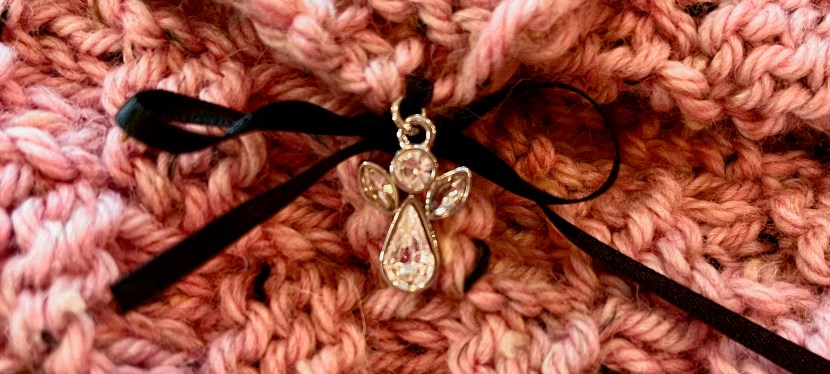
A couple weeks ago, while taking a class at a local yarn shop, I spotted some blush pink, wool yarn with tiny black flecks spun into it. The yarn spoke to me – the soft pink reminded me of early springtime here in Southern Appalachia, with the soft pinks of cherry trees soon making their appearance. The black flecks reminded me of the black ashes I would soon have traced in the shape of a cross on my forehead for Ash Wednesday. 

After hearing a call to personal growth during the Ash Wednesday service last week, I decided to make a prayer shawl just for me with this pink and black flecked yarn. I had made numerous prayer shawls for others this past year, but I reminded myself that my soul needed attention, too. Those of us active in our churches tend to find ourselves very busy ministering to other people. We serve as greeters and lectors, pack up Christmas gifts for the homeless, attend committee meetings and generally lend a listening ear or a warm hug to those in need in our communities. Lent is a time not to forget all those tasks, but to remember that you need to work on yourself, too. 

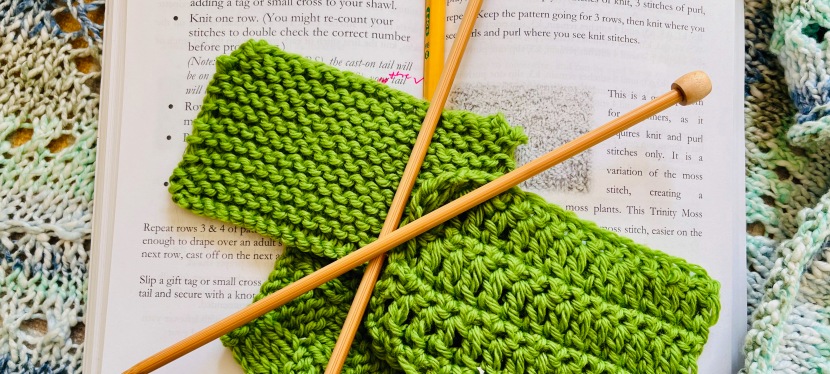
My personal prayer shawl, like those I make for others, uses a simple pattern I don’t have to think about. I’m using a triple moss stitch – 3 knits, 3 purls, repeat – so that I can both zone out of day-to-day life but still stay alert enough to think and focus on my spiritual issues. We all need a fairly simple pattern for our lives, I think. We need structure and a pattern that doesn’t overwhelm us, one that keeps us from veering into chaos. But we need to keep ourselves alert and at least a little challenged as well. 

This Lent, as I sit quietly knitting my pale pink prayer shawl, speckled with the black ashes of Lent, I think about how far I’ve come since becoming widowed 2 years ago. I also think about the challenges and personal growth I still need to work on. Like the progress on my personal prayer shawl, I’ve made much progress, and I’m developing into a recognizable shape. But I’ve still got a good bit of work in front of me. With God’s help, each day this Lenten season, I’ll spend a few minutes each day in quiet knitting and prayer.  I’ll work on the fabric of my life, watching it grow and stretch into something complete and whole, one stitch at a time. 

With Blessings for a Holy Lent, Cindy

Cynthia Coe is the author of The Prayer Shawl Chronicles, interrelated stories about knitters and those for whom they knit and love. The sequel to this book, The Knitting Guild of All Saints, has been released! Available in paperback and on Kindle, included in Kindle Unlimited. 

Learning to Knit – What’s Your Story?

I learned to knit from my mother in the late 1970’s, as a teenager. My mother did not knit on a regular basis. She made one big project that I know of – a garter stitch blanket for my dad. She made this one project back in the 1950’s, when my dad had lung surgery to remove a piece of debris stuck in his lung since childhood, and my mother had many anxious hours spent at the hospital, knitting to pass the time. My mother only knew how to cast on, make the knit stitch, and cast off. She never learned to purl. But she passed on what little she knew to me, and knitting soon became a beloved craft for me.

There’s a story behind each and every person who learns to knit. Maybe you learned to knit from a favorite aunt or a grandmother. Maybe you learned at summer camp, or at church, or from videos online, stuck at home during the pandemic. Many of the stories in my books, The Prayer Shawl Chronicles, feature someone going through a difficult time and learns to knit, finding healing along the way. A washed-up ballerina goes back to her hometown, learns to knit from a female lawyer, and starts a new career as a paralegal. A young girl coming out of the foster care system sits on the curb of a food pantry, trying to figure out what to do with two sticks and a ball of string. A woman walking her dog in a church garden gets caught in the rain, ducks into a church service for shelter, and stumbles on a Blessing of the Prayer Shawls service. 

This weekend, I’m hosting a Knitting Social at my local church. I’ve invited anyone who knits or wants to learn to knit. I’ve got a plan for teaching knitting from scratch, balls of yarn lined up, and several pairs of size 9 needles ready to offer. Who will show up? What will their story be? Will they stick with knitting for the rest of their lives, or will they find it a passing thing they may pick up again years from now? Will they, like my mother, pass on these knitting lessons to young girls or boys born far into the future? It’s exciting to think of the possibilities!

What’s your story of learning to knit? Who taught you? Where were you, both in time and in your emotional state? Did knitting help you heal in some way, or was it something fun or creative to do?  I bet there’s a story there!

Blessings on your knitting journey, 

Cindy

Cynthia Coe is the author of The Prayer Shawl Chronicles, interrelated stories about knitters and those for whom they knit and love. The sequel to this book, The Knitting Guild of All Saints, has been released! Available in paperback and on Kindle, included in Kindle Unlimited. 

Yarn – It’s Fundamental to Human Culture

We’ve all seen the memes. “My other hobby is buying yarn.” “My yarn stash exceeds my expected lifespan.” “Yarn is like chocolate; you can never have too much.” 

We treat yarn as if there’s an abundant worldwide stash ready for us to buy, in any amount. Craft stores literally stock enough yarn to reach the ceiling. You can obtain yarn for any project you have in mind with a couple of clicks on your phone.

This wasn’t always the case. In researching for my next book in The Prayer Shawl Chronicles, I’ve been shocked to learn how much time women have spent over the centuries making yarn and thread. Before industrialization, if you were a human being and a woman, you would spend a good part of your waking hours making yarn or thread. If you were a Neanderthal woman, you would have used fibers from the inner bark of conifer trees to make string for fishing lines and nets, to hang food to dry, to set traps for small animals, and to sew together animal hides for clothes and shelter. If you lived in Europe up until the industrial revolution, you would carry around a spindle and a fist full of wool, and you would make yarn while you watched the kids, walked, talked, and generally while you kept an eye on whatever else went on in your life. You would know how to work a spinning wheel as well as you knew how to cook. It’s what your family needed to survive.

Why don’t we study this in history class? Why don’t we see remnants of these time-consuming tasks featured in museums? Think about it – yarns, threads, and cloths eventually deteriorate and rot. These cushy, soft products don’t survive as long as items made of metal, stone, or even wood. So our foremothers’ efforts put into anything woven, knitted, or sewn have largely faded (or rotted) away from the saved artifacts of human culture.

The next time you pick up a skein of yarn to knit your next project, consider yourself blessed. Thanks to human ingenuity, all you had to do to get that yarn was click buttons on your phone or make a craft store run, which you probably enjoyed. Appreciate that you, as a 21st century woman, have the leisure to simply sit and knit for the sheer pleasure of it. 

Blessings, Cindy

Recommended Reading:

The Fabric of Civilization: How Textiles Made the World, by Virginia Postrel

Women’s Work: The First 20,000 Years, by Elizabeth Wayland Barber 

Cynthia Coe is the author of The Prayer Shawl Chronicles, interrelated stories about knitters and those for whom they knit and love. The sequel to this book, The Knitting Guild of All Saints, has been released! Available in paperback and on Kindle, included in Kindle Unlimited. 

As an Amazon Associate and Author, I provide links to products (including books I have written) and earn a very small fee if you click on the links and buy something. There is no additional charge to you!

Knitting Hasn’t Always Been “Just a Hobby”

Knitting is just a hobby, right? A way to pass the time. Maybe a reason to get together with other crafty friends. Perhaps just a harmless and inexpensive thing you do while watching television. 

Knitting hasn’t always held such a frivolous place in human lives. At many points in human history, knitting was serious business. If you were poor and needed money to feed yourself, you knitted. And you knitted socks, lots of them. You might knit every night until you couldn’t see the wool in front of you. You might knit every spare moment you found in your difficult and dreary life. Because you had to. Knitting was how you got by.

This past month, I’ve done a deep dive into the history of knitting. In preparing to write a new novel in the Prayer Shawl Chronicles series, I’m looking at why people – mostly women – knitted over the last decades and centuries. What exactly did they knit? How did they learn to knit? What did they use for needles? How did they get access to patterns? And my big question has been, what place did knitting have in the average woman’s life?

Several of the answers surprised me. Knitting used to be all about socks. The oldest found knitted garment was an ancient Egyptian sock. Up until the 1920’s, knitting continued to be a way to provide high quality socks to the aristocracy and others who could afford them. In more recent years, soldiers fighting one war or another (with wet, dirty, sore, and blistered feet) went through socks like there was no tomorrow. They needed the womenfolk back home to keep them supplied. 

When you think of “handknitted garments,” the first items to come to the 21st century mind might be “scarves” or “sweaters.” Socks are difficult and advanced projects for most of us. We’re just knitting to pass the time, remember. Up until Coco Chanel introduced us all to “sportswear” in the early part of the 20th century, people generally did not wear sweaters – with the noted exceptions of British fishermen. Hard to imagine, right? 

Enjoy your knitting. You’re very blessed to live in a time when you probably don’t have to knit. You don’t have to crank out a zillion pairs of socks just to put food in your children’s tummy. You probably aren’t knitting essential items for the military. You can afford to just knit because you want to. Sure, you may knit to economize and make an all-wool sweater that would cost a lot at your local department store. But you have that option. (And I bet you thoroughly enjoy making that sweater, too.)

But give a thought to those women who don’t have the option of “free time.” Give a thought to women who are working very hard, doing something with their hands, for the same reasons our foremothers knitted long into the night by candlelight to keep the soup bowl filled. Because, but for the grace of God, we all could have lived in a place and time when we knitted not for fun, but for survival. 

Here’s my recommended books on the history of knitting in Britain and the United States. Both are beautifully researched and a pleasure to read. 

This Golden Fleece: A Journey Through Britain’s Knitted History by Esther Rutter (2021)

No Idle Hands: The Social History of American Knitting by Anne L. Macdonald (1990)

Happy Knitting, Cindy

Cynthia Coe is the author of The Prayer Shawl Chronicles, interrelated stories about knitters and those for whom they knit and love. The sequel to this book, The Knitting Guild of All Saints, has been released! Available in paperback and on Kindle, included in Kindle Unlimited. 

As an Amazon Associate and Author, I provide links to products (including books I have written) and earn a very small fee if you click on the links and buy something. There is no additional charge to you!

RIP Knit Club Kits – But I’m Still Enjoying You Lots

Back in a different time and place  – 2018 – I discovered Knitting kits. These high quality knitting kits opened a whole new world of knitting for me. I started using real wool and other “luxury” all-natural fibers for the first time, and my knitting skill increased by leaps and bounds. 

My late husband gifted me my first kit for Christmas at the end of 2018 (after a helpful nudge from me, of course). I blogged about this kit in 2019, “Knitting Kits – Worth the Money?” I learned a new and previously-unknown-to-me technique, mosaic knitting, along with several other more advanced techniques.

Reader, I fell in love. I went on to purchase several more kits from Kitterly and learned to make Raglan sweaters, additional mosaic colorwork techniques, and even German short rows (gasp!). Having achieved at least an “advanced intermediate” level of knitting, I proceeded on, discovering kits and videos on Bluprint and monthly subscription kits with Knitcrate. Oh my, did my knitting skills level up! 

Then 2020 happened. The bottom fell out of all these lovely knitting kit companies. Kitterly quietly went out of business – or at least they quit sending out ads and emails. Bluprint’s more publicized demise suddenly put me in the position of “buy them now or not at all,” and I quickly purchased a number of high quality kits at pennies on the dollar. My stash went from one basket to three baskets to a situation of wondering where I would even store all these kits I knew I wouldn’t get to for a long time.

Knitcrate hung in until just last month. I think most of its customers saw the handwriting on the wall, with an astonishing 80% clearance sale in late 2022 signaling that the end was nigh. Like with Bluprint, I recognized this was crunch time. I could get terrific deals on gorgeous alpaca, wool, and even silk-blend yarns. Then, it would all be gone.

So here I am, in early 2023, finally getting to one of those Bluprint kits I bought for next-to-nothing over two years ago. I’m still learning lots and increasing my skills, making an oversized Raglan sweater with complicated cables and a shawl collar. It’s sad, seeing references to “online resources” through my former Bluprint account. Those online resources just aren’t there anymore. I’m really, really glad I bought so many kits when I did and even more glad I have the print copies of the patterns in my hands. 

Meanwhile, I’ve got an entire cabinet of yarns I’ve purchased through Knitcrate over the last couple of years. While those yarn purchases seemed extravagant at the time, I rationalized that I was getting high quality products at terrific deals. Yes, I was. That fact is truer now than when I made the purchases in the first place.

RIP Kitterly, Bluprint, and especially Knitcrate, with its monthly surprise packages and friendly online community of crafters. I’m still enjoying your kits. I’m still enjoying your yarns. And with a mammoth stash of clearance sale kits stocked up, I will continue to enjoy and learn from you for several years to come. 

Cynthia Coe is the author of The Prayer Shawl Chronicles, interrelated stories about knitters and those for whom they knit and love. The sequel to this book, The Knitting Guild of All Saints, has been released! Available in paperback and on Kindle, included in Kindle Unlimited. 

Are you using a kit subscription or other knitting kit you love? Feel free to give them a shout-out in the comments. I have no dog in the hunt, and I’m happy to help out knit companies who need the business!