Your Crafting Supplier Goes Out of Business. What do you do?

Many of us have recently learned that a major crafting retailer is going out of business for good, nationwide. And many of us wonder, what to do? Here are tips.

Here we go again: another round of business closings, and this time it affects our beloved hobbies of knitting, sewing, crocheting, jewelry making, and many other crafts. Those of us using these hobbies to keep our sanity, calm down, express creativity, or just make something nice for ourselves or loved ones might wonder how we get the basic supplies for these crafts.

We’ve been here before. During the pandemic, ALL of the online retailers supplying my yarns for knitting eventually went out of business. And reader, I got some huge bargains on top quality yarns, which I’m still using and expect to use for many years to come. Here’s what I learned:

  • Don’t fret about where to buy your next yarn stashes just yet. Nature abhors a vacuum. Supply markets naturally fill gaps when they arise. If you don’t have a nice place to buy crafting materials in the near future, again, Patience! Work through your stash. If you have indeed bought plenty of yarns or other materials from the big going-out-of-business sales, you’ll have plenty to do. If you must, order online or visit a locally owned shop. At some point, if there’s demand, another business will snatch up the market for reasonably priced crafting materials!
  • Deep Clearance Sales WILL Happen. You’re about to scoop up some deals on crafting supplies, but you may need to be patient. Businesses handle these closure sales different ways. One retailer suddenly had huge sales BEFORE announcing a closure. If you see this, read the red flags and move! On the other hand, other businesses may keep trying to sell merchandise they think they can squeeze more money out of before they are finally forced to go to deep discounts. If you KNOW a business is closing and still has vast quantities of yarns or other craft supplies on hand, wait. Then, when those discounts finally happen, pounce!
  • Buy plenty of yarn or other supplies you absolutely know you will use. If you knit sweaters or blankets, there will be no way to get more skeins if you run out. Buy at least as much as you think you’ll need for a project, plus extra. (You can always make something small, like a cowl or coasters, with the spare materials after you finish your big project.)
  • On the other hand, DON’T buy yarn you know deep in your heart you’ll never use. Just because something is 90% off doesn’t mean it’s a great deal for you. Only buy yarns you would have bought or strongly considered buying if not on sale. If you see something at 75-90% off that you think you might want to try for a small project, go ahead if you have the spare cash. Otherwise, don’t buy something that will be sitting in a closet ten years from now.
  • Think about storage and future plans. During the pandemic, I bought huge amounts of all-wool yarns in my favorite colors and weights. I was also in the process of moving and downsizing. Given that I will (and already have) put these yarns to good use at some point, I ended up re-purposing a china cabinet for these yarns. I ditched a bunch of things that cabinet used to hold – items I never used. Before you buy huge amounts of yarn or other crafting supplies, think: where will I store it, what can I get rid of to free up storage, and do my future plans allow for this? (Pssst…you might get storage bins on sale, too, if you have room for them.)
  • If you’re buying wool yarns, think about preservation. Moths just love wool. They love to eat it, especially if hidden away in quiet, dark places. So if your yarn-buying spree involves wool or other such yarns, be prepared to seal up your purchases in large plastic bags. Save yourself future heartbreak.

In the meantime, happy retail therapy at bargain prices!!! Cindy

Cynthia Coe is the author of The Prayer Shawl Chronicles, a collection of interrelated short stories about knitters and those they meet through knitting and sharing prayer shawls. 

Be sure to check out my newly published A Prayer Shawl Handbook: Inspiration and Resources for Your Prayer Shawl Ministry, now available in paperback and e-book editions and included in Kindle Unlimited.

Cynthia Coe is a writer, book reviewer, and avid knitter. Her books and blog posts can be found on her Amazon Author Page

Knitting on Vacation: What to Pack

Spring is here, and many of us will soon head out on fun vacations. You, of course, will take your knitting. What else would you do, sitting in the sun or with a gorgeous view in front of you, and plenty of time on your hands? Yes, you’ll definitely need your knitting. 

What to pack? As a well-traveled, experienced Knitter, here’s my list:

  • Yarn, but not too much. You’ll need enough yarn to get you through your vacation and back, but don’t feel you need to pack enough for the next six months. I am always tempted to pack waaaaay too much, taking up space I could better use for clothes, shoes, or souvenirs on the way back. 
    • Think about how well your project fits your destination. Heavy wool at the beach? Not a great fit, in my opinion. If you’re going someplace warm, light cotton yarns will keep you from sweltering underneath your project and will work best thrown in a beach bag and exposed to sand and water. Going to a ski resort? Pack the heavy wool and let your project keep your knees warm.
    • Can your yarn be replaced? Think about the “what ifs.” If you lose your luggage, spill red wine on your yarn, or some other disaster befalls your yarn, will it be the end of the world for you? Think about taking inexpensive and easily replaced yarn when travelling.
    • How’s your eyesight and attention level on vaca? You’ll likely be on the move (and hopefully, pleasantly distracted) when knitting on vacation, so consider a larger weight yarn you can knit in less-than-ideal lighting and with lots of other things going on. Vacation is a time to zone out, so give yourself that option. 
  • Knitting Needles, But Only What You Really Need. Yes, you need to be prepared. But not for every single project you could possibly make on vacation. Again, check your pattern before leaving town and make sure you have the right size. Believe me, trying to find knitting needles while on the road is difficult and takes up time you could be spending doing something fun. If you’re not sure on what size you need, start your project at home or at least make a swatch. 
    • Circular Needles Travel Better. Remember the time you lost a straight knitting needle in the sofa cushions? It happens. Don’t let it happen on an airplane, in a rental car, or who-knows-where and you can’t find it and can’t replace it. With circular knitting needles, you’re far less likely to lose a single knitting needle and thus ruining your vacation.
    • Airline Travel? Yes, you can travel with knitting needles. TSA says so. I’ve never had a problem in decades of airline travel. Some airlines may ask you to put away your knitting needles during take-off and landing. Be considerate and do so. Do so anyway; these are sharp sticks we’re talking about. Also, I take point protectors with me and use them on the plane when I’m not knitting, just to be safe. 
  • Scissors, but not on the plane. You would think you could take a tiny pair of dull scissors on the plane, but not those sharp-pointed knitting needles, right? WRONG. TSA in Knoxville has taken possession of several small pairs of scissors and a couple of really cute Swiss-Army knives from me over the last couple of years (including the ones with the sweet Edelweiss flowers on them!!!!). But they’ve never even questioned my knitting needles. Go figure. I think you could probably pack a pair of scissors in your checked luggage (the bags you may or may not see again), but do so at risk of losing them. Prepare to buy a cheap pair of nail clippers or something else with a blade once you get to your destination or clear security. Most cotton yarns can be cut with a good yank, just sayin.’
  • Patterns – store it on your phone. Hit the easy button on this. You don’t want to haul around a pattern book with you, and paper copies get lost and damaged beyond recognition. Take a photo of your pattern and keep it on your phone, at least as a back-up. If you need to refer to it while you’re in the air (and your phone is supposed to be off), jot it down on a sticky note or inside a paperback book you also plan to take. 
  • Other Stuff? Keep it Simple. Remember, you’re on vacation! Knitting should be stress free and simply something to help you relax and pass away the time in the airport or just while zoning out, listening to the waves hit the beach. Yes, of course, take whatever stitch holders or whatever you know you will need, but only take what you absolutely must have. Leave the rest at home!

I hope all my readers get to enjoy their Knitting Someplace Special this coming spring and summer! Blessings, Cindy

Cynthia Coe is the author of The Prayer Shawl Chronicles, interrelated stories about knitters and those for whom they knit and love. The sequel to this book, The Knitting Guild of All Saints, has been released! Available in paperback and on Kindle, included in Kindle Unlimited. 

Are Knitting Books Now Obsolete?

As a writer and lifelong bookworm, I love finding a new knitting book, newly published and on display in the bookstore. But lately, I’m finding myself less and less enthusiastic about newly published collections of knitting patterns, even if they are beautifully designed hardbacks with full color illustrations and photos. Nice to look at, but…?

As some of you know, I often have the special treat of reviewing brand new books digitally, well before they hit the market. In reviewing new knitting books, I’m seeing a trend that makes my eyes glaze over. Many – if not all – of these new knitting books assume I’ve never picked up a pair of knitting needles in my life. These books offer voluminous tips on how to get started, what tools I need, how to choose yarn, and even how to make the most basic of stitches. Lord knows I’ve covered that territory umpteen times before. 

So when I eagerly pick up a new knitting book, I inevitably skip large chunks of introductory material and skip straight to the new patterns. The patterns are usually fine; but do I want to buy an entire book just for a few patterns?

In the meantime, a plethora of interesting and innovative patterns are now available on multiple platforms for just a few bucks a piece. Why buy a book of info you don’t need, when you can buy only what you want for much less? 

And as for instructions on how to knit, it’s all about video these days. I rarely figure out a new stitch from two-dimensional illustrations on paper. But show me a quick video, and I’ve got it under my belt in no time.

I’m going to make a pronouncement (because it’s my blog and I can): Knitting instruction books are obsolete. If you want to learn how to knit, do a search and find a video. If you want a pattern, check out Ravelry, Etsy, or who knows what other platforms are out there in cyberspace. 

I love books, but time and innovation move forward. 

Happy Knitting! Cindy

Cynthia Coe is the author of The Prayer Shawl Chronicles, a collection of interrelated short stories about knitters and those they meet through knitting and sharing prayer shawls. 

As an Amazon Associate and Author, I provide links to products (including books I have written) and earn a very small fee if you click on the links and buy something. There is no additional charge to you!

DIY Knitting Design – When You Can’t Find a Pattern That’s Just Right

You may have heard that knitted vests are all the rage these days. I’ve seen quite a number of knitted vests and armless tunics featured in fashion magazines, though I haven’t really seen many in the stores yet. 

Honestly, I haven’t worn a knitted vest since around 1987. Would I wear one again? I just might. If I could find a pattern I liked….

With plenty of yarn at my disposal (my yarn cabinet overflows), I have many yarn options available. The problem? I can’t find a pattern that works. I searched high and low on Ravelry for a free pattern. But everything on offer featured complicated details, the dreaded short rows, or intricate stitching that would ruin my eyesight. The few I liked called for fingerling yarn (too small) or bulky (too large). I just couldn’t find that Goldilocks “just right” pattern.

As I’ve found many times in my knitting life, sometimes it’s just easier to make up your own pattern that works for you. In fact, unless you have EXACTLY the yarn called for in a pattern – which is rare – you might save yourself a lot of time searching through the multitude of patterns on the web by scribbling out your own design.

It’s not that hard to come up with your own design. Here’s my process:

  • Identify a favorite sweater that fits just right. It can be store bought and manufactured.
  • Measure it. Write down the width and the length of the body, along with the dimensions of the arms and the neck.
  • Knit a swatch and determine the gauge. How many stitches to an inch? Multiply the dimensions of the favorite sweater by your gauge, subtracting stitches for neckline, armpits, and so forth. If you’re off, forgive yourself and carry on. 
  • Use your favorite stitches to give your garment some zing. I usually do this as I go.

Do you need pages-long instructions and umpteen books to do DIY Knit Design? Nope. What I find most helpful are bare bones charts for top-down sweaters (telling me how many stitches to increase on top and how many stitches to put on a lifeline for the arms) and a comprehensive stitch dictionary. Here are my current go-to sources:

As a knitter, you have skills. You have the ability to make precisely what you want. Go for it!

Blessings on your DIY Designs, Cindy

Cynthia Coe is the author of The Prayer Shawl Chronicles, a collection of interrelated short stories about knitters and those they meet through knitting and sharing prayer shawls. 

Knitting Luxuries – Let’s Talk Stitch Markers

In my continuing quest to master the art of Cardigans, I suddenly find myself in need of more stitch markers. Lots of them. After conquering (at least in my mind) the art of yoke sweaters, I’ve moved on to raglans. Lesson Number One before starting a raglan sweater: you need a whole handful of stitch markers, at least 8 of them. 

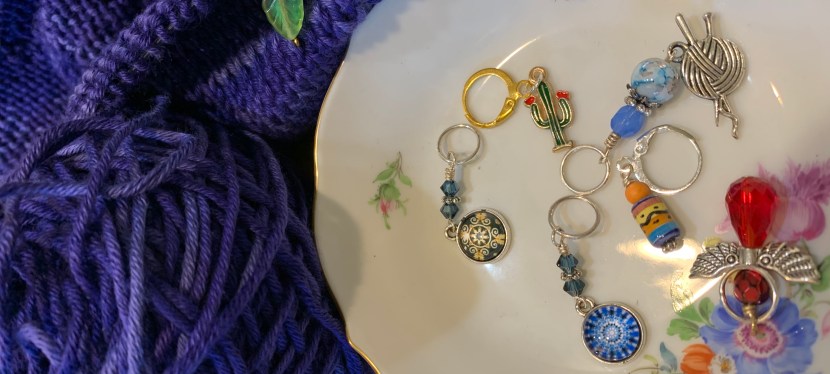
Recently, I’ve bought several types of stitch markers. Have I simply bought the plastic ones sold at the big box craft stores? Oh no. That’s no fun. The prettiest ones are handmade and come from woman-owned small businesses. If you need a rationalization for your purchases (you don’t), you’re helping out small businesses owned by kindred spirits by buying the fancy ones.

My favorites have tiny mandalas and sparkly crystals attached to them. I must confess, I match my stitch markers to the colors of the knitting project I’m working on. (It gives me a sense of balance and harmony, and in this crazy time, that’s something.) For lightweight yarn – or if using a lot of markers – I like the ones with fine, ultrathin wires that barely weigh a thing. In my mind at least, they’re easier on my hands and wrists. 

Sure, you can make stitch markers out of spare yarn. I’ve even heard of knitters using the pop top from a canned drink for a stitch marker. But me? I need stitch markers that are pretty and make me happy. Lovely tools for knitting are a luxury, I know. But in the great scheme of things, it’s a small investment for the craft you love. 

Here’s what I’ve bought recently, after lots of browsing online:

I’ve bought a number of stitch markers from Jill’s Beaded Knit Bits, both on Amazon and Etsy. Her work is high quality, useful, and she ships quickly from Pennsylvania. She also offers row counting chains and other knitting related jewelry. 

I’ve also bought stitch markers from Crafty Cat Knitty Bits in the U.K.  She offers the ultrathin wire stitch markers I prefer when using multiple markers. Even though my order was shipped from England, I received it quickly AND got postage stamps with pictures of the Queen for the husband’s stamp collection. Double win!

What are your favorite stitch markers? Feel free to comment and share your faves!

Blessings, Cindy

Cynthia Coe is the author of The Prayer Shawl Chronicles, a collection of interrelated short stories about knitters and those they meet through knitting and sharing prayer shawls. 

What’s Your “Small But Essential” Knitting Toolkit?

It’s the small things in life that make a difference. For knitters, we usually have a handful of small “must-have” tools we can’t knit without. Some of these are inexpensive, some a bit pricier, some may be items we’ve re-purposed.

Here’s my list of small but essential tools I use just about every day:

  • A small pair of really sharp scissors. I’m making a temperature blanket this year, and I’m changing colors (and cutting off loose ends) frequently. In tying up any loose ends, I’ve found a really sharp pair of scissors makes a difference. My go-to is a small pair of Fiskars.
  • A crochet needle. My pretty Birch-wood crochet needleis always within reach when I’m knitting. In addition to weaving in loose ends when a project’s complete, it’s handy for picking up dropped stitches as well. I recently found an inexpensive pack of crochet needles in every size imaginable, and I’m using the tiny ones for socks and lace weight projects.
  • A pattern page marker. I’m nearsighted, and I wear “progressive” glasses. I don’t need to ruin what vision I still have trying to decipher knitting patterns. This is a fairly new product I found recently, by Clover. It has magnets to mark exactly where you are on the pattern page.
  • Tapestry needles. Necessary for sewing up seams and useful for loose ends. I keep mine in a cork from a wine bottle so I won’t lose them.
  • Row counter. I’ve got one with sparkles on it, along with a claspthat I use to clip it to my project or knitting basket (‘cause they’re really easy to lose). 
  • Stitch gauge and ruler. These have been around since God was young, and they still get the job done. Measure your gauge, measure your work-in-progress, and figure out what size needles you’ve got – all in the same tool. 

What are your essentials? Feel free to comment to share ideas and tips with other readers!

Peace, Love, and Knitting, 

Cindy

Cynthia Coe is the author of The Prayer Shawl Chronicles, a collection of interrelated short stories about knitters and those they meet through knitting and sharing prayer shawls.