Why You Shouldn’t Be Embarrassed to Do “Granny Crafts”


If you’re a 20-something who knits, crochets, or embroiders—this is for you. Granny Crafts aren’t just for grannies. They’re quiet, powerful tools for stress relief, creativity, and deep comfort through every stage of life.
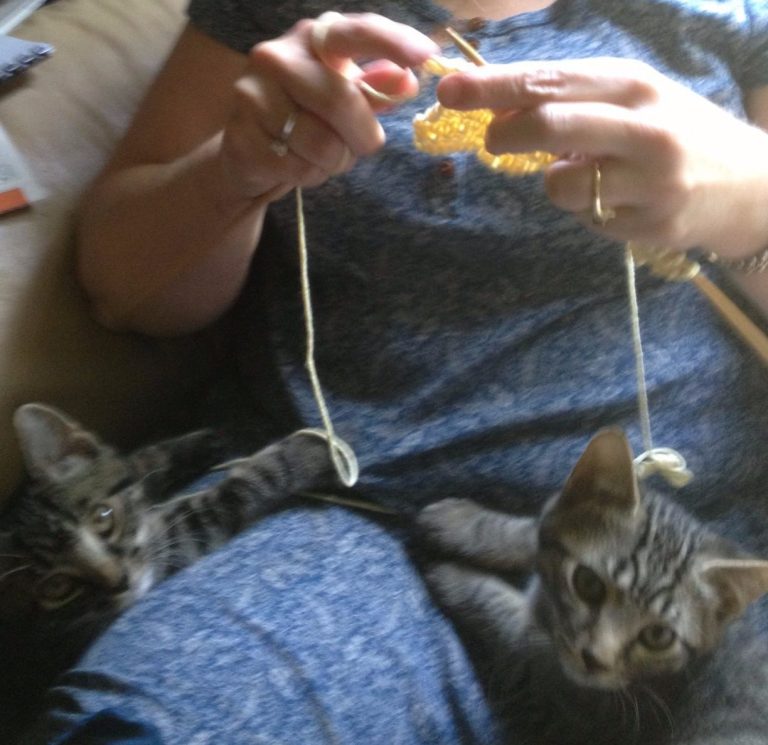
Cindy Knitting with Cats

Dear Young Crafty Kindred Spirit,

Lately, more and more people are talking about how young adults are embracing so-called “Granny Crafts”—and I love it.

If you’re here because you knit, crochet, embroider, or sew—or want to—you’re in good company. I’ve been knitting since I was a teenager myself. But it wasn’t until college, when stress started to weigh heavy on my shoulders, that I really picked it up as a coping mechanism. I’d sit in my dorm room or in a quiet corner of the student center, needles in hand, letting the rhythm of the yarn pull me back from the brink.

Some days, you just want everything—school, jobs, relationships, even the noise of the world—to go away for a while. I get it.

You were born into the digital age. My own kids got their first iPods in middle school and were among the first to start texting. Now, we all carry around little rectangles that buzz and ping and demand our attention 24/7. But here’s the secret: you can turn it off. Just for a few minutes. Really. The world won’t end.
And when you do? That’s when Granny Crafts work their quiet magic.

There’s no algorithm here. No pressure to go viral. No rush to the finish line. When you pick up a needle or a hook, it’s just you, your yarn, and your own rhythm. You can work slowly. Thoughtfully. Or set it down and pick it back up a month later. Granny Crafts are deeply human—analog, if you will. They exist on your terms, not someone else’s timeline.

You may not know it yet, but you’re building something far bigger than a handmade scarf. You’re building a lifelong tool for patience and comfort. Someday, you’ll find yourself stuck in medical waiting rooms. You’ll sit through school pickup lines or kids’ gymnastics practice. You’ll be at hospital bedsides or nursing homes, offering your presence when there’s nothing more you can do. Except this: stitch by stitch, you wait. You love. You breathe.

Granny Crafts give you something to hold on to when the rest of life feels uncertain. They will anchor you when stress comes crashing in, and they will accompany you through every phase of adulthood with grace and beauty.

Welcome to the circle. You’re not alone.

With love and yarn,
Cindy
Knitter, writer, and lifelong lover of “Granny Crafts”

If you’re looking for stories of other women—young, old, and in-between—who have walked that road, I invite you to follow my blog and check out my novels. I write about knitting, community, and faith in a world that is often spinning too fast. Sometimes, we need the quiet power of yarn and human connection to slow it down.

Cynthia Coe is the author of The Prayer Shawl Chronicles, a series of fictional stories woven together by the theme of human connections made through prayer shawls and the craft of knitting. Her newest book is her first historical novel, Knitting Through Time: Stories of How We Learned to Knit. Learn more by visiting her Author Page at this link

Write Your Own Knitting Patterns? Yes, You Can!

Inside: My story of how I wrote my first knitting patterns

You’ve made lovely hand-knitted sweaters and scarves. You have a go-to blanket pattern etched in your head. You constantly hear, “what pattern is that?” and you sheepishly say, “uh…I just made it up.” Then you hear, “no kidding? You should publish that!”

Yes, you should. And with a plethora of self-publishing and crafty platforms available to everyone, you absolutely can publish anything you want, including your own knitting patterns.

But how to get started?

Reader, I faced this problem just a couple of months ago. In writing my upcoming new book, “A Prayer Shawl Handbook,” I knew I had to provide some basic prayer shawl patterns for my readers to truly call this book a comprehensive handbook for this crafting ministry. 

A Sneak Preview of Cindy’s Upcoming New Book, “A Prayer Shawl Handbook”

I have several “go-to” prayer shawl patterns in my head – patterns I don’t even think about and can simply cast-on and knit. But write these down???? Gasp. I’m not a technical writer by any stretch of the imagination. Fiction writing and knitting pattern writing are not, in my poor little mind, in the same skill set. 

How to get started? Try. Sit yourself down, pull out a pencil and a blank sheet of paper, and take your first stab at it. 

What about formatting your pattern?

Fortunately, a new book called “The Knitting Pattern Handbook: How to Write Great Patterns That Knitters Will Love to Make” by Kristina McGrath and Sarah Walworth has just been published, and I was fortunate enough to be given an advance copy for review by the publisher.  What timing! I gulped down this little book and decided, yes, I could do this.

I cast on my favorite memorized patterns and took notes as I went along. I ripped out, re-figured, crumbled up and tossed some early drafts in the trash can. But I persevered until I got some basic prayer shawl patterns knocked out, along with three prayer patch patterns. 

Yes, there are formats you need to use and abbreviations you need to adhere to. You probably recognized them from your own knitting projects you’ve made from other people’s patterns. You just need to focus on these things and make sure you’re consistent.

My tip: don’t skip steps or assume the reader of the pattern knows everything there is to know about knitting. Especially if your patterns are geared towards beginners (which mine are), something you think is obvious may not be. 

Get friends to help proof and test your draft patterns

This is where it gets really terrifying, in my experience. You hand off your draft pattern to a trusted fellow knitter and see if they come up with what you came up with. They may say, “this makes no sense whatsoever.” They may say, “I just don’t understand what you mean by a yarn-over. What is that?” You go back to the drawing board and explain the details you thought you included but didn’t. 

The authors of the new Knitting Pattern Handbook suggest that you hire technical editors and pay them for proofing and revising your patterns. Did I do this? No. I’m just starting out, and I can’t justify shelling out a lot of money for some basic patterns. Friends who knit told me what I needed to know. If I get the notion to start designing intricate sweaters in five different sizes, I’ll certainly re-think and probably get professional help. But as a newbie knitting designer, that’s not where I am.

Everybody starts with the basics

Where I am as a knitting designer is at the beginning. I have some basic patterns that are great for beginners and for simple “meditative” knitting. These are patterns I’d like to share with my readers, so I will. 

If you, too, have some basic knitting patterns you’d like to at least share with friends, go for it! If you’d like to get into the knitting design business and make a few bucks (or a lot!), go for that, too! Every knitting designer starts somewhere, likely with a nice, basic design. And you can, too!

Blessings on your knitting designs, no matter how intricate or basic! Cindy

Cynthia Coe is the author of The Prayer Shawl Chronicles, interrelated short stories woven around those who make and receive handmade, prayerfully crafted gifts of prayer shawls. Click this link to order or for more information. 

Follow me and subscribe for news of my upcoming new books!

As an Amazon Associate and Author, I provide links to products (including books I have written) and earn a very small fee if you click on the links and buy something. There is no additional charge to you!