Patterns in Nature, Patterns in Fiber Arts

Why do some knitting patterns just “look right”? Where could you find inspiration for designing your next fiber arts project?

Look no further than Mother Nature herself! Certain patterns are found time and time again in nature. Intuitively, we are already hard-wired and attuned to recognizing these patterns. So if you find yourself stumped for design ideas or a pattern that’s sure to please, here are design elements found in nature and their knitting or other fiber arts equivalents.

The Wave: This pattern lends itself easily to the inherently linear nature of knitting. Most knitting patterns are done in rows, and rows are akin to long, thin waves. These waves can have crests and dips, interruptions and smooth sections – just like many knitting or crochet rows.  If you’re knitting in any kind of garter stitch pattern or with other repetitive lines, you’ve got your wave.

A pattern in nature related to the Wave includes the Meander pattern. Think a pathway, river, or snake. Though our finished products in knitting and other fiber arts usually no longer meander, our yarns certainly meander from our skeins to our needles as we’re working!
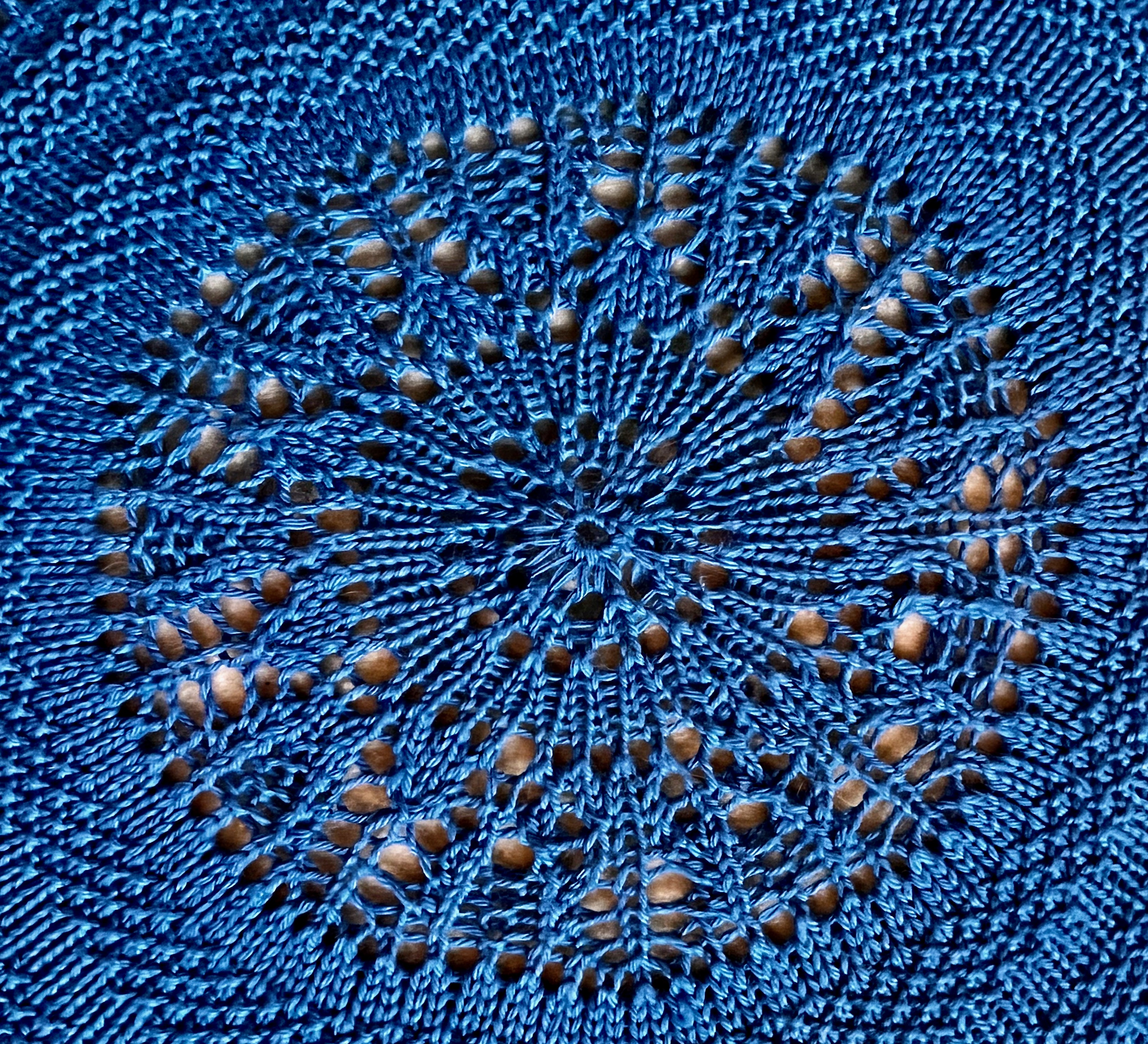
The Burst: Think of the iconic photograph of a drop of milk making a round, crown shaped pattern. Or the shape of a daisy or other flowers or plants “bursting” with a central point. This circular pattern is a bit trickier for knitters. Making a circular pattern with double pointed needles can be fiddly and, in my opinion, is a rather advanced skill. But if you want to knit to impress, this would be your “wow” pattern. This pattern is much easier in crochet, and many crochet patterns feature increasing numbers of stitches starting from a small space. 

The Spiral pattern is similar to the Burst pattern. Both are round patterns, with the spiral meandering around and around instead of making a round burst from a central point. Spirals are more often found in crochet patterns than knitting. 

Fractals: Think branches of a tree or other plant, fractals branch out from a central line, just as tree limbs or leaves branch out from a stem or trunk. We see a lot of fractals in embroidery and other fiber arts using decorative stitches. Many more advanced knitting stitches do feature fractals that mimic plant leaves. These are sure to give your design a nod to nature.

Cells and Bubbles: Cells are the building block of nature, so cell-like designs are often found in all finds of knitting, crochet, and other fiber arts. They may take the form of holes or spaces in our stitches, or we may make block-like patterns in our colorwork or stitching. Think moss stitch in knitting or even basketweave. Bubbles are similar to cell patterns and can give a pattern the feel of fun and joy. 

These patterns are all around us – in our own bodies, in plants, and in the heavens. We know these patterns; we recognize these patterns. Take a look at your favorite fiber arts patterns some time. What do you recognize from the natural world?

Enjoy Your Fiber Arts Designing…and Time in Nature! Cindy

Cynthia Coe is the author of The Prayer Shawl Chronicles, a collection of interrelated short stories about knitters and those they meet through knitting and sharing prayer shawls. 

Be sure to check out my newly published A Prayer Shawl Handbook: Inspiration and Resources for Your Prayer Shawl Ministry, now available in paperback and e-book editions and included in Kindle Unlimited.
It’s All About Color: Crafting Color Symbolism in Every Stitch

Exploring Symbolic Colors in Prayer Shawl Design

When you embark on the journey of creating a prayer shawl – or any other crafting project – the choice of colors goes beyond aesthetics; it can carry profound symbolism. Across various traditions, colors have played a significant role in conveying concepts and stories. Whether you’re crafting for spiritual or personal reasons, understanding the symbolism of colors can add a meaningful layer to your prayer shawl design.

Here’s list of common colors and traditional symbolism associated with each:

  • Red: Passion, Love, and Energy
  • Red symbolizes passion, love, energy, courage, warning, power, celebration, and attention, with its meanings varying across cultures and contexts.
  • White: Celebration and Renewal
  • White, representing celebration and renewal, symbolizes purity, a fresh start, and the illuminating power of light.
  • Purple: Rich Emotions
  • Purple can evoke both warmth and calmness.
  • Blue: Calmness and Spirituality
  • Blue brings a sense of calmness. It suggests elements of water, peace, and the expansive sky.
  • Green: Growth and Abundance
  • The color of growth, green is used after Pentecost. It signifies nature, abundance, and tranquility.
  • Yellow and Gold: Warmth and Cheerfulness
  • Yellow suggests cheerfulness and sunshine, while gold brings a sense of coziness and warmth.
  • Pink: Joy and Playfulness
  • Pink represents joy, youthfulness, and cheerfulness.
  • Brown: Earthy Humility
  • Brown symbolizes humility, reminiscent of monk’s robes. It brings warmth through its connection to nature and soil.
  • Beige: Calming Desert Tones
  • A calming color reminiscent of sand, beige can symbolize time spent in the desert or on the beach.

In moments of uncertainty, neutral tones such as beige, cream, grey, taupe, and sand always make for a beautiful prayer shawl. Consider the soothing, cozy, and comfortable feelings these colors can evoke. After all, your hand-crafted work aims to embrace someone with a heartfelt hug.

Whether you find inspiration in religious symbolism or personal preferences, let your prayer shawl be a reflection of warmth, comfort, and love.

Happy knitting!

Cindy

Cynthia Coe is the author of The Prayer Shawl Chronicles, a collection of interrelated short stories about knitters and those they meet through knitting and sharing prayer shawls. 

Be sure to check out my newly published A Prayer Shawl Handbook: Inspiration and Resources for Your Prayer Shawl Ministry, now available in paperback and e-book editions and included in Kindle Unlimited.

DIY Knitting Design – When You Can’t Find a Pattern That’s Just Right

You may have heard that knitted vests are all the rage these days. I’ve seen quite a number of knitted vests and armless tunics featured in fashion magazines, though I haven’t really seen many in the stores yet. 

Honestly, I haven’t worn a knitted vest since around 1987. Would I wear one again? I just might. If I could find a pattern I liked….

With plenty of yarn at my disposal (my yarn cabinet overflows), I have many yarn options available. The problem? I can’t find a pattern that works. I searched high and low on Ravelry for a free pattern. But everything on offer featured complicated details, the dreaded short rows, or intricate stitching that would ruin my eyesight. The few I liked called for fingerling yarn (too small) or bulky (too large). I just couldn’t find that Goldilocks “just right” pattern.

As I’ve found many times in my knitting life, sometimes it’s just easier to make up your own pattern that works for you. In fact, unless you have EXACTLY the yarn called for in a pattern – which is rare – you might save yourself a lot of time searching through the multitude of patterns on the web by scribbling out your own design.

It’s not that hard to come up with your own design. Here’s my process:

  • Identify a favorite sweater that fits just right. It can be store bought and manufactured.
  • Measure it. Write down the width and the length of the body, along with the dimensions of the arms and the neck.
  • Knit a swatch and determine the gauge. How many stitches to an inch? Multiply the dimensions of the favorite sweater by your gauge, subtracting stitches for neckline, armpits, and so forth. If you’re off, forgive yourself and carry on. 
  • Use your favorite stitches to give your garment some zing. I usually do this as I go.

Do you need pages-long instructions and umpteen books to do DIY Knit Design? Nope. What I find most helpful are bare bones charts for top-down sweaters (telling me how many stitches to increase on top and how many stitches to put on a lifeline for the arms) and a comprehensive stitch dictionary. Here are my current go-to sources:

As a knitter, you have skills. You have the ability to make precisely what you want. Go for it!

Blessings on your DIY Designs, Cindy

Cynthia Coe is the author of The Prayer Shawl Chronicles, a collection of interrelated short stories about knitters and those they meet through knitting and sharing prayer shawls.