Patterns in Nature, Patterns in Fiber Arts

Why do some knitting patterns just “look right”? Where could you find inspiration for designing your next fiber arts project?

Look no further than Mother Nature herself! Certain patterns are found time and time again in nature. Intuitively, we are already hard-wired and attuned to recognizing these patterns. So if you find yourself stumped for design ideas or a pattern that’s sure to please, here are design elements found in nature and their knitting or other fiber arts equivalents.

The Wave: This pattern lends itself easily to the inherently linear nature of knitting. Most knitting patterns are done in rows, and rows are akin to long, thin waves. These waves can have crests and dips, interruptions and smooth sections – just like many knitting or crochet rows.  If you’re knitting in any kind of garter stitch pattern or with other repetitive lines, you’ve got your wave.

A pattern in nature related to the Wave includes the Meander pattern. Think a pathway, river, or snake. Though our finished products in knitting and other fiber arts usually no longer meander, our yarns certainly meander from our skeins to our needles as we’re working!
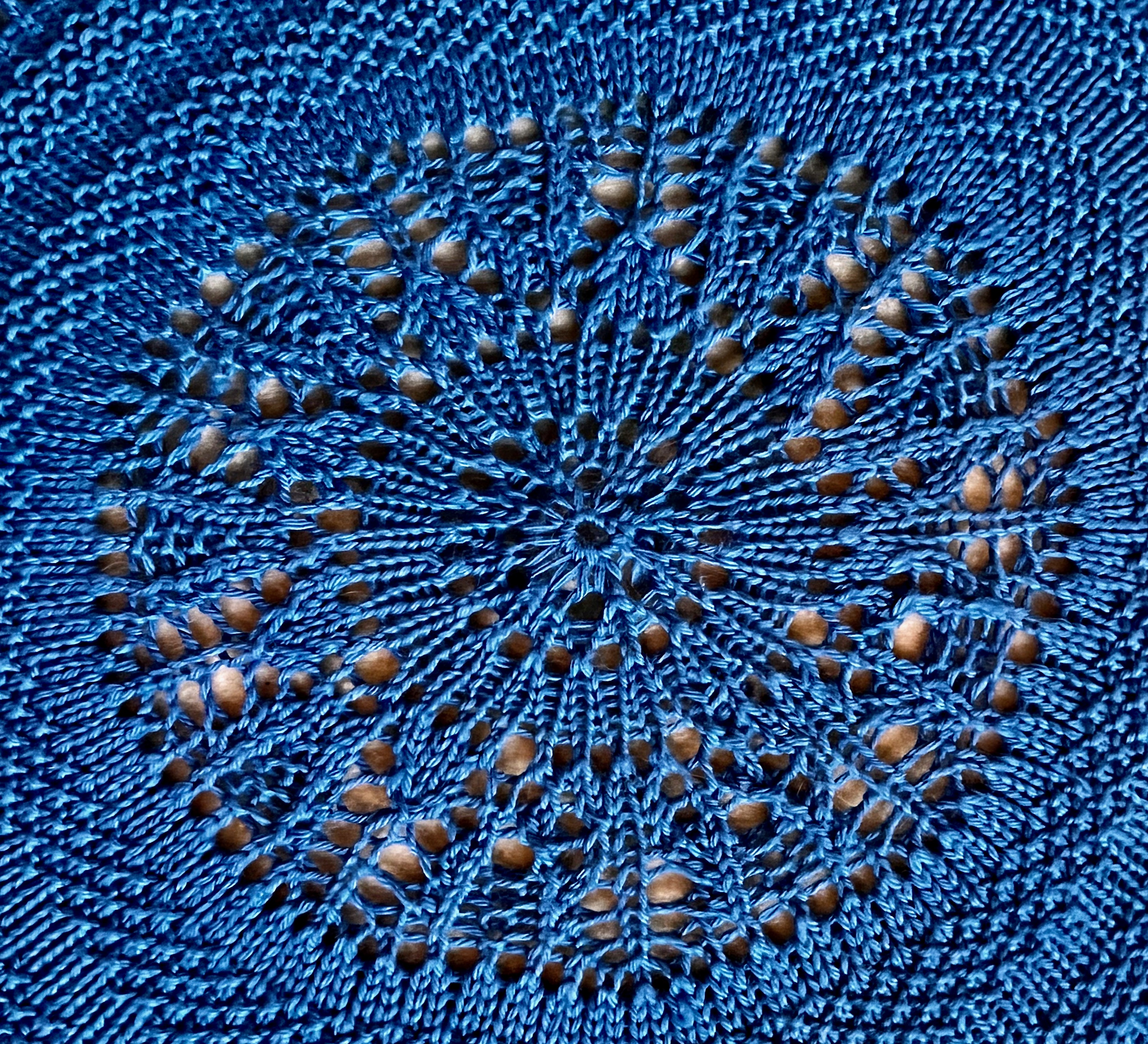
The Burst: Think of the iconic photograph of a drop of milk making a round, crown shaped pattern. Or the shape of a daisy or other flowers or plants “bursting” with a central point. This circular pattern is a bit trickier for knitters. Making a circular pattern with double pointed needles can be fiddly and, in my opinion, is a rather advanced skill. But if you want to knit to impress, this would be your “wow” pattern. This pattern is much easier in crochet, and many crochet patterns feature increasing numbers of stitches starting from a small space. 

The Spiral pattern is similar to the Burst pattern. Both are round patterns, with the spiral meandering around and around instead of making a round burst from a central point. Spirals are more often found in crochet patterns than knitting. 

Fractals: Think branches of a tree or other plant, fractals branch out from a central line, just as tree limbs or leaves branch out from a stem or trunk. We see a lot of fractals in embroidery and other fiber arts using decorative stitches. Many more advanced knitting stitches do feature fractals that mimic plant leaves. These are sure to give your design a nod to nature.

Cells and Bubbles: Cells are the building block of nature, so cell-like designs are often found in all finds of knitting, crochet, and other fiber arts. They may take the form of holes or spaces in our stitches, or we may make block-like patterns in our colorwork or stitching. Think moss stitch in knitting or even basketweave. Bubbles are similar to cell patterns and can give a pattern the feel of fun and joy. 

These patterns are all around us – in our own bodies, in plants, and in the heavens. We know these patterns; we recognize these patterns. Take a look at your favorite fiber arts patterns some time. What do you recognize from the natural world?

Enjoy Your Fiber Arts Designing…and Time in Nature! Cindy

Cynthia Coe is the author of The Prayer Shawl Chronicles, a collection of interrelated short stories about knitters and those they meet through knitting and sharing prayer shawls. 

Be sure to check out my newly published A Prayer Shawl Handbook: Inspiration and Resources for Your Prayer Shawl Ministry, now available in paperback and e-book editions and included in Kindle Unlimited.
Write Your Own Knitting Patterns? Yes, You Can!

Inside: My story of how I wrote my first knitting patterns

You’ve made lovely hand-knitted sweaters and scarves. You have a go-to blanket pattern etched in your head. You constantly hear, “what pattern is that?” and you sheepishly say, “uh…I just made it up.” Then you hear, “no kidding? You should publish that!”

Yes, you should. And with a plethora of self-publishing and crafty platforms available to everyone, you absolutely can publish anything you want, including your own knitting patterns.

But how to get started?

Reader, I faced this problem just a couple of months ago. In writing my upcoming new book, “A Prayer Shawl Handbook,” I knew I had to provide some basic prayer shawl patterns for my readers to truly call this book a comprehensive handbook for this crafting ministry. 

A Sneak Preview of Cindy’s Upcoming New Book, “A Prayer Shawl Handbook”

I have several “go-to” prayer shawl patterns in my head – patterns I don’t even think about and can simply cast-on and knit. But write these down???? Gasp. I’m not a technical writer by any stretch of the imagination. Fiction writing and knitting pattern writing are not, in my poor little mind, in the same skill set. 

How to get started? Try. Sit yourself down, pull out a pencil and a blank sheet of paper, and take your first stab at it. 

What about formatting your pattern?

Fortunately, a new book called “The Knitting Pattern Handbook: How to Write Great Patterns That Knitters Will Love to Make” by Kristina McGrath and Sarah Walworth has just been published, and I was fortunate enough to be given an advance copy for review by the publisher.  What timing! I gulped down this little book and decided, yes, I could do this.

I cast on my favorite memorized patterns and took notes as I went along. I ripped out, re-figured, crumbled up and tossed some early drafts in the trash can. But I persevered until I got some basic prayer shawl patterns knocked out, along with three prayer patch patterns. 

Yes, there are formats you need to use and abbreviations you need to adhere to. You probably recognized them from your own knitting projects you’ve made from other people’s patterns. You just need to focus on these things and make sure you’re consistent.

My tip: don’t skip steps or assume the reader of the pattern knows everything there is to know about knitting. Especially if your patterns are geared towards beginners (which mine are), something you think is obvious may not be. 

Get friends to help proof and test your draft patterns

This is where it gets really terrifying, in my experience. You hand off your draft pattern to a trusted fellow knitter and see if they come up with what you came up with. They may say, “this makes no sense whatsoever.” They may say, “I just don’t understand what you mean by a yarn-over. What is that?” You go back to the drawing board and explain the details you thought you included but didn’t. 

The authors of the new Knitting Pattern Handbook suggest that you hire technical editors and pay them for proofing and revising your patterns. Did I do this? No. I’m just starting out, and I can’t justify shelling out a lot of money for some basic patterns. Friends who knit told me what I needed to know. If I get the notion to start designing intricate sweaters in five different sizes, I’ll certainly re-think and probably get professional help. But as a newbie knitting designer, that’s not where I am.

Everybody starts with the basics

Where I am as a knitting designer is at the beginning. I have some basic patterns that are great for beginners and for simple “meditative” knitting. These are patterns I’d like to share with my readers, so I will. 

If you, too, have some basic knitting patterns you’d like to at least share with friends, go for it! If you’d like to get into the knitting design business and make a few bucks (or a lot!), go for that, too! Every knitting designer starts somewhere, likely with a nice, basic design. And you can, too!

Blessings on your knitting designs, no matter how intricate or basic! Cindy

Cynthia Coe is the author of The Prayer Shawl Chronicles, interrelated short stories woven around those who make and receive handmade, prayerfully crafted gifts of prayer shawls. Click this link to order or for more information. 

Follow me and subscribe for news of my upcoming new books!

As an Amazon Associate and Author, I provide links to products (including books I have written) and earn a very small fee if you click on the links and buy something. There is no additional charge to you!

Writing Knitting Patterns – Is There Hope for a Creative “Pantser” Like Me?

Do you write knitting patterns? Do you love the process or – like me – feel your soul enter a state of utter dread when you even ponder such a thing?

As I prepare the final draft of a new book, I know I need to include at least a few knitting patterns in this book (it’s a non-fiction how-to book). I know this, but I have yet to put pattern to paper. And yes, this is supposed to be a “final” draft.

In writing terms, I’m a total “pantser.” This means I generally fly by the seat of my pants when I work on creative projects. This process works beautifully for some of us.( Just start typing and feel awe and wonder at what appears on the screen!!!) Other writers are “plotters.” They plan out every single step of their writing projects, complete with detailed outline (or so I’m told). 

As a knitting designer, I’m a “pantser” as well. People ask what I’m making, and I say, “a prayer shawl, I hope.” I cast on a hundred or so stitches and see what happens. I usually come up with an interesting pattern with texture, contrasting elements, whimsy – all that stuff. But if asked to duplicate what I’ve done…that’s a problem.

I’ve discerned that pattern writing and “pantsing” are not compatible. And yet, I really need to share my prayer shawl patterns. As I’ve recruited fellow church members to knit or crochet prayer shawls for our parish ministry, they inevitably ask, “got a pattern for me?” 

I got my hands on a soon-to-be published pattern writing handbook and eagerly jumped in, hoping for some inspiration. I felt filled with growing confidence for a couple of chapters. Then, the authors tell me I need to find “beta testers” and “tech editors.” Really???? Just for a simple prayer shawl pattern I could do in my sleep?

As I begin to work on my new book, I hear a song playing in the background. “Don’t worry about a thing,” the lyrics tell me. I proceed in hope.

Do you write knitting patterns? Tips or tricks? Feel free to drop them in the comments!

Be sure to check out The Knitting Pattern Writing Handbook, scheduled for publication on October 31 and available for pre-order. A great resource, especially for newbies and pattern-writing wanna be’s like me. 

Blessings, Cindy

Cynthia Coe is the author of The Prayer Shawl Chronicles, interrelated stories about knitters and those for whom they knit and love. The sequel to this book, The Knitting Guild of All Saints, has been released! Available in paperback and on Kindle, included in Kindle Unlimited. 

As an Amazon Associate and Author, I provide links to products (including books I have written) and earn a very small fee if you click on the links and buy something. There is no additional charge to you!

DIY Knitting Design – When You Can’t Find a Pattern That’s Just Right

You may have heard that knitted vests are all the rage these days. I’ve seen quite a number of knitted vests and armless tunics featured in fashion magazines, though I haven’t really seen many in the stores yet. 

Honestly, I haven’t worn a knitted vest since around 1987. Would I wear one again? I just might. If I could find a pattern I liked….

With plenty of yarn at my disposal (my yarn cabinet overflows), I have many yarn options available. The problem? I can’t find a pattern that works. I searched high and low on Ravelry for a free pattern. But everything on offer featured complicated details, the dreaded short rows, or intricate stitching that would ruin my eyesight. The few I liked called for fingerling yarn (too small) or bulky (too large). I just couldn’t find that Goldilocks “just right” pattern.

As I’ve found many times in my knitting life, sometimes it’s just easier to make up your own pattern that works for you. In fact, unless you have EXACTLY the yarn called for in a pattern – which is rare – you might save yourself a lot of time searching through the multitude of patterns on the web by scribbling out your own design.

It’s not that hard to come up with your own design. Here’s my process:

  • Identify a favorite sweater that fits just right. It can be store bought and manufactured.
  • Measure it. Write down the width and the length of the body, along with the dimensions of the arms and the neck.
  • Knit a swatch and determine the gauge. How many stitches to an inch? Multiply the dimensions of the favorite sweater by your gauge, subtracting stitches for neckline, armpits, and so forth. If you’re off, forgive yourself and carry on. 
  • Use your favorite stitches to give your garment some zing. I usually do this as I go.

Do you need pages-long instructions and umpteen books to do DIY Knit Design? Nope. What I find most helpful are bare bones charts for top-down sweaters (telling me how many stitches to increase on top and how many stitches to put on a lifeline for the arms) and a comprehensive stitch dictionary. Here are my current go-to sources:

As a knitter, you have skills. You have the ability to make precisely what you want. Go for it!

Blessings on your DIY Designs, Cindy

Cynthia Coe is the author of The Prayer Shawl Chronicles, a collection of interrelated short stories about knitters and those they meet through knitting and sharing prayer shawls. 

New Knitting Books for Summer 2019

Greetings, Knitters! I hope you are having a wonderful summer (or winter, for friends Down Under) and getting in some good knitting time. 

Do you get patterns from knitting books? Personally, I get my patterns from a variety of sources – online patterns sold individually, magazines I pick up in the grocery store, and a handful of go-to and much used knitting books. I know online patterns bought digitally from Ravelry, Etsy, or other websites are all the rage, but believe or not, some good knitting pattern books are still being published (and you can keep them all in one place on your bookshelf).

Sycamore Cove Knitting reviews the new ones in advance of publication and gives you the scoop on what’s new and worthwhile. Here’s what new and just published in knitting books for June-July 2019:

Big Yarn, Beautiful Lace Knits by Barbara Benson. A very nice pattern book for the coming cool weather season. The concept of this book is lace knitting with larger sized needles and bulkier weights. The results? Quicker projects with more intricate, showier designs than you normally see with bulky yarns.

The Art of Circular Yokes by Kerry Bogert. This book of yoke sweater patterns give the advanced knitter plenty to sink her teeth into. The designs are lovely and intricate. Most of them are designed for small needles and fairly fine yarn. These are projects that will take a lot of skill, time, and concentration.

 One Stitch Baby Knits by Val Pierce. This is a nice collection of baby knit patterns. They are intended as “beginner” level patterns, but I would rate them as more “advanced beginner” or even “intermediate” level patterns. This is by a British knitting expert, and I appreciate that she took the trouble to translate some of the British knitting terms into American English. However, many of the yarns listed are those available in Britain; I only recognized one yarn readily available in the U.S.

 A Year of Creativity by Petra Hoeksema, Lidy Nooij, Miriam Catshoek, and Bregje Konings. This books is all about “craft dates” for knitters and other crafty people. The idea is to get friends together, share some snacks, have fun, and everybody makes a craft together. I quite like this idea, and it’s a beautiful book. Coming July 23.

And now time for the shameless plug:

The Prayer Shawl Chronicles by Cynthia Coe: Set in an Episcopal parish in Tennessee, hear the stories of women who knit and donate prayer shawls and the remarkable and remarkable connections with those who receive them. A fairly quick read of short stories, this book is great for taking along on vacation.

Enjoy your Summer Knitting! Cindy

Cynthia Coe is the author of The Prayer Shawl Chronicles: Stories of Unlikely Connections & Unexpected Gifts. Available worldwide exclusively on Amazon and included in Kindle Unlimited. Paperback edition coming very soon.