New Knitting Books for Summer 2019

Greetings, Knitters! I hope you are having a wonderful summer (or winter, for friends Down Under) and getting in some good knitting time. 

Do you get patterns from knitting books? Personally, I get my patterns from a variety of sources – online patterns sold individually, magazines I pick up in the grocery store, and a handful of go-to and much used knitting books. I know online patterns bought digitally from Ravelry, Etsy, or other websites are all the rage, but believe or not, some good knitting pattern books are still being published (and you can keep them all in one place on your bookshelf).

Sycamore Cove Knitting reviews the new ones in advance of publication and gives you the scoop on what’s new and worthwhile. Here’s what new and just published in knitting books for June-July 2019:

Big Yarn, Beautiful Lace Knits by Barbara Benson. A very nice pattern book for the coming cool weather season. The concept of this book is lace knitting with larger sized needles and bulkier weights. The results? Quicker projects with more intricate, showier designs than you normally see with bulky yarns.

The Art of Circular Yokes by Kerry Bogert. This book of yoke sweater patterns give the advanced knitter plenty to sink her teeth into. The designs are lovely and intricate. Most of them are designed for small needles and fairly fine yarn. These are projects that will take a lot of skill, time, and concentration.

 One Stitch Baby Knits by Val Pierce. This is a nice collection of baby knit patterns. They are intended as “beginner” level patterns, but I would rate them as more “advanced beginner” or even “intermediate” level patterns. This is by a British knitting expert, and I appreciate that she took the trouble to translate some of the British knitting terms into American English. However, many of the yarns listed are those available in Britain; I only recognized one yarn readily available in the U.S.

 A Year of Creativity by Petra Hoeksema, Lidy Nooij, Miriam Catshoek, and Bregje Konings. This books is all about “craft dates” for knitters and other crafty people. The idea is to get friends together, share some snacks, have fun, and everybody makes a craft together. I quite like this idea, and it’s a beautiful book. Coming July 23.

And now time for the shameless plug:

The Prayer Shawl Chronicles by Cynthia Coe: Set in an Episcopal parish in Tennessee, hear the stories of women who knit and donate prayer shawls and the remarkable and remarkable connections with those who receive them. A fairly quick read of short stories, this book is great for taking along on vacation.

Enjoy your Summer Knitting! Cindy

Cynthia Coe is the author of The Prayer Shawl Chronicles: Stories of Unlikely Connections & Unexpected Gifts. Available worldwide exclusively on Amazon and included in Kindle Unlimited. Paperback edition coming very soon.

Designing the Perfect Beach Cover-Up

Before I went to the beach this summer, I dreamed of the perfect beach cover-up. It would be all cotton and a light color for high temperatures on the coast of South Carolina in June. It would be mini-skirt length and have kicky vents on the sides to show off my legs and for freedom of movement when I went on one of my long and meditative walks on the beach. It would cover my shoulders and prevent sunburn. It would have a rounded but modest neckline. It would feel loose and free and fit me perfectly.

Alas, I looked and looked through umpteen pattern books and magazines but found nothing even close to what I wanted. So, I designed my own. I’ve been knitting since I was a teenager, usually easy patterns that allow me to watch TV or just sit and think while I knit. I don’t go for anything complicated or patterns that have me glued to an incomprehensible piece of paper or that gives me eye strain.

Much to my surprise, for my first beach cover-up design, I came up with an incredibly simple pattern that fits me perfectly, covers my shoulders, and is flowy and comfortable to wear. Here’s the pattern (such as it is – it’s in plain English, no abbreviations, challenging techniques, or anything a moderately experienced knitter couldn’t pull off):

The “Cindy” Beach Cover-Up

General Concept:Knit two large rectangles and a drawstring. Knit holes below the bustline to insert the drawstring.  Adjust measurements to fit yourself. (I’m 5’4” and wear US dress sizes 10-12.)

Materials:

Bernat Handicrafter Cotton Yarn(Two 12 ounce skeins, you’ll have lots left over)

-Size 9 circular needles

-stitch holder for neckline

Front: 

-Cast on 84 stitches (more or less if you’re bigger or smaller)

-Knit until you’ve got 21 inches (again, adjust if your waistline if longer or shorter)

-Put in holes in the next row. (I used a pattern of knit two + yarnovers to accomplish this)

-Knit until you’ve got a total of 30” (more or less, adjusting for your size)

-To make a simple rounded neckline, bind off about 20 stitches in the middle of the garment, decrease on each side of the neckline until you have about 22 stitches on each side

-Bind off each side

Back:

-Cast on 84 stitches (or same number you cast on for the front)

-Knit until you’ve got 21 inches (or same length to drawstring row as the front)

-Put in a row of holes for the drawstring (Knit Two + yarnovers)

-Knit until you’ve got a total of 31” (more or less depending on depth of back neckline)

-Cast off about 20 stitches, decrease each side until you’ve got 22 stitches on each side

-Bind off each side

Drawstring:

-Cast on 3 stitches, make an I-cord (look online for how to do this; use double pointed needles or circular needles – it’s easy)

-Make the drawstring as long as you want it (I’d make it 70” to 80”, depending on your waistline)

-Cast off

Construction:

-attach the front to the back by putting seams on each side between the drawstring row and about 8-10” from the bottom (leaving vents for ease of movement)

-if neckline is floppy, crochet one row around it to cinch it up a bit

-sting the drawstring through the holes and cinch for comfort

Extras: (These are what I did to personalize my own beach cover-up)

-for a cooler garment, make rows of holes (simple knit two + yarnover pattern) along the bottom few rows

-to add texture to the bottom of the garment, I used this pattern: Knit rows 1, 3, & 4; purl row 2

-to add texture to the top of the garment, I used this pattern: on reverse side, purl two, yarnover, purl 2 more, pull yarnover stitch over the last two purls (I added this pattern about every 4 rows)

For more info on basic stitches and construction of garments, I highly recommend the new Vogue Knitting book. It’s a huge book that covers it all.  If you had to buy one book on knitting, this would be the one. Available at: https://amzn.to/2sImZ7W

If you like to design your own projects, a good comprehensive stitch dictionary is invaluable. You might try Debbie Tomkies’ Knit Stitch Dictionary: 250 Essential Knit Stitches, available affordably in both paperback and Kindle editions at: https://amzn.to/2JzCJjS

Blessings, Cindy

Copyright 2018 Cynthia Coe. All rights reserved!

Knitting Terminology Justs Makes It Seem Hard – Socks Aren’t That Difficult

When I last blogged, I had just finished knitting my first pair of socks. I used the “afterthought heel” method, leaving a grafted row where the heel would go, then knitting the heel last. That method seemed less intimidating, an easier way to knit a pair of socks than the more traditional method of making a heel flap, heel turn, and gusset.

Heel flap? Heel turn? Gusset? I couldn’t imagine what those things could be. Even after knitting a multitude of sweaters, shawls, blankets, and tote bags, that knitting terminology scared the living daylights out of me.

Then I actually tried knitting a pair of socks using these traditional elements, and bingo, I mastered them on the first try. I’m not a knitting genius; these techniques just aren’t that hard.

Here’s the honest truth about this terminology:

           “Heel flap” just means knit straight down for a couple of inches. Put half the stitches on a holder to keep them out of the way. Your pattern might call for you to slip some stitches. No big deal.

            “Heel turn” just means flip the dang thing around to the other side when the pattern says so. Make some decreases along the way. Again, no big deal. 

   “Gusset” just means you pick up some stitches, then decrease along the sides of the sock for a bit. Again, easy-peasy. You make a nifty-looking triangle before you know what hit you.

There, that’s not so bad, is it? The process of making a sock simply uses basic techniques you probably already know – decreases using either K2Tog or slip-slip-knit, slipping stitches from one needle to the other (easier than actually knitting or purling), or turning your work around backwards.  To learn to do these skills, view a couple of YouTube videos for a few minutes. Google these terms, and a zillion video links will pop up, most of them free and well-done.

It’s the knitting terminology that scares us from improving and expanding our skills, I’ve learned, not the actually knitting of the sock itself. So if you’ve never gotten out of your comfort zone to try a new skill, remember that whatever you’re learning likely won’t be as difficult as you imagine – whether it’s knitting or any other life skill.

Blessings, Cindy

Tackling Hand-Knit Socks for the First Time

After knitting since I was a teenager, I finally knit my first pair of socks. I’ve knit blankets, sweaters, five sets of place mats, more shawls than I care to think about, and even a couple of baby outfits. But socks???!!!  I was totally intimidated by the mere thought of knitting socks.

But my husband dearly wanted a pair of all-wool, hand-knit socks. He’s a serious woodworker, and he’s made me a living room sofa, chairs, picture frames, and numerous book shelves. How could I refuse to make him one measly pair of socks? My darling husband pushed me over the edge of my discomfort by telling me that knitting socks is like making a chair in woodworking. Yes, it’s difficult; but if you want to call yourself a serious crafter, this is what you need to learn to make. 

Then, lo and behold, the knitting kit subscription service I just joined sent me – of course – a sock knitting kit. I’d have to do it. Despite my lack of comfort with double-pointed needles, yarn so thin you can hardly see it, and teeny-tiny needles, I bit the bullet and endeavored to persevere on my first pair of socks.

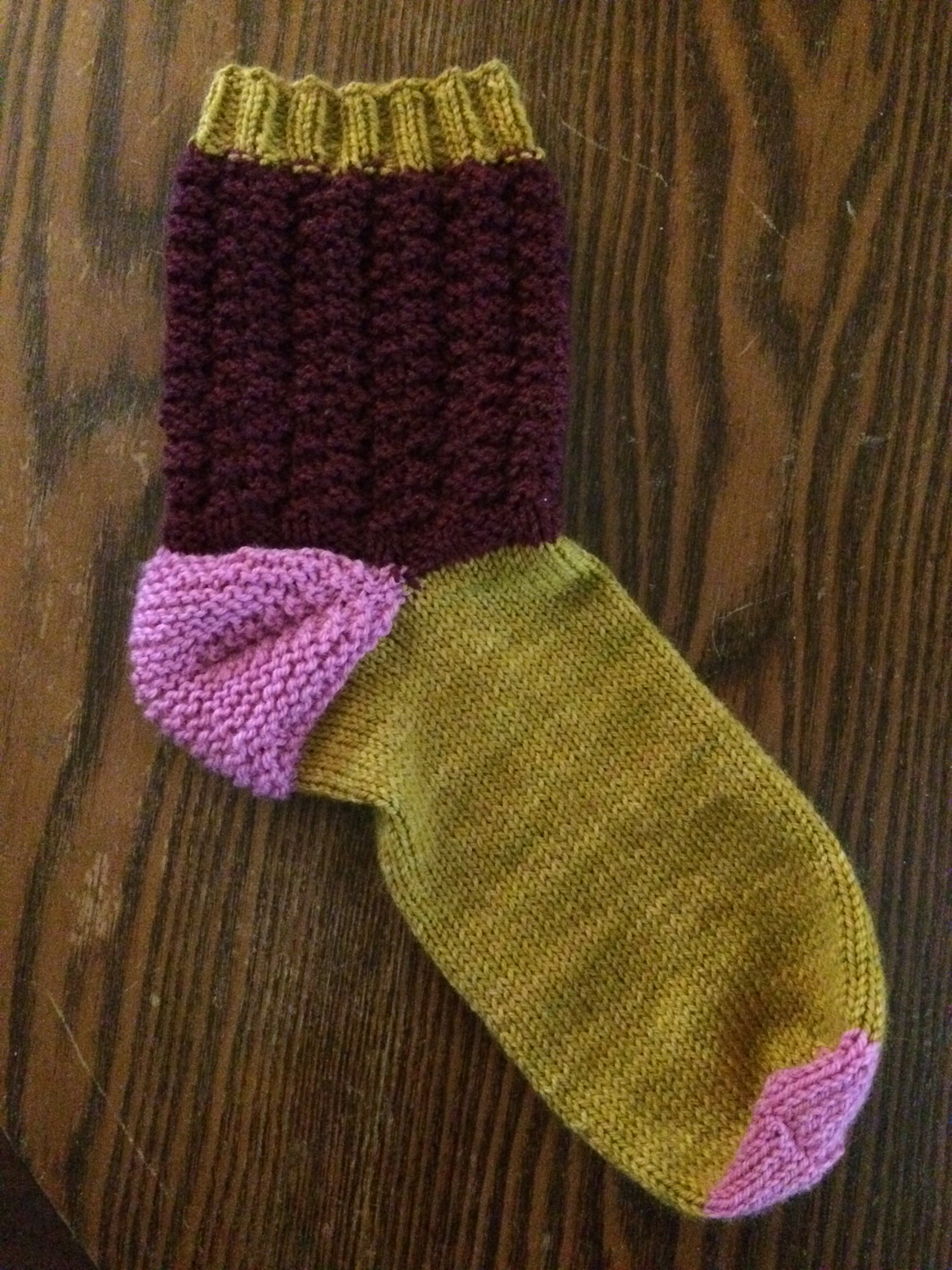
Sock Under Construction, with graft for afterthought heel

Okay, sock knitting wasn’t so bad. I ditched the irritating double-pointed needles for a new set of tiny circular needles, only using the double points for the end of the toes and heels. The pattern called for an “afterthought heel,” which involved “lifelines” and a “graft.” As terrifying as those concepts seemed, I mastered them on the first try and actually produced a functioning pair of socks. My husband loves them. All’s right with the world around my house.

Like any new endeavor, knitting socks came seem daunting before you actually try it. But if you have some basic knitting skills, you can take the dare and master a couple of new skills that open new possibilities for your craft. You just need to give it a try. 

Here are some tools I found helpful in tackling sock knitting for the first time:

ChiaoGoo Twist Shorties Red Lace Interchangeable Knitting Needles. Pricey? Yes. Necessary? Oh yes. After deciding I couldn’t deal with double pointed needles for an entire project, I found these after a lengthy search for just the right sock needles. They come in a well-made pouch that will fit in a purse. The set includes teeny-tiny stitch markers for use with small sized projects (my regular sized markers fell off), a small ruler, three tiny cables and two sets of needle points. Highly recommended.

Clover Double Pointed Needles. Even if you use circular needles for most of your socks, you’ll still need double points right before you bind off the toes and heels. I love my Clover bamboo needles and added a new set of double points to my collection just for socks. 

Getting Started Knitting Socks by Ann Budd. If you don’t use a kit, this book comes highly rated. Methods using both circular needles and double pointed needles are covered, including all the basics. 

Good luck to those tackling sock knitting for the first time!

Cindy

My First Completed Sock

Temperature Blankets – Marking the Days With a Knitting Ritual

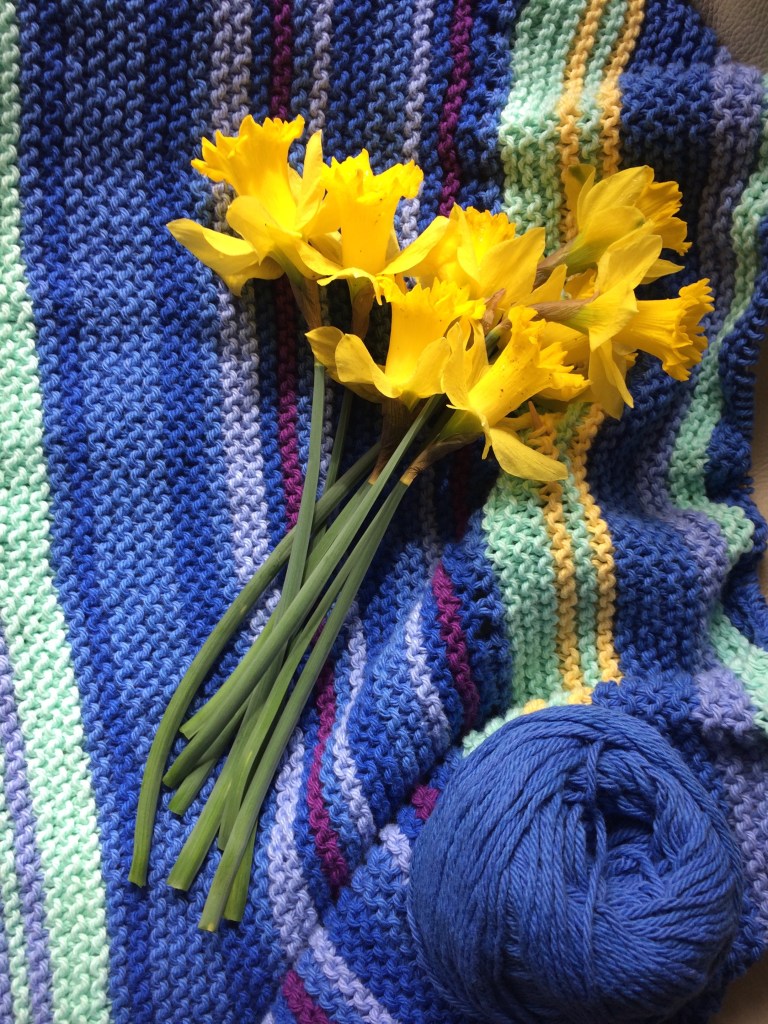
Intrigued by the idea of a “temperature blanket,” I began my first one on New Year’s Eve by casting on with a bright yellow to celebrate the gorgeous 70 degree day here in Tennessee. My temperature blanket soon became a mosaic of blues for our normal cool January, sprinkled with some pale greens for warmer 60 degree days and a few purple rows for crisper cold days. We have a saying here in the Smoky Mountains – “if you don’t like the weather here, stick around; it’ll change.” It’s the perfect climate for a temperature blanket.

Mostly to remember to work on my temperature blanket each day, I began a ritual of knitting my one garter ridge each night, right after dinner as my family watched a TV show together. I didn’t mean to start a new daily ritual, but that’s what it’s become. When I sit down in my favorite chair to work on my temperature blanket each evening, it’s as if I’m marking the end of a day, a time of peace and quiet. It’s a time to think, for better or for worse, I’ve done what I could do today. It’s time to relax and put all worries aside.

I’ve noticed I work my temperature blanket more slowly than my other works in progress. Perhaps that’s because, by definition, I only knit two rows a day, making a loop from one side to the other and back. The point of this knitting is to mark an occasion, not necessarily to “make” a finished garment. This knitting mimics the movement of the earth, making a loop each and every day. As I knit through the seasonal cycles of nature, my knitting reflects the cold days giving way to the warm, the short days turning into longer late spring days of bright yellow and orange sunshine. It shows the process in rich colors I can touch and feel. 

Marking these daily changes grounds me in nature and in the cycles of life. It’s a simple thing, knitting these two daily rows. But this daily ritual has become a little celebration of life ever moving forward, ever renewing. 

My Temperature Blanket Pattern:

-Cast on 100 stitches

-Knit 2 rows each day (one garter pattern), using a color to mark the temperature of the day

-At the beginning of each month, I knit one row of K2, YO. I knit the number of stitches for the number of the month (e.g. 4 stitches for the 4thmonth of April, 5 for the 5thday of May), then do the same number of K2, YO and repeat this pattern down the row. I knit the second row of this garter ridge as usual to keep the pattern on track for the rest of the month.

Blessings on your knitting rituals! Cindy

Cynthia Coe is a writer and avid knitter based in the Smoky Mountains of Tennessee. Visit her Author Page on Amazon by clicking this link.

What to Do with All Those Knitted Shawls?

Knitted Shawls are all the rage at the moment, and for good reason. They’re fun to knit – projects that are not too small, not too overwhelming, and you don’t have to stitch them together or make fit any particular size. You can knit fairly plain shawls or jazz them up with fancy lacework or colorwork, as you choose.

But after knitting one or two shawls (or two dozen), you begin to wonder, what do I do with all these shawls? You could always wear them, of course. But in warmer times of the year, you don’t exactly need a sprawling piece of wool knitwear draped across your shoulders. It’s already 80 degrees during the days here in Tennessee, so my shawl wearing is confined to early mornings and the odd cool evening. 

After going on a shawl-knitting kick last summer, I couldn’t stand to simply put away all my pretty shawls until January. After displaying a couple of brightly colored shawls across chairs, I decided to leave them there on a more or less permanent basis. Textiles make a home, I decided. It’s the soft textures, bright colors, and our own personal touches that make a home feel comfy, cheerful,  and totally our own. 

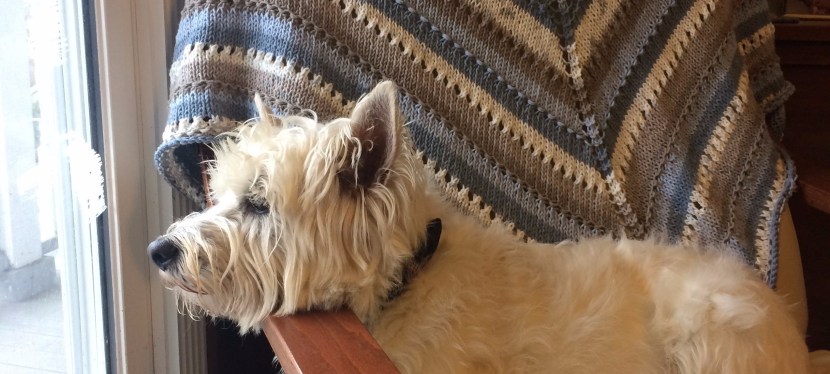
So in my home, you’re likely to see shawls adding a pop of color and an inviting place to sit on many of my chairs and sofas. Even the dog gets his own shawl for lounging and keeping an eye out for passing wildlife. Shawls as housewares get more use this way than actually wearing them!

What do you do with your knitted shawls?

Happy Shawl Knitting, Cindy

Cynthia Coe knits as some sort of meditative thing before sitting down to write (or do anything else, for that matter). Check out her Author Page on Amazon to buy one of her novels or spiritual resources. 

Get news of new publications by following this blog or any of her social accounts, all listed on the right sidebar of this page. 

Getting More Knit From The Kit – Using Leftover Yarn From Knitting Kits

Have you finished a knitting project and had yarn left over? This happens frequently to me. If it’s inexpensive yarn, I usually put it in a bin I keep for donations. Once a year, I give this bin to a school, camp, or summer program for crafting by children. But if it’s expensive yarn I really like, I want to make something else from it.

I recently began knitting from kits ordered online. I’ve done two kits by Kitterly (www.Kitterly.com), and I just started my first kit by KnitCrate (www.KnitCrate.com). When I first started knitting from kits, I feared I’d get to the end of a pricey project and not have enough yarn to finish. Happily, I can now report that both of the Kitterly kits I’ve done left me with plenty of leftover yarn. (The verdict’s still out on KnitCrate, but so far, so good. I’m impressed with all the extra patterns I get with their kits.)

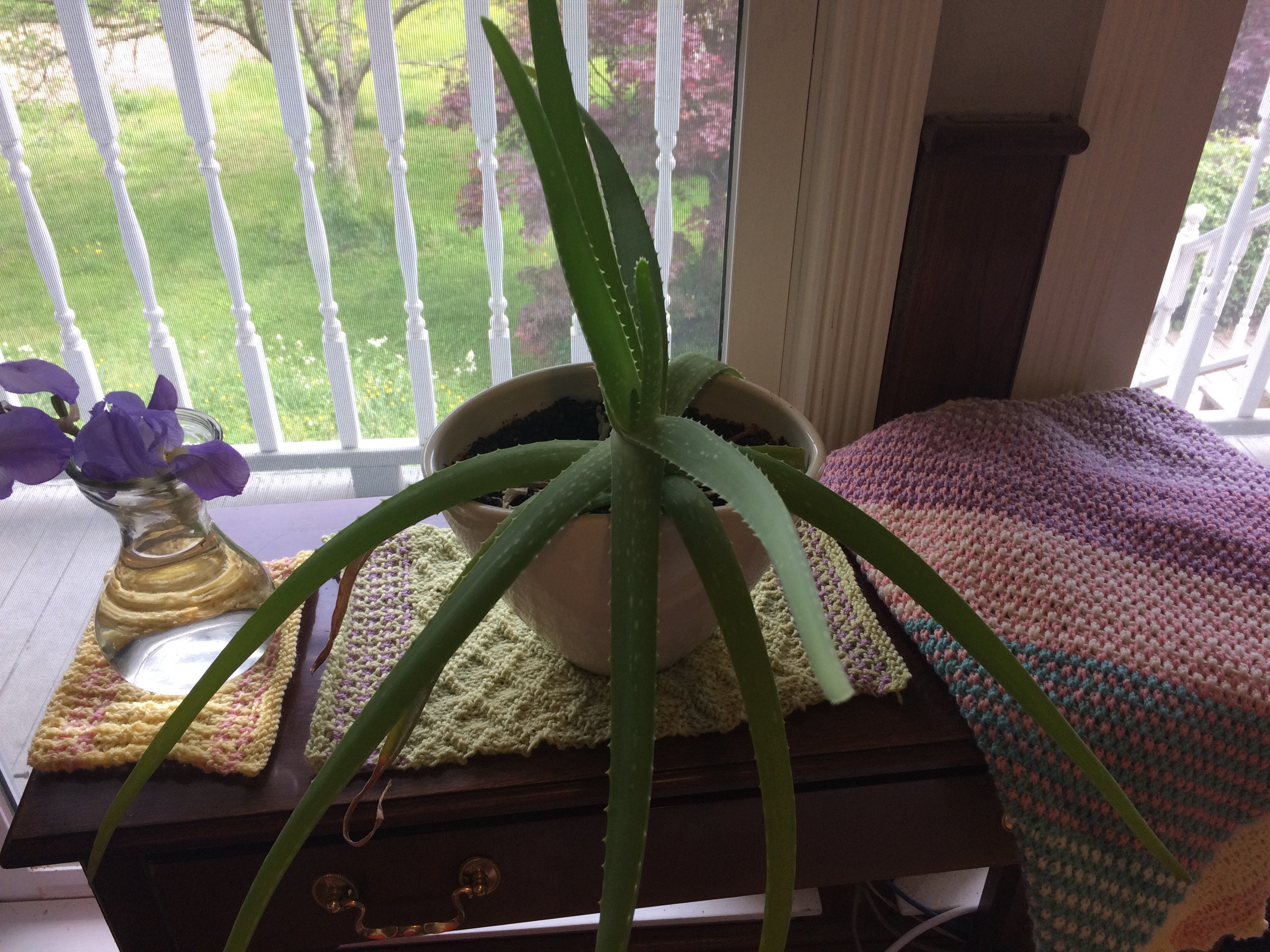
What do you do with a good hank of expensive, high-quality yarn that’s too big to simply toss out? After working through a Kitterly shawl kit, I had enough to make both a narrow runner for use on a credenza and a large coaster. I also re-used the colorwork pattern on my “extra” items, since the pattern was still in my head. These small projects made nice transitions after spending a couple of weeks on the main shawl project. I also felt better getting three projects out of an expensive kit, instead of just one. (Honestly, I may end up using the runner and coaster more than the shawl!)

Knitting is a frugal craft. We make high quality items rather than buy cheap ones at the store. Knitters are the kind of people who look for good value for their money and don’t like to see nice materials go to waste. By getting “more knit for the kit,” knitters both use their awesome creativity to make something useful and get maximum value for their purchases. 

What do you do with leftover yarn?

Happy Crafting! Cindy

Cynthia Coe is a writer, book reviewer, and avid knitter. Her books and blog posts can be found on her Amazon Author Page.

Knitting & Cats Don’t Mix – Or Do They?

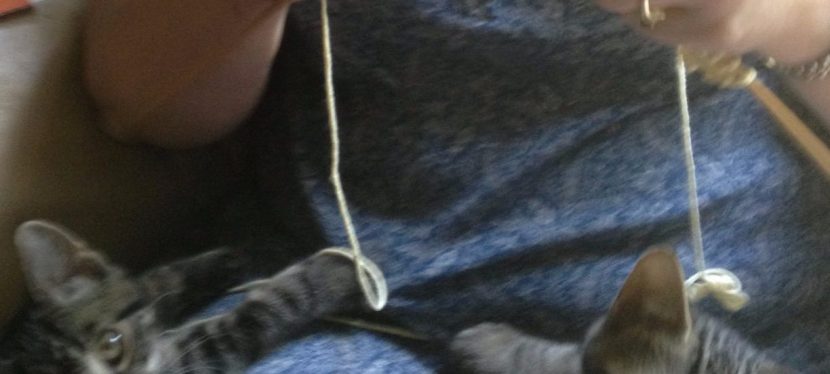
 Sitting down for a nice, calming session of knitting, and who turns up to “help”? The cat, of course. When my cats Scamper and Milo see me sit down in my favorite chair with a wooly skein of yarn beside me, to them, it’s an invitation to play. 

Knitting with cats is both the most wonderful thing in the world and the most annoying. A soft, furry creature with big yellow eyes plops down on your lap and purrs right as you take out your knitting needles. What a knitter to do? You want to knit, but you don’t want to run off the cutie pie sitting on your work-in-progress, either. Eventually, the cat gets exasperated by those sharp sticks waved in front of his face, and he moves along. Or you push him.

A ball of yarn is the ultimate temptation to cause mischief for a cat. My cats usually know not to mess with my knitting yarn, fearing an almighty tongue-lashing that comes with batting around a yarn ball attached to a sweater under construction. But sometimes, a cat just needs to play with what is obviously a toy provided for a cat’s pleasure. Occasionally, I let the cat play…until the ball of yarn is roped around six pieces of furniture and knotted into a mess requiring a half hour of untangling. Then it’s time to “re-think” my policy of cats and yarn.

The problem with cats and knitting is that many of us seriously love them both. Both are warm, fuzzy, and lovely to look at. Both knitting and cats require attention from our hearts and our hands. Cat People are often Knitting People. And in those moments when the two clash and chaos breaks out, I hope we’ll remember that really, what’s a little frayed yarn and knots when you have the pleasure of seeing a cute little kitten batting about a “just right” ball of yarn?

Blessings on your cats (and yarn), Cindy

New Resources of the Week:

Knitted Animal Friends: Knit 12 Well-Dressed Animals, Their Clothes and Accessories by Louise Crowther. This charming new book tells you how to knit and construct adorable animal toys. There’s a cat pattern, of course, along with other critters including a dog, mouse, hedgehog, and clothes for all of them. Perfect for making gifts for children or for trying something new and fun. Coming on May 7, available for pre-order at a good discount

Jill’s Beaded Knits Bitshas some new Abacus Counting Bracelets, along with some cute new stitch markers. She handmakes her products and ships them out pronto. I recently treated myself to some new stitch markers, but I’ve not tried the abacus counting bracelets yet. I’d love to hear from anyone who has.

P.S. This blog is completely independent! I recommend books and other items I’ve read/used and like. Books are usually provided to me free through NetGalley and their publishers. 

Putting Away the Winter Stash

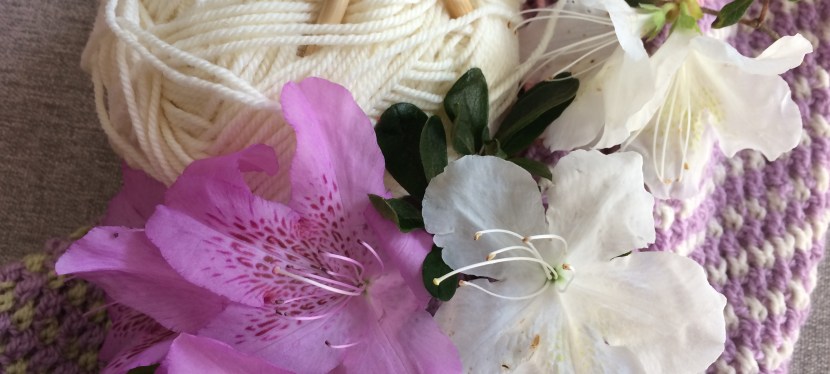
Springtime has come to Sycamore Cove in a sudden burst of green leaves, yellow buttercups, violets and azalea blossoms. Winter is good and gone. It’s time to put up the winter knitting supplies.

My jewel-toned yarns of burgundy, teal, dark blue, and greys go to the zipped-up bin in the upstairs closet where I won’t use them until autumn. My “works-in-progress” baskets scattered around the house now hold yarns in pastel pinks, spring greens, and cheerful yellows.

Putting up the winter stash elicits mixed emotions. Thinking of the Christmas gifts, winter hats, and warm sweaters I made last season gives me a satisfied sense of accomplishment. But then there’s the projects I planned to make and didn’t, the yarns I had pegged for sweaters or hats or lap blankets that just plain didn’t get made. I wonder if I’ll get to them next year. I wonder where I’ll be in my life, whether that yarn will “speak” to me like it did last year, or whether I’ll come up with some new and unexpected use for those unused skeins.

Life is sometimes like that unused winter stash – projects you planned don’t pan out, you don’t have time for them, or you lost interest in them. Maybe you’ll get back to them, maybe you won’t. Maybe you’ll surprise yourself with a great new idea next year that just hadn’t occurred to you this year. You feel good about what you did accomplish and give yourself a pat on the back for completed and successful items that gave joy to others or served some useful purpose.

But for now, it’s a new season. New yarns mean new projects, new opportunities, new possibilities. It’s springtime – a time for new beginnings in life and in knitting.

Cynthia Coe is a writer, book reviewer, and avid knitter. Her books and blog posts can be found on her Amazon Author Page

Knitting Kits – Worth The Money?

My knitting skills hit a plateau recently, and I decided to try one of the new knitting kits now available through the miracles of online shopping. I’ll admit, I was wary. Would I really get everything I needed for a finished piece of knitting in one shipment? Scarred by childhood memories of cheap craft kits that didn’t have enough paint or whatever to actually finish a project – leaving me with an unfinished and totally wasted craft – I nevertheless jumped into the new world of knitting kits.

My husband actually pushed me into my first knitting kit with a pricey shawl kit for Christmas. At around $80, it impressed me as a rather lavish gift for two skeins of yarn and a pattern I had to print out myself. But the yarn turned out to be quite nice – 100% wool, generously large skeins, and no kinks or knots that you usually get with yarn from the big box stores. And lo and behold, the kit included more than enough to finish my project. I even had enough of the contrast color to use in another project.

More importantly, I upped my knitting skills significantly. I learned a new way to make shawls, a new way to use colorwork in my knitting, and mastered the picot bind-off (which I wouldn’t have dared tackle of my own accord). I impressed myself with how well and how much I learned in the course of one project.

So was it worth the eighty bucks? Maybe so. Instead of aimless shopping for a massive bag of yarn at the big box store, I got just enough for the project, with no random skeins left over and wasted. In the long run, I could see spending less on kits overall than on the impulse purchases of yarn that sit in a closet for years. But what sold me on the kit was that I actually learned a lot and became a better knitter. That’s worth a lot. I just started my second kit, and I’m growing more confident with new skills already.

For me, the knitting kits are a lot like the meal kits – Blue Apron, Plated, etc. You get just what you need, and you don’t have a lot of leftovers to deal with. Best yet, at the end of the process, you’ll look like a star.  

Cynthia Coeis a writer, book reviewer, and avid knitter. Her books and blog posts can be found on her Amazon Author Page.