Patterns in Nature, Patterns in Fiber Arts

Why do some knitting patterns just “look right”? Where could you find inspiration for designing your next fiber arts project?

Look no further than Mother Nature herself! Certain patterns are found time and time again in nature. Intuitively, we are already hard-wired and attuned to recognizing these patterns. So if you find yourself stumped for design ideas or a pattern that’s sure to please, here are design elements found in nature and their knitting or other fiber arts equivalents.

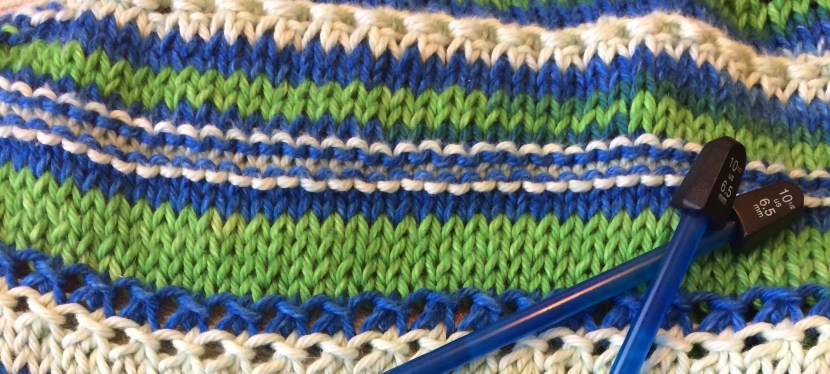
The Wave: This pattern lends itself easily to the inherently linear nature of knitting. Most knitting patterns are done in rows, and rows are akin to long, thin waves. These waves can have crests and dips, interruptions and smooth sections – just like many knitting or crochet rows.  If you’re knitting in any kind of garter stitch pattern or with other repetitive lines, you’ve got your wave.

A pattern in nature related to the Wave includes the Meander pattern. Think a pathway, river, or snake. Though our finished products in knitting and other fiber arts usually no longer meander, our yarns certainly meander from our skeins to our needles as we’re working!
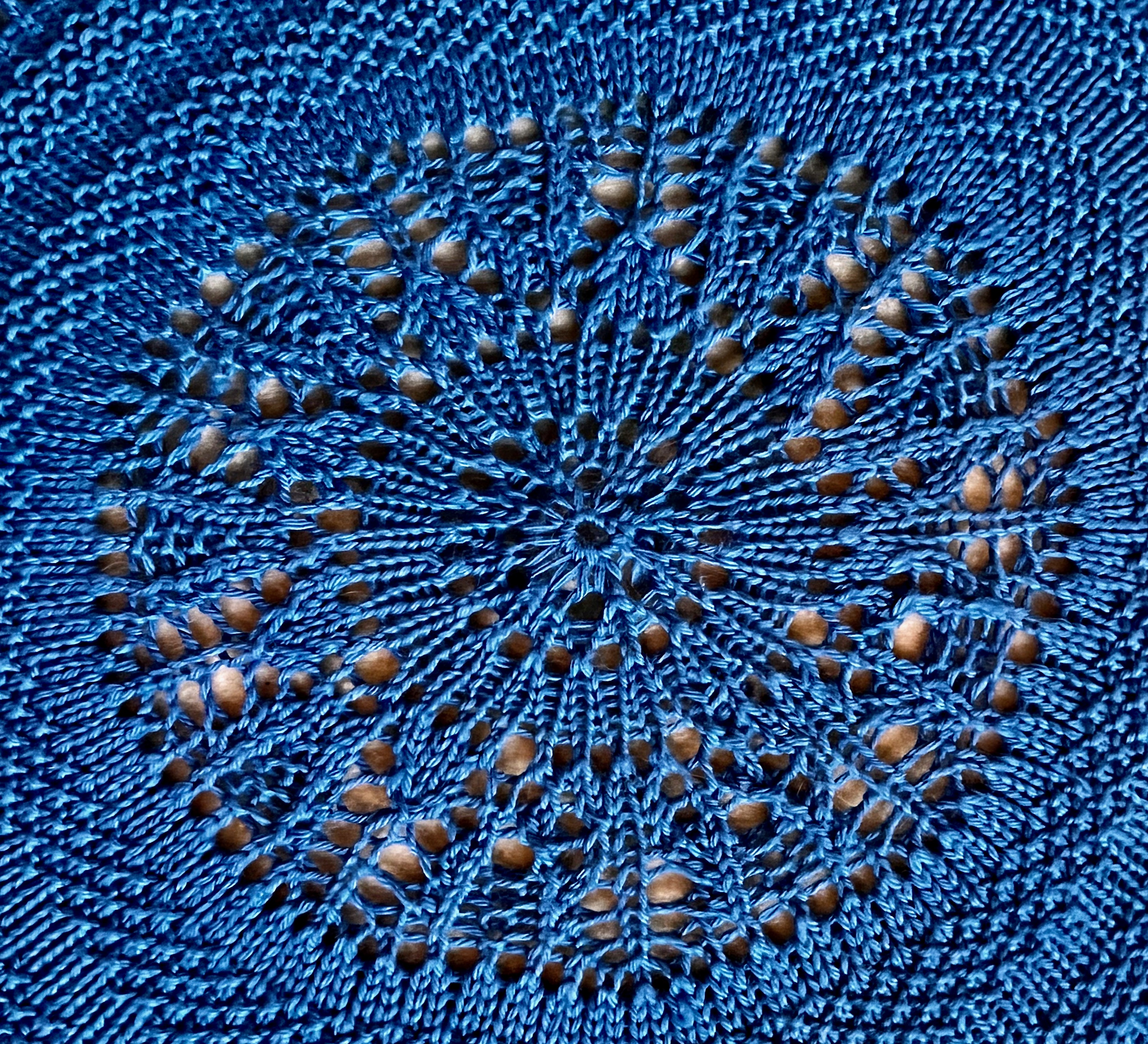
The Burst: Think of the iconic photograph of a drop of milk making a round, crown shaped pattern. Or the shape of a daisy or other flowers or plants “bursting” with a central point. This circular pattern is a bit trickier for knitters. Making a circular pattern with double pointed needles can be fiddly and, in my opinion, is a rather advanced skill. But if you want to knit to impress, this would be your “wow” pattern. This pattern is much easier in crochet, and many crochet patterns feature increasing numbers of stitches starting from a small space. 

The Spiral pattern is similar to the Burst pattern. Both are round patterns, with the spiral meandering around and around instead of making a round burst from a central point. Spirals are more often found in crochet patterns than knitting. 

Fractals: Think branches of a tree or other plant, fractals branch out from a central line, just as tree limbs or leaves branch out from a stem or trunk. We see a lot of fractals in embroidery and other fiber arts using decorative stitches. Many more advanced knitting stitches do feature fractals that mimic plant leaves. These are sure to give your design a nod to nature.

Cells and Bubbles: Cells are the building block of nature, so cell-like designs are often found in all finds of knitting, crochet, and other fiber arts. They may take the form of holes or spaces in our stitches, or we may make block-like patterns in our colorwork or stitching. Think moss stitch in knitting or even basketweave. Bubbles are similar to cell patterns and can give a pattern the feel of fun and joy. 

These patterns are all around us – in our own bodies, in plants, and in the heavens. We know these patterns; we recognize these patterns. Take a look at your favorite fiber arts patterns some time. What do you recognize from the natural world?

Enjoy Your Fiber Arts Designing…and Time in Nature! Cindy

Cynthia Coe is the author of The Prayer Shawl Chronicles, a collection of interrelated short stories about knitters and those they meet through knitting and sharing prayer shawls. 

Be sure to check out my newly published A Prayer Shawl Handbook: Inspiration and Resources for Your Prayer Shawl Ministry, now available in paperback and e-book editions and included in Kindle Unlimited.
It’s All About Color: Crafting Color Symbolism in Every Stitch

Exploring Symbolic Colors in Prayer Shawl Design

When you embark on the journey of creating a prayer shawl – or any other crafting project – the choice of colors goes beyond aesthetics; it can carry profound symbolism. Across various traditions, colors have played a significant role in conveying concepts and stories. Whether you’re crafting for spiritual or personal reasons, understanding the symbolism of colors can add a meaningful layer to your prayer shawl design.

Here’s list of common colors and traditional symbolism associated with each:

  • Red: Passion, Love, and Energy
  • Red symbolizes passion, love, energy, courage, warning, power, celebration, and attention, with its meanings varying across cultures and contexts.
  • White: Celebration and Renewal
  • White, representing celebration and renewal, symbolizes purity, a fresh start, and the illuminating power of light.
  • Purple: Rich Emotions
  • Purple can evoke both warmth and calmness.
  • Blue: Calmness and Spirituality
  • Blue brings a sense of calmness. It suggests elements of water, peace, and the expansive sky.
  • Green: Growth and Abundance
  • The color of growth, green is used after Pentecost. It signifies nature, abundance, and tranquility.
  • Yellow and Gold: Warmth and Cheerfulness
  • Yellow suggests cheerfulness and sunshine, while gold brings a sense of coziness and warmth.
  • Pink: Joy and Playfulness
  • Pink represents joy, youthfulness, and cheerfulness.
  • Brown: Earthy Humility
  • Brown symbolizes humility, reminiscent of monk’s robes. It brings warmth through its connection to nature and soil.
  • Beige: Calming Desert Tones
  • A calming color reminiscent of sand, beige can symbolize time spent in the desert or on the beach.

In moments of uncertainty, neutral tones such as beige, cream, grey, taupe, and sand always make for a beautiful prayer shawl. Consider the soothing, cozy, and comfortable feelings these colors can evoke. After all, your hand-crafted work aims to embrace someone with a heartfelt hug.

Whether you find inspiration in religious symbolism or personal preferences, let your prayer shawl be a reflection of warmth, comfort, and love.

Happy knitting!

Cindy

Cynthia Coe is the author of The Prayer Shawl Chronicles, a collection of interrelated short stories about knitters and those they meet through knitting and sharing prayer shawls. 

Be sure to check out my newly published A Prayer Shawl Handbook: Inspiration and Resources for Your Prayer Shawl Ministry, now available in paperback and e-book editions and included in Kindle Unlimited.
Snow-Bound? Stranded? Time for Creative Yarn De-Stashing

I’ve found myself in Florida much longer than expected, and I’m a knitter stranded alone with a “mystery stash” of yarn. What to do???

It’s a great luxury to plan a project, decide exactly what yarn to use, and even mull over exactly what color you’ll use from a wide selection available. It’s nice to make a few swatches and decide which size knitting needles to use. 

But what if you can’t? 

I checked into a condo in Florida at the end of December, and I’m still here. With Tennessee closed for snow for the foreseeable future, I’ll be here for a while. Fortunately, I had ordered a “mystery stash” of clearance sale yarn shipped to me before I arrived, so I’m not exactly hurting for high quality yarn to knit with.

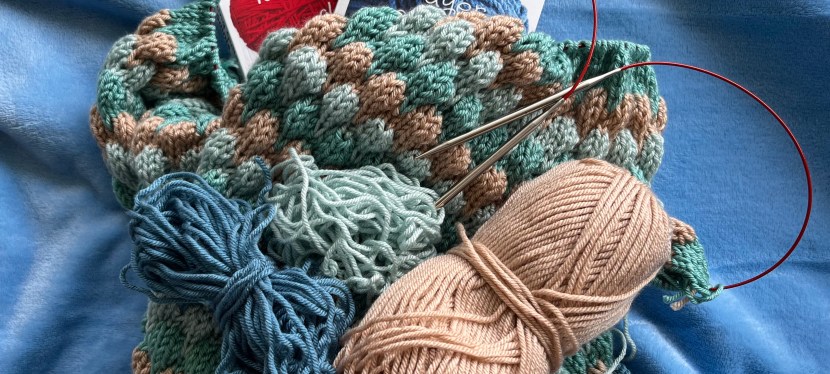
The problem is, I received 4 skeins of two different yarns from this mystery box – 4 skeins of a dark grey yarn, and 4 skeins of a bold pink and grey striped yarn. From past experience, I know it usually takes 5 skeins of these kinds of yarn to make a sweater (which I need; it’s 34 degrees here in paradise today). I puzzled over these yarns and made a swatch with the only needles I’ve got on hand. Mercifully, the needles will work with the yarn. But what to do with an underabundance of one or the other color of each yarn?

This is where necessity becomes creativity’s best friend. Like it or not, I’m looking at stripes. With the loud pink, I could end up with a sweater I wouldn’t be caught dead in. Or I could end up with a sweater I never would have planned but turns out better than expected. So I cast on and see how it goes.

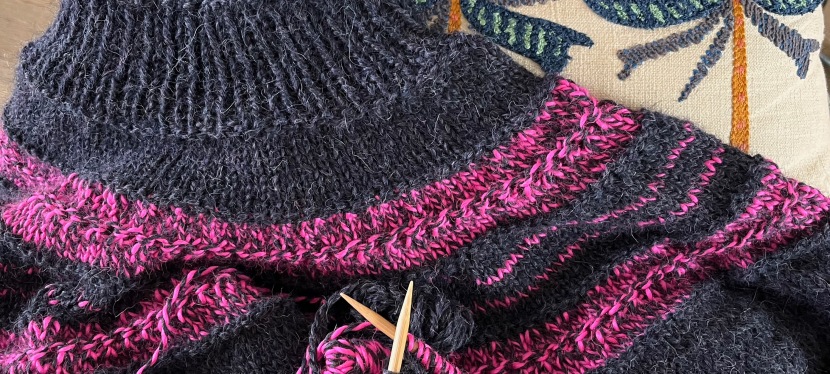
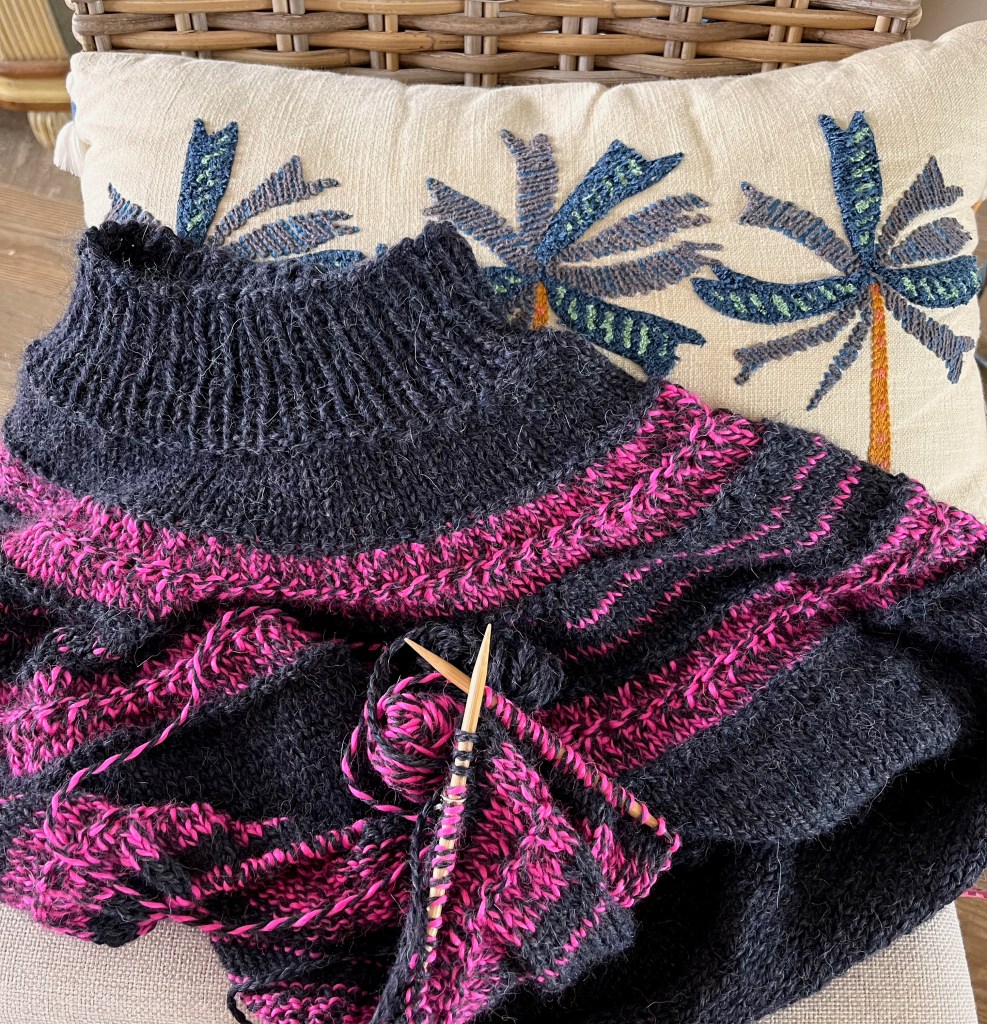
I’ve ended up with a sweater with more texture and interest than I would have designed if I’d had my pick of materials. It’s mostly dark grey, in a heavy wool and alpaca, with pink and grey stripes that pop…but not too much.  Heck, it might be one of my favorite sweaters!

And all because I’m stranded and used what I had. Sometimes maybe we need to look at what’s in front of us and work out a solution we wouldn’t have even considered otherwise. Maybe that’s what makes the best crafting – letting necessity befriend and collaborate with the creativity that needs a little shove before it kicks into action. 

Blessings to those who are snowed in or stranded this winter day!

Cindy

Cynthia Coe is the author of The Prayer Shawl Chronicles, interrelated short stories woven around those who make and receive handmade, prayerfully crafted gifts of prayer shawls. Click this link to order or for more information. 

Cynthia Coe is the author of The Prayer Shawl Chronicles, a collection of interrelated short stories about knitters and those they meet through knitting and sharing prayer shawls. 

Be sure to check out my newly published A Prayer Shawl Handbook: Inspiration and Resources for Your Prayer Shawl Ministry, now available in paperback and e-book editions and included in Kindle Unlimited.
It’s Color that Gives Knitwork Star Quality


It’s all in the color, I often tell people who admire my knitting. 

I’m a “process knitter,” I’ll admit. I like fairly simple, easy-to-remember patterns. I like to sit and let my mind go vacant as I concentrate on nothing but whether I need to knit or purl the next row. It’s my “me time.” It’s my meditative time.

But I get bored with simple stockinette or garter stitches for inches on end. Even as I zone out, I need a sense of change. I get a sense of accomplishment from finishing a section of one color and moving on to the next.

With the many self-striping and variegated yarns now available, it’s easy to give your otherwise plain, straightforward stockinette pops of color that make you look like a star. People who don’t knit will think you’re over-the-top talented if you display a knitwork with lots of intricate color. People will think you’re a genius if you add a few rows of yarn-overs to make a lacey pattern along with the colorwork knitting.

Colors give us a sense of accomplishment, give depth to our work – often without even changing skeins.

Several new books on colorwork in knitting have recently come out! Be sure to check them out:

Gradient Style: Color-Shifting Techniques & Knitting Patterns, edited by Kerry Bogert (Interweave): Specifically for knitters, this book helps crafters take advantage of the wide range of gradient colored yarn sets currently on the market. Some basics of using the color wheel are included in the introduction, followed by a good number of projects patterns using gradient colors: socks, sweaters, shawls, and mittens. The editor wisely advises knitters to go to the yarn shop and physically mix and match colors for new projects, rather than simply buying materials online. This book is great for anyone who wants to give their flat knitting some kick by using gradient color combinations. Currently on sale, in paperback and Kindle

Beginner’s Guide to Colorwork Knitting by Ella Austin. Despite the title, this book would best be used by advanced beginners or intermediate knitters. The photographs do an excellent job of showing exactly what is meant by each color work technique, but I think you would have to go to YouTube videos to be able to actually learn these techniques. If you are comfortable working with charts, this is the book for you. Just Published! Available in paperback and Kindle on March 19, 2019.

Love Color: Choosing Colors to Live Withby Anna Starmer: This gorgeous book by a color expert gives you lots of excellent ideas for choosing color schemes. I appreciated that the author urges readers to start with items of sentimental significance in creating color design choices. Many palettes are featured in the book, with tips on contrasting colors, working with textures, and use of lighting. The author does a great job of bolstering readers’ confidence in making bolder uses of color and incorporating colors that simply put them in a good mood. Available in hardback and Kindlefor less than $20.

Happy Colorwork Knitting! Cindy

Cynthia Coe is an avid knitter and author. Check out her books on her Amazon Author Page for more information.