Snow-Bound? Stranded? Time for Creative Yarn De-Stashing

I’ve found myself in Florida much longer than expected, and I’m a knitter stranded alone with a “mystery stash” of yarn. What to do???

It’s a great luxury to plan a project, decide exactly what yarn to use, and even mull over exactly what color you’ll use from a wide selection available. It’s nice to make a few swatches and decide which size knitting needles to use. 

But what if you can’t? 

I checked into a condo in Florida at the end of December, and I’m still here. With Tennessee closed for snow for the foreseeable future, I’ll be here for a while. Fortunately, I had ordered a “mystery stash” of clearance sale yarn shipped to me before I arrived, so I’m not exactly hurting for high quality yarn to knit with.

The problem is, I received 4 skeins of two different yarns from this mystery box – 4 skeins of a dark grey yarn, and 4 skeins of a bold pink and grey striped yarn. From past experience, I know it usually takes 5 skeins of these kinds of yarn to make a sweater (which I need; it’s 34 degrees here in paradise today). I puzzled over these yarns and made a swatch with the only needles I’ve got on hand. Mercifully, the needles will work with the yarn. But what to do with an underabundance of one or the other color of each yarn?

This is where necessity becomes creativity’s best friend. Like it or not, I’m looking at stripes. With the loud pink, I could end up with a sweater I wouldn’t be caught dead in. Or I could end up with a sweater I never would have planned but turns out better than expected. So I cast on and see how it goes.

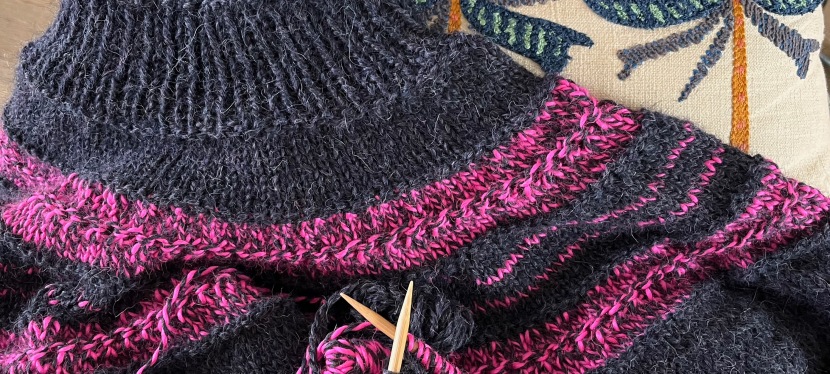
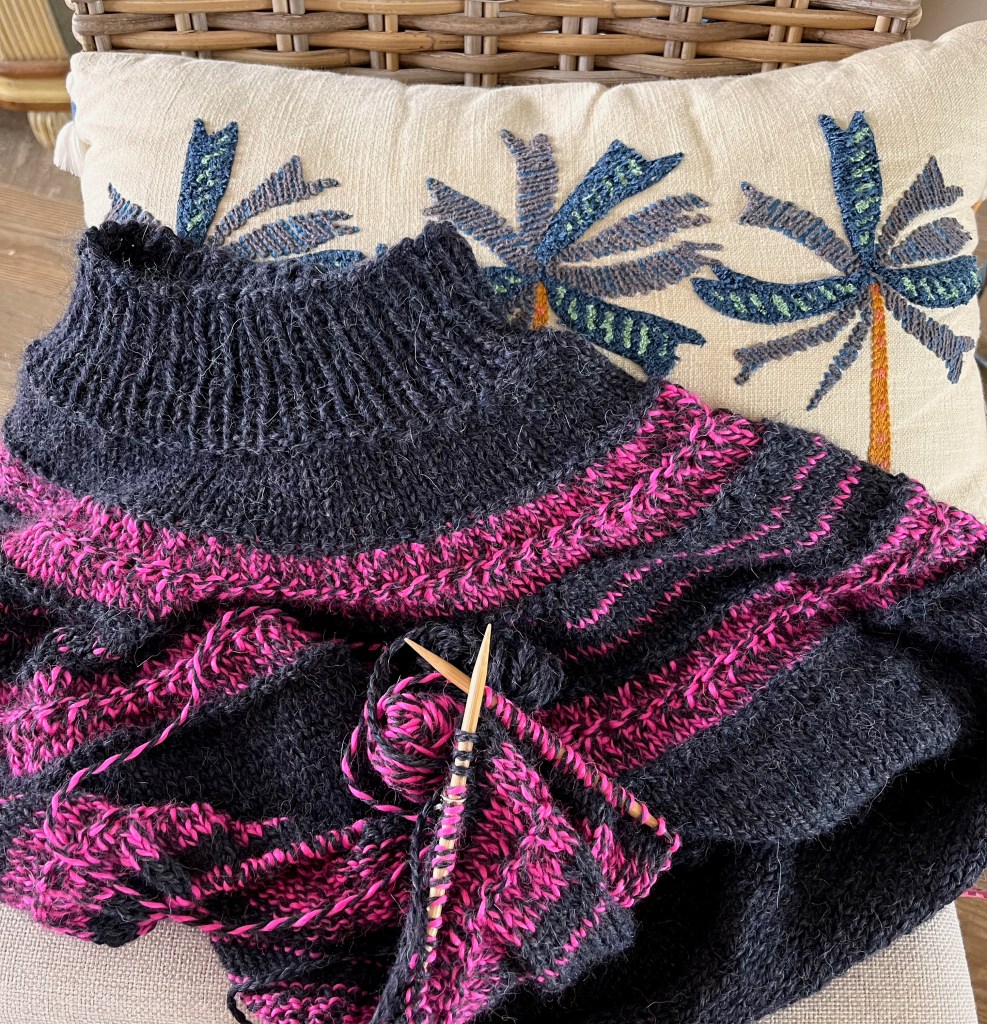
I’ve ended up with a sweater with more texture and interest than I would have designed if I’d had my pick of materials. It’s mostly dark grey, in a heavy wool and alpaca, with pink and grey stripes that pop…but not too much.  Heck, it might be one of my favorite sweaters!

And all because I’m stranded and used what I had. Sometimes maybe we need to look at what’s in front of us and work out a solution we wouldn’t have even considered otherwise. Maybe that’s what makes the best crafting – letting necessity befriend and collaborate with the creativity that needs a little shove before it kicks into action. 

Blessings to those who are snowed in or stranded this winter day!

Cindy

Cynthia Coe is the author of The Prayer Shawl Chronicles, interrelated short stories woven around those who make and receive handmade, prayerfully crafted gifts of prayer shawls. Click this link to order or for more information. 

Cynthia Coe is the author of The Prayer Shawl Chronicles, a collection of interrelated short stories about knitters and those they meet through knitting and sharing prayer shawls. 

Be sure to check out my newly published A Prayer Shawl Handbook: Inspiration and Resources for Your Prayer Shawl Ministry, now available in paperback and e-book editions and included in Kindle Unlimited.
What To Do with Leftover Luxury Yarn?

I don’t play yarn chicken. Life is too short for that kind of teeth grinding, blood pressure elevating stress in my life. If I’m knitting a nice sweater out of all-wool, cashmere, alpaca, or some other luxury yarn, I make sure I have enough yarn to make the best sweater I can make. 

That leaves a happier problem than running out of yarn (i.e., losing at yarn chicken – frantically trying to finish your project before you run out of yarn). You’re left with a skein or two of really nice yarn you don’t want to just toss in your stash.

What do you make out of just a small amount of luxury yarn? I usually make a simple scarf to go with my newly handknit sweater. A scarf makes a nice accessory for any outfit, and it gives a matching sweater that “wow” factor. Store-bought sweaters almost certainly do not come with matching scarves – only we hand knitters get these lux perks. If this scarf turns out a little short, no problem. Just stitch the ends together, and voila, you have a matching cowl instead. 

Here’s some other items I sometimes make with leftover luxury yarn:

  • Table runners
  • Coasters
  • Placemats or fabrics to place under plants or office items (pencil box, stapler, phone, etc.)
  • Bathmats 
  • For a larger amount of yarn, a shawl or throw blanket

I don’t overthink the design of these handknit extras. In fact, here’s my Go-To Pattern for scarves and any other rectangle-shaped small fabric:

The Five by Five – a Simple Checkerboard pattern, pictured in this blog post.

  • Cast on 20 stitches (for larger items, cast on additional sets of 8 stitches)
  • Row 1: (K4, P4) x 2, K4
  • Row 2: (P4, K4) x 2, P4 
  • Rows 3 & 4: Repeat rows 1 & 2.
  • Row 5: (P4, K4) x 2, P4
  • Row 6: (K4, P4) x 2, K4
  • Rows 7 & 8: Repeat rows 5 & 6. 
  • Continue these 8 rows until you run out of yarn, cast off. 

For more simple patterns, follow me for news of my upcoming book, A Prayer Shawl Handbook, to be published in early December! 

What do YOU do with leftover yarn? Feel free to join the discussion by commenting on this blog or on my Facebook page! Share your great ideas!

Blessings, Cindy

Cynthia Coe is the author of The Prayer Shawl Chronicles, interrelated stories about knitters and those for whom they knit and love. The sequel to this book, The Knitting Guild of All Saints, has been released! Available in paperback and on Kindle, included in Kindle Unlimited. 

Copyright Cynthia Coe 2023. All Rights Reserved.

Confessions of a Hand Knitter: I Still Wear Store-Bought Sweaters

“Did you make that?” Someone asked me recently, admiring a new cardigan with intricate cable work, made of tiny laceweight yarn. “Uh, no,” I replied sheepishly. My admirer gasped. “YOU bought a sweater at a STORE?!”

Yes. I, an avid knitter and maker of pullover and cardigan sweaters, still buy sweaters at stores. 

It all goes down to eyesight. I’ve worn glasses since I was seven years old, moving from nearsightedness as a nerdy child with her head in a book, to a middle-aged woman needing “progressives” to see up close. Knitting with the fine weight yarns I prefer to wear has never been a good fit for me. 

Then there’s the time factor. In my experience, knitting a large garment using fingerling or lace weight yarn takes FOREVER. Between the frustration of squinting to see stitches and the difficulty of correcting mistakes while using threadlike yarn, I’m usually done with dealing with such yarns as the project extends beyond several weeks. 

But I do admire fine weight knitted fabrics, intricate patterns, and complicated cable work. I admire buttons sewn on just-so with an abundance of sturdy thread, ribbon backings on the button bands and perfect pockets. Could I make these garments with such advanced techniques myself? Maybe not. There’s a reason people started manufacturing sweaters, right?

Just last week, I bought a cardigan sweater at a well-known retailer while traveling to New Haven, Connecticut for my son’s wedding. I spied a cream-colored cardigan with abundant bobbles along the sides of the button bands, crisp ribbon facings, elegant gold buttons, and cables that would make me pull my hair out if I attempted to knit them myself. It fit perfectly and felt oh-so-luscious on my arms. So heck yeah, I bought it! 

As a knitter, I confess I am primarily a meditative knitter. I knit to zone out, to find a place and space of calm and peacefulness. I knit to keep my fingers from fidgeting when I want to think or pray or just take a break from the busy-ness of real life.

And I also confess to buying great knit pieces at the store…especially when they’re on sale and look terrific on me!

Peace, Cindy

Cynthia Coe is the author of The Prayer Shawl Chronicles, interrelated stories about knitters and those for whom they knit and love. The sequel to this book, The Knitting Guild of All Saints, has been released! Available in paperback and on Kindle, included in Kindle Unlimited. 

That Liberating Feeling of Ripping Out Your Knitting Project

We’ve all been there. You start a knitting or crochet project. You’re well underway with it. And you hate it. What do you do? Soldier on, or rip it out and start over?

I found myself in this place with a knitted sweater recently. I had designed it myself, using expensive alpaca and wool yarn, in a deep red color. Since the yarn was a delicate fingerling weight using tiny needles, I had put hours upon hours of work into it. But I could tell it would be way, way too small for me.  What to do? 

Reader, I ripped out the entire project. All of it. And I felt liberated. Instead of keeping myself in a rut I couldn’t get out of, I got to re-think and start an entirely new project. 

When I ripped out my former sweater, I honestly did not regret the time I spent on it. As with all knitting projects, I enjoyed pleasant, restorative quiet time while making this sweater. I enjoyed knitting along while watching and listening to my favorite shows. Was this wasted time? Absolutely not. In fact, I considered the ripping out process as getting double the value for the money spent on this particular yarn. 

My former knitted sweater is now in the process of becoming a crocheted prayer shawl I’m making as a prototype for a new book. I have no regrets. Instead of suffering through a project I would never wear, I’m making something that will wrap around someone’s shoulders and fit perfectly, no matter the size of the person. 

Other crafters – woodworkers, painters, metal workers – may have to throw away or destroy projects that don’t work. I imagine that must hurt and be costly. As knitters and crocheters, we get to do something most people can’t do. We get a do-over. If a project isn’t working for us – for whatever reason – all we have to do is pull that piece of yarn and keep pulling until the project literally doesn’t exist anymore. Our flexible yarns give us the possibility of release from our mistakes and the possibility of a brand new start. 

Blessing for all the do-overs in your life, Cindy

Cynthia Coe is the author of The Prayer Shawl Chronicles, interrelated stories about knitters and those for whom they knit and love. The sequel to this book, The Knitting Guild of All Saints, has been released! Available in paperback and on Kindle, included in Kindle Unlimited. 

DIY Knitting Design – When You Can’t Find a Pattern That’s Just Right

You may have heard that knitted vests are all the rage these days. I’ve seen quite a number of knitted vests and armless tunics featured in fashion magazines, though I haven’t really seen many in the stores yet. 

Honestly, I haven’t worn a knitted vest since around 1987. Would I wear one again? I just might. If I could find a pattern I liked….

With plenty of yarn at my disposal (my yarn cabinet overflows), I have many yarn options available. The problem? I can’t find a pattern that works. I searched high and low on Ravelry for a free pattern. But everything on offer featured complicated details, the dreaded short rows, or intricate stitching that would ruin my eyesight. The few I liked called for fingerling yarn (too small) or bulky (too large). I just couldn’t find that Goldilocks “just right” pattern.

As I’ve found many times in my knitting life, sometimes it’s just easier to make up your own pattern that works for you. In fact, unless you have EXACTLY the yarn called for in a pattern – which is rare – you might save yourself a lot of time searching through the multitude of patterns on the web by scribbling out your own design.

It’s not that hard to come up with your own design. Here’s my process:

  • Identify a favorite sweater that fits just right. It can be store bought and manufactured.
  • Measure it. Write down the width and the length of the body, along with the dimensions of the arms and the neck.
  • Knit a swatch and determine the gauge. How many stitches to an inch? Multiply the dimensions of the favorite sweater by your gauge, subtracting stitches for neckline, armpits, and so forth. If you’re off, forgive yourself and carry on. 
  • Use your favorite stitches to give your garment some zing. I usually do this as I go.

Do you need pages-long instructions and umpteen books to do DIY Knit Design? Nope. What I find most helpful are bare bones charts for top-down sweaters (telling me how many stitches to increase on top and how many stitches to put on a lifeline for the arms) and a comprehensive stitch dictionary. Here are my current go-to sources:

As a knitter, you have skills. You have the ability to make precisely what you want. Go for it!

Blessings on your DIY Designs, Cindy

Cynthia Coe is the author of The Prayer Shawl Chronicles, a collection of interrelated short stories about knitters and those they meet through knitting and sharing prayer shawls. 

My Season of Knitting Cardigan Sweaters

I wear cardigan sweaters all the time. Here in the Smoky Mountains of East Tennessee, we rarely have bitter cold weather. But in the pastel beauty of the Appalachian spring and among the yellow and orange leaves of autumn, we have cool mornings and crisp evenings perfect for a light sweater. During the heat of the summers, cardigans are perfect for peeling off by midmorning or to cope with excessive air conditioning indoors.

This year, I pledged to learn to knit my own cardigans. My closet is full of fairly inexpensive, store-bought cardigans, but I didn’t have a single cardigan sweater I had made myself. As a longtime knitter, I found this situation embarrassing and unacceptable. I admit, I found all the shaping, button bands, and tricky necklines highly intimidating. 

But I resolved to learn the skills needed and become a Cardigan Queen. Two months into the year, I’m pleased to say I’ve completed two cardigans and have another well under way. I started with a yoke-neck cardi. Much to my surprise, my first cardigan took less than two weeks to complete, fit perfectly, and is now a “go-to” part of my wardrobe. 

The verdict is still out on the “saddle” neck cardi I’m making, using a kit from Kitterly. It’s complicated, using German short rows, make-one-lefts and rights, cable cast-ons, and some other techniques I hadn’t used before. But I followed the directions and somehow got several indescribable shapes onto one set of needles to form a corset shaped garment that is starting to look like a sweater. 

Will my season of cardigans come to a successful conclusion? Probably. Though my season of cardis is not yet in full bloom and I still have a lot to learn, the seeds of a fruitful harvest of all new cardis is firmly planted, taking root, and in a promising growing season. 

Here’s What I’m Using to Make Cardigans

Margaret Hubert, One-Piece Knits: Essential Designs in Multiple Sizes and Gauges for Sweaters Knit Top Down, Side Over, and Back to Front (This book of charts proved easier than it initially looks. I’ve easily adjusted the charts slightly to fit me. Several techniques are included. Highly recommended.)

Yarn: Knitcrate offers very high-quality yarns at very affordable costs. If you subscribe to the “member crate,” you’ll get enough yarn for a small project (patterns included). At the end of the month, you can get fantastic deals on the featured yarns (and get enough yarn for a sweater). Buy early – they sell out! Click this link to get a crate for only $5.

Kits: I’m using kits from Kitterly. These kits are pricey but include high quality yarn and well-designed but complicated patterns. They work, but you’ll need to pay close attention to the directions. 

Blessings on you own season of knitting, 

Cindy

Cynthia Coe is the author of The Prayer Shawl Chronicles, a collection of interrelated short stories about knitters and those they meet through knitting and sharing prayer shawls. 

Top Down Knitted Sweaters – Where Have You Been All My Life?

For knitters, there’s no greater joy than wearing your favorite hand-knitted sweater, knowing that you made it yourself.  And if the sweater fits perfectly, looks terrific, and gets you lots of compliments, you feel a special kind of pride.

Up until the last year or so, I stayed away from making my own sweaters. I learned to knit sweaters the “flat” way, making four pieces (front, back, two arms) from the bottom up and stitching the pieces together at the end, putting in a neckline by picking up stitches and hoping I had enough yarn left to finish the project. My necklines never looked professional. My efforts looked amateur. 

Then came all those pretty “cake” or “sweet roll” yarns with the lovely colors and inviting rounds rolls begging me to knit something marvelous. I made the big switch to top-down knitting and circular needles. Much to my surprise, I came out with a sweater I wear at least once a week, proudly and confidently that it’s a great looking and fitting garment. (And the sweater’s “done” as soon as I’ve finished knitting – no tedious mattress stitching and few loose ends to tie up.)

This leaves me thinking, “where have top-down knitted sweaters been all my life?” I’m guessing it’s all about the new widespread availability of circular needle sets, along with a plethora of new yarns made for the self-striping colors that make a top-down knitted sweater pop. In any case, I’m so glad I made the switch. I may never buy another store-bought sweater again.

Here’s what I’m using for my top-down sweaters:

Pattern bookThe Knitter’s Handy Book of Top-Down Sweatersby Ann Budd. (I’m using the chart for the “Seamless Yoke Sweaters” on page 23.)

YarnCaron Cakes (I’ve needed three cakes to make a sweater. You’ll have a good bit left over for a matching scarf.)

NeedlesClover Takumi Circular Needle Set(available online for about half the retail price) I’ve used size 8 needles with the Caron Cake yarn.

MarkersJill’s Beaded Knit Bits. I love these markers, handmade and sold by the artisan online. You’ll need at least one marker for yoke sweaters, a set for raglan designs. Jill also carries row counters and other useful jeweled tools.

Happy Sweater Knitting!

Feel free to comment if you have projects to show off or tips for new knitters!

Blessings, Cindy