Knitting Together Faith, History, and Community: The Prayer Shawl Chronicles Series

Knitting is much more than crafting a beautiful piece of fabric. It’s about weaving together threads that, on their own, may seem ordinary, but when intertwined, form something greater—something full of meaning and purpose. That’s exactly how I view my series, The Prayer Shawl Chronicles.

While each book stands alone, much like individual strands of yarn, together they create a rich, interconnected story that spans generations, cultures, and the deep role of faith in our communities. My goal with this series has always been to show how knitting, community, and faith intertwine, much like the stitches of a prayer shawl, creating warmth and connection where it’s needed most.

In the first book, The Prayer Shawl Chronicles, we dive into the close-knit (pun intended!) relationships within a small church, where knitting isn’t just a craft—it’s a form of spiritual and emotional support. The women of the church use their knitting needles to form bonds, offer prayers, and express love.

The second book, The Knitting Guild of All Saints, broadens this view, taking readers deeper into the history of a community knit together by faith and a shared love of creating. The guild connects across time, showing how past and present come together to form a lasting legacy through their works of kindness, friendship, and artistry.

Finally, Knitting Through Time steps fully into historical fiction, weaving a tale that travels through different eras, illustrating how the act of knitting—and faith—has long been a thread that connects generations. It’s a tribute to those who came before us and the ways they influenced not just their world, but ours today.

I encourage you to read each of these books not only for their stand-alone stories but also to experience how they interlace into one powerful narrative of faith, knitting, and community. These are stories of people much like us, who find strength in faith and fellowship—and who just so happen to have a love for knitting along the way!

Happy reading, and as always, happy knitting!

Cindy

Cynthia Coe is the author of The Prayer Shawl Chronicles, a series of fictional stories woven together by the theme of human connections made through prayer shawls and the craft of knitting. Her newest book is her first historical novel, Knitting Through Time: Stories of How We Learned to Knit. Learn more by visiting her Author Page at this link

Write Your Own Knitting Patterns? Yes, You Can!

Inside: My story of how I wrote my first knitting patterns

You’ve made lovely hand-knitted sweaters and scarves. You have a go-to blanket pattern etched in your head. You constantly hear, “what pattern is that?” and you sheepishly say, “uh…I just made it up.” Then you hear, “no kidding? You should publish that!”

Yes, you should. And with a plethora of self-publishing and crafty platforms available to everyone, you absolutely can publish anything you want, including your own knitting patterns.

But how to get started?

Reader, I faced this problem just a couple of months ago. In writing my upcoming new book, “A Prayer Shawl Handbook,” I knew I had to provide some basic prayer shawl patterns for my readers to truly call this book a comprehensive handbook for this crafting ministry. 

A Sneak Preview of Cindy’s Upcoming New Book, “A Prayer Shawl Handbook”

I have several “go-to” prayer shawl patterns in my head – patterns I don’t even think about and can simply cast-on and knit. But write these down???? Gasp. I’m not a technical writer by any stretch of the imagination. Fiction writing and knitting pattern writing are not, in my poor little mind, in the same skill set. 

How to get started? Try. Sit yourself down, pull out a pencil and a blank sheet of paper, and take your first stab at it. 

What about formatting your pattern?

Fortunately, a new book called “The Knitting Pattern Handbook: How to Write Great Patterns That Knitters Will Love to Make” by Kristina McGrath and Sarah Walworth has just been published, and I was fortunate enough to be given an advance copy for review by the publisher.  What timing! I gulped down this little book and decided, yes, I could do this.

I cast on my favorite memorized patterns and took notes as I went along. I ripped out, re-figured, crumbled up and tossed some early drafts in the trash can. But I persevered until I got some basic prayer shawl patterns knocked out, along with three prayer patch patterns. 

Yes, there are formats you need to use and abbreviations you need to adhere to. You probably recognized them from your own knitting projects you’ve made from other people’s patterns. You just need to focus on these things and make sure you’re consistent.

My tip: don’t skip steps or assume the reader of the pattern knows everything there is to know about knitting. Especially if your patterns are geared towards beginners (which mine are), something you think is obvious may not be. 

Get friends to help proof and test your draft patterns

This is where it gets really terrifying, in my experience. You hand off your draft pattern to a trusted fellow knitter and see if they come up with what you came up with. They may say, “this makes no sense whatsoever.” They may say, “I just don’t understand what you mean by a yarn-over. What is that?” You go back to the drawing board and explain the details you thought you included but didn’t. 

The authors of the new Knitting Pattern Handbook suggest that you hire technical editors and pay them for proofing and revising your patterns. Did I do this? No. I’m just starting out, and I can’t justify shelling out a lot of money for some basic patterns. Friends who knit told me what I needed to know. If I get the notion to start designing intricate sweaters in five different sizes, I’ll certainly re-think and probably get professional help. But as a newbie knitting designer, that’s not where I am.

Everybody starts with the basics

Where I am as a knitting designer is at the beginning. I have some basic patterns that are great for beginners and for simple “meditative” knitting. These are patterns I’d like to share with my readers, so I will. 

If you, too, have some basic knitting patterns you’d like to at least share with friends, go for it! If you’d like to get into the knitting design business and make a few bucks (or a lot!), go for that, too! Every knitting designer starts somewhere, likely with a nice, basic design. And you can, too!

Blessings on your knitting designs, no matter how intricate or basic! Cindy

Cynthia Coe is the author of The Prayer Shawl Chronicles, interrelated short stories woven around those who make and receive handmade, prayerfully crafted gifts of prayer shawls. Click this link to order or for more information. 

Follow me and subscribe for news of my upcoming new books!

As an Amazon Associate and Author, I provide links to products (including books I have written) and earn a very small fee if you click on the links and buy something. There is no additional charge to you!

Writing Knitting Patterns – Is There Hope for a Creative “Pantser” Like Me?

Do you write knitting patterns? Do you love the process or – like me – feel your soul enter a state of utter dread when you even ponder such a thing?

As I prepare the final draft of a new book, I know I need to include at least a few knitting patterns in this book (it’s a non-fiction how-to book). I know this, but I have yet to put pattern to paper. And yes, this is supposed to be a “final” draft.

In writing terms, I’m a total “pantser.” This means I generally fly by the seat of my pants when I work on creative projects. This process works beautifully for some of us.( Just start typing and feel awe and wonder at what appears on the screen!!!) Other writers are “plotters.” They plan out every single step of their writing projects, complete with detailed outline (or so I’m told). 

As a knitting designer, I’m a “pantser” as well. People ask what I’m making, and I say, “a prayer shawl, I hope.” I cast on a hundred or so stitches and see what happens. I usually come up with an interesting pattern with texture, contrasting elements, whimsy – all that stuff. But if asked to duplicate what I’ve done…that’s a problem.

I’ve discerned that pattern writing and “pantsing” are not compatible. And yet, I really need to share my prayer shawl patterns. As I’ve recruited fellow church members to knit or crochet prayer shawls for our parish ministry, they inevitably ask, “got a pattern for me?” 

I got my hands on a soon-to-be published pattern writing handbook and eagerly jumped in, hoping for some inspiration. I felt filled with growing confidence for a couple of chapters. Then, the authors tell me I need to find “beta testers” and “tech editors.” Really???? Just for a simple prayer shawl pattern I could do in my sleep?

As I begin to work on my new book, I hear a song playing in the background. “Don’t worry about a thing,” the lyrics tell me. I proceed in hope.

Do you write knitting patterns? Tips or tricks? Feel free to drop them in the comments!

Be sure to check out The Knitting Pattern Writing Handbook, scheduled for publication on October 31 and available for pre-order. A great resource, especially for newbies and pattern-writing wanna be’s like me. 

Blessings, Cindy

Cynthia Coe is the author of The Prayer Shawl Chronicles, interrelated stories about knitters and those for whom they knit and love. The sequel to this book, The Knitting Guild of All Saints, has been released! Available in paperback and on Kindle, included in Kindle Unlimited. 

As an Amazon Associate and Author, I provide links to products (including books I have written) and earn a very small fee if you click on the links and buy something. There is no additional charge to you!

New Knitting & Crochet Books Coming Fall 2023

Hello Crafty Readers! I’m blogging for the first time in a while. I just finished the first draft of a new novel in The Prayer Shawl Chronicles series, so my head and heart have been preoccupied with that these past several months.

My new novel will probably come out some time in 2024, but in the meantime, there’s plenty of new knitting and crochet books to keep all of us occupied. 

I review books for NetGalley, and publishers kindly give me pre-publication peeks of their new books. Here’s what’s on tap for us crafty types (all available for pre-order; click the links for more info):

The Knitting Pattern Writing Handbook by Kristina McGrath and Sarah Walworth (Storey Publishing). Highly recommended if you write your own knitting patterns or plan to in the future. This little book tells you all you need to know to put your own patterns out into the world. Concise, plain language. Invaluable if you sell patterns online; helpful if you just want to share patterns with friends or understand what all those abbreviations mean. 

A Year of Knitting Stitches by Tabetha Hedrick (Globe Pequot, Stackpole Books). This is an excellent collection of knitting stitch patterns. I’ve used a couple in the past and always found several stitches that became “keepers.” This will definitely sit on my desk next year; the perfect gift for a knitter.

A Year of Crochet Stitches by Jill Wright (Globe Pequot, Stackpole Books). This is an equally excellent collection of crochet stitches for those of us who enjoy making up our own patterns or just want something different and all our own. In this collection, stitches are nicely organized by type of stitch (e.g. all kinds of bobble stitches). Perfect for the intermediate and advanced crocheter and an excellent gift idea.

Oversize Fashion Crochet by Salena Baca (Globe Pequot, Stackpole Books). This is a collection of only 6 patterns of oversized sweaters, a poncho, and other bulky garments. While this is a limited group of patterns, I found them all do-able and attractive for the average crafter. The schematics and drawings of how to assemble the garments were particularly good. 

More blogging to come, now that my next novel is on the back burner for a bit!

Happy Crafting, Cindy

Cynthia Coe is the author of The Prayer Shawl Chronicles, interrelated short stories woven around those who make and receive handmade, prayerfully crafted gifts of prayer shawls. Click this link to order or for more information. 

Introducing My New Novel: The Knitting Guild of All Saints

We are all in one big knitting guild. That is the message of my newest novel, The Knitting Guild of All Saints. Whether you knit well or not, knit a lot or only sporadically, you are part of a community of knitters that all share something in common and are woven together by the practice of knitting.

In my first book in this series, The Prayer Shawl Chronicles, we see community formed around the ministry of knitting and gifting prayer shawls. These prayer shawls are made with love, knitted or crocheted to show someone that a community of believers cares about them, prays about them, and surrounds them in love like a big warm blanket. In this novel, unlikely friendships form, and romances are sparked. People both within and on the margins of the fictional All Saints Church are enfolded in the love and prayers of this community of faith. 

In The Knitting Guild of All Saints, the second novel in this series, the community expands far beyond the fictional Episcopal church at the heart of the action. The “Rogue Knitting Guild” formed in the first book takes off as a ministry all its own, with a surprising and highly unlikely new leader. New prayer shawl guilds are formed in churches far way and even poolside in Florida. Familiar characters from Book One find themselves in unlikely new situations. And, of course, an unlikely romance begins between two new characters. 

I hope you enjoy my new novel. I try hard to keep the plot going and the characters interesting and even humorous at times. I hope you join my characters in their new journeys, walking in their shoes for just a bit and seeing the world from their perspectives. Isn’t that what reading is all about?

Many blessings! Cindy

Cynthia Coe is the author of The Prayer Shawl Chronicles, interrelated stories about knitters and those for whom they knit and love. The sequel to this book, The Knitting Guild of All Saints, has been released! Available in paperback and on Kindle, included in Kindle Unlimited. 

Are Knitting Books Now Obsolete?

As a writer and lifelong bookworm, I love finding a new knitting book, newly published and on display in the bookstore. But lately, I’m finding myself less and less enthusiastic about newly published collections of knitting patterns, even if they are beautifully designed hardbacks with full color illustrations and photos. Nice to look at, but…?

As some of you know, I often have the special treat of reviewing brand new books digitally, well before they hit the market. In reviewing new knitting books, I’m seeing a trend that makes my eyes glaze over. Many – if not all – of these new knitting books assume I’ve never picked up a pair of knitting needles in my life. These books offer voluminous tips on how to get started, what tools I need, how to choose yarn, and even how to make the most basic of stitches. Lord knows I’ve covered that territory umpteen times before. 

So when I eagerly pick up a new knitting book, I inevitably skip large chunks of introductory material and skip straight to the new patterns. The patterns are usually fine; but do I want to buy an entire book just for a few patterns?

In the meantime, a plethora of interesting and innovative patterns are now available on multiple platforms for just a few bucks a piece. Why buy a book of info you don’t need, when you can buy only what you want for much less? 

And as for instructions on how to knit, it’s all about video these days. I rarely figure out a new stitch from two-dimensional illustrations on paper. But show me a quick video, and I’ve got it under my belt in no time.

I’m going to make a pronouncement (because it’s my blog and I can): Knitting instruction books are obsolete. If you want to learn how to knit, do a search and find a video. If you want a pattern, check out Ravelry, Etsy, or who knows what other platforms are out there in cyberspace. 

I love books, but time and innovation move forward. 

Happy Knitting! Cindy

Cynthia Coe is the author of The Prayer Shawl Chronicles, a collection of interrelated short stories about knitters and those they meet through knitting and sharing prayer shawls. 

As an Amazon Associate and Author, I provide links to products (including books I have written) and earn a very small fee if you click on the links and buy something. There is no additional charge to you!

How Do You Knit Socks?

When I knitted my first socks two years ago, the entire process of making socks was a mystery. What’s a gusset? What’s a heel turn or a heel flap, and are those two different things? What’s this Kitchener stitch everyone talks about with reverence and awe but can never seem to remember?

My first pair of socks found me, as I signed up for a subscription service that sent a sock kit as the new subscriber freebie. I had pondered trying to knit a pair of socks for some time, but even as an experienced knitter, I couldn’t figure out how in the world the process worked. But I gamely got myself an outrageously small set of circular needles and dove in.

This first pattern I tackled featured an “afterthought” heel. You make the body of the sock and go back and knit the heel afterwards. This process includes putting in a lifeline and the terrifying act of pulling the lifeline out on this project you’ve toiled over for a week, trying to get the thing back on your toothpick sized needles. I survived the experience, presented my husband with the cozy wool socks he had asked for years ago, but pondered whether I would have the nerve to knit another pair.

A month later, I gathered myself and tried another sock pattern. This time, mercifully, there were no afterthought heels or any other high wire acts involving life lines. As I got to the heel flap (whatever that was), I slavishly followed the instructions through a mystifying process of slip stitches, picked up stitches around a tiny rectangle, and a series of decreases that somehow looked like an increasingly larger triangle. But finally, I successfully rounded the corner of the heel and ended up with a piece of knitting that actually looked like the embryo of a sock. I even mastered the Kitchener stitch and sewed up the toe neat and pretty.

Was this steep learning curve worth the effort? Oh yes. Hand-knitted socks are a luxury on par with hot chocolate made with real cream and topped with high-end marshmallows. On a cold day, nothing compares.

I admit I have not tried any more afterthought heels. Life seems too short to deal with lifelines when you don’t have to. But who knows what the future holds? Live dangerously once in a while. I do like the color contrasts you get when you make the heel a different color, so I might give it another go one of these days.

Want to learn to make socks?

  • This is my go to resource for sock knitting – a classic, in my opinion: Getting Started Knitting Socks by Ann Budd. It includes everything you need to know about knitting socks. Invaluable is an extensive stitch dictionary for adding pizzaz to your socks. You can make them as plain or fancy as you want.
  • Want to try a new method? A new book with a new and innovative method is coming out soon, Knit 2 Socks in 1 by Safiyyah Talley. I’ve gotten a pre-publication peek at this book. You basically make one long tube, then make a cuff, a toe, and afterthought heels later.

Will I try afterthought heels and the dreaded lifelines again? Maybe. The beauty of trying and succeeding something challenging is that you gain both mastery and a new sense of confidence in your work. Worth it? Oh yes.

Blessing to those trying new knitting techniques! Cindy

Cynthia Coe is the author of The Prayer Shawl Chronicles, a collection of interrelated short stories about knitters and those they meet through knitting and sharing prayer shawls. 

As an Amazon Associate and Author, I provide links to products (including books I have written) and earn a very small fee if you click on the links and buy something. There is no additional charge to you!

New Knitting Books for Summer 2019

Greetings, Knitters! I hope you are having a wonderful summer (or winter, for friends Down Under) and getting in some good knitting time. 

Do you get patterns from knitting books? Personally, I get my patterns from a variety of sources – online patterns sold individually, magazines I pick up in the grocery store, and a handful of go-to and much used knitting books. I know online patterns bought digitally from Ravelry, Etsy, or other websites are all the rage, but believe or not, some good knitting pattern books are still being published (and you can keep them all in one place on your bookshelf).

Sycamore Cove Knitting reviews the new ones in advance of publication and gives you the scoop on what’s new and worthwhile. Here’s what new and just published in knitting books for June-July 2019:

Big Yarn, Beautiful Lace Knits by Barbara Benson. A very nice pattern book for the coming cool weather season. The concept of this book is lace knitting with larger sized needles and bulkier weights. The results? Quicker projects with more intricate, showier designs than you normally see with bulky yarns.

The Art of Circular Yokes by Kerry Bogert. This book of yoke sweater patterns give the advanced knitter plenty to sink her teeth into. The designs are lovely and intricate. Most of them are designed for small needles and fairly fine yarn. These are projects that will take a lot of skill, time, and concentration.

 One Stitch Baby Knits by Val Pierce. This is a nice collection of baby knit patterns. They are intended as “beginner” level patterns, but I would rate them as more “advanced beginner” or even “intermediate” level patterns. This is by a British knitting expert, and I appreciate that she took the trouble to translate some of the British knitting terms into American English. However, many of the yarns listed are those available in Britain; I only recognized one yarn readily available in the U.S.

 A Year of Creativity by Petra Hoeksema, Lidy Nooij, Miriam Catshoek, and Bregje Konings. This books is all about “craft dates” for knitters and other crafty people. The idea is to get friends together, share some snacks, have fun, and everybody makes a craft together. I quite like this idea, and it’s a beautiful book. Coming July 23.

And now time for the shameless plug:

The Prayer Shawl Chronicles by Cynthia Coe: Set in an Episcopal parish in Tennessee, hear the stories of women who knit and donate prayer shawls and the remarkable and remarkable connections with those who receive them. A fairly quick read of short stories, this book is great for taking along on vacation.

Enjoy your Summer Knitting! Cindy

Cynthia Coe is the author of The Prayer Shawl Chronicles: Stories of Unlikely Connections & Unexpected Gifts. Available worldwide exclusively on Amazon and included in Kindle Unlimited. Paperback edition coming very soon.

Knitting in Public

Knitting in public cures a host of social awkwardness ills. If you’re waiting for a plane, waiting for a doctor’s appointment, or just find yourself in a place with nothing much to do, knitting fills the gap. 

This morning, I found myself in one of these places, waiting as my son got his hair cut. I hadn’t had my morning quiet time yet, so I pulled out my small on-the-go knitting project out of my tote bag and got a few rows in while I waited. But looking around me as I waited, I noticed something different.

Usually, when I knit in public, at least a couple of people will come up to me and strike up a conversation.  “What are you making?” they usually ask. “I’d love to learn to knit,” they occasionally say. Or maybe they wistfully remember a mom or grandmother who used to knit.

But this morning, no one said a word. They all focused solely on their phones. I felt like I was the only one in the waiting area truly getting “me time.”

Hoping you’re getting some knitting “me time” today! Cindy

Just published! 

Coffehouse Knits: Knitting Patterns and Essays with Robust Flavor, edited by Kerry Bogert. Classic sweaters, cowls, shawls, socks, and even a nice pair of cozy mittens. This book has a nice collection of patterns plus several essays on knitting and community. The authors evoke a warm coffeehouse oozing with friendship and wooly knitting projects. This would be a nice gift book for the knitters in your life. On sale in hardback for about $18; Kindle for about $15

Beginner’s Guide to Colorwork Knitting by Ella Austin. Everything you could possibly need to know about colorwork knitting. Numerous techniques and projects included. The website on Amazon has a nice preview of the book. Available in paperback and Kindle and on sale for about $18 paperback and $14 Kindle.

It’s Color that Gives Knitwork Star Quality


It’s all in the color, I often tell people who admire my knitting. 

I’m a “process knitter,” I’ll admit. I like fairly simple, easy-to-remember patterns. I like to sit and let my mind go vacant as I concentrate on nothing but whether I need to knit or purl the next row. It’s my “me time.” It’s my meditative time.

But I get bored with simple stockinette or garter stitches for inches on end. Even as I zone out, I need a sense of change. I get a sense of accomplishment from finishing a section of one color and moving on to the next.

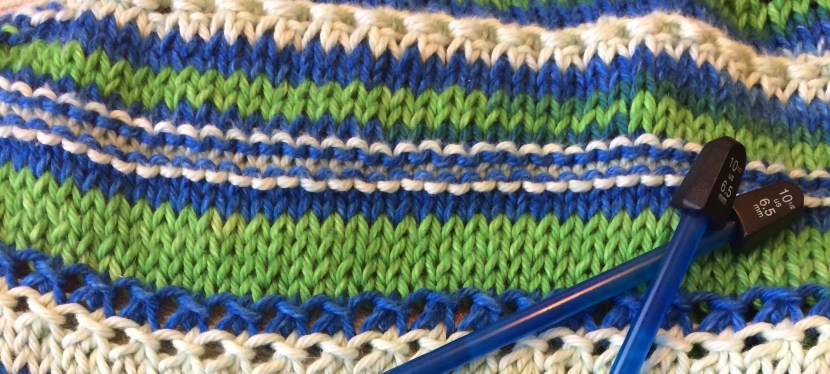
With the many self-striping and variegated yarns now available, it’s easy to give your otherwise plain, straightforward stockinette pops of color that make you look like a star. People who don’t knit will think you’re over-the-top talented if you display a knitwork with lots of intricate color. People will think you’re a genius if you add a few rows of yarn-overs to make a lacey pattern along with the colorwork knitting.

Colors give us a sense of accomplishment, give depth to our work – often without even changing skeins.

Several new books on colorwork in knitting have recently come out! Be sure to check them out:

Gradient Style: Color-Shifting Techniques & Knitting Patterns, edited by Kerry Bogert (Interweave): Specifically for knitters, this book helps crafters take advantage of the wide range of gradient colored yarn sets currently on the market. Some basics of using the color wheel are included in the introduction, followed by a good number of projects patterns using gradient colors: socks, sweaters, shawls, and mittens. The editor wisely advises knitters to go to the yarn shop and physically mix and match colors for new projects, rather than simply buying materials online. This book is great for anyone who wants to give their flat knitting some kick by using gradient color combinations. Currently on sale, in paperback and Kindle

Beginner’s Guide to Colorwork Knitting by Ella Austin. Despite the title, this book would best be used by advanced beginners or intermediate knitters. The photographs do an excellent job of showing exactly what is meant by each color work technique, but I think you would have to go to YouTube videos to be able to actually learn these techniques. If you are comfortable working with charts, this is the book for you. Just Published! Available in paperback and Kindle on March 19, 2019.

Love Color: Choosing Colors to Live Withby Anna Starmer: This gorgeous book by a color expert gives you lots of excellent ideas for choosing color schemes. I appreciated that the author urges readers to start with items of sentimental significance in creating color design choices. Many palettes are featured in the book, with tips on contrasting colors, working with textures, and use of lighting. The author does a great job of bolstering readers’ confidence in making bolder uses of color and incorporating colors that simply put them in a good mood. Available in hardback and Kindlefor less than $20.

Happy Colorwork Knitting! Cindy

Cynthia Coe is an avid knitter and author. Check out her books on her Amazon Author Page for more information.