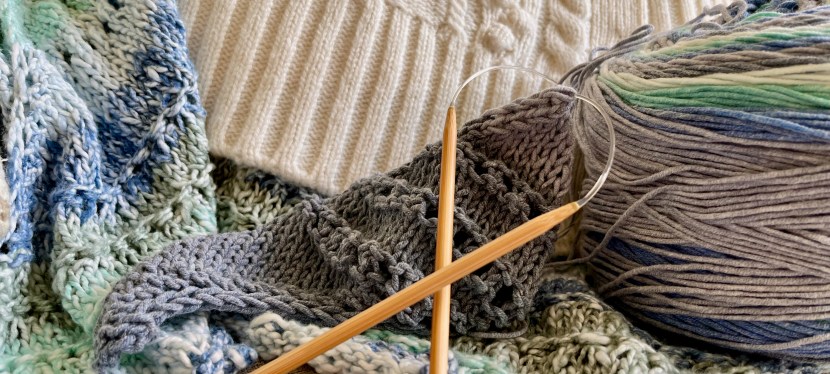
Beginner, Intermediate, and Advanced in Knitting Patterns – What the Definitions Should Mean!

Spoiler Alert: “Advanced” is reserved for “I couldn’t possibly knit that while watching TV”

Do you ever check the “Level of Difficulty” on a knitting pattern? Have you ever picked up a “beginner” level pattern, only to find it way, way, way beyond your skill level? Or found that an “intermediate” pattern required you to count each and every movement of the yarn you made, and it still didn’t come out right?

Friends, I’ve been there. I would consider myself a fairly experienced knitter, but I enjoy fairly mindless “meditative” knitting, especially while I’m watching TV or listening to an audio book. Recently, I grimaced in annoyance at a pattern that was labeled for “beginners.” This pattern required yarn-overs, yarn-overs on the purl side that required an extra loop that the pattern failed to mention, and slip stitches that were supposed to go over all that. And at beginner level knitter was supposed to navigate all that??? Really???

So here’s my own definitions of what “beginner,” “intermediate,” and “advanced” should mean in patterns for those of us who knit for pleasure:

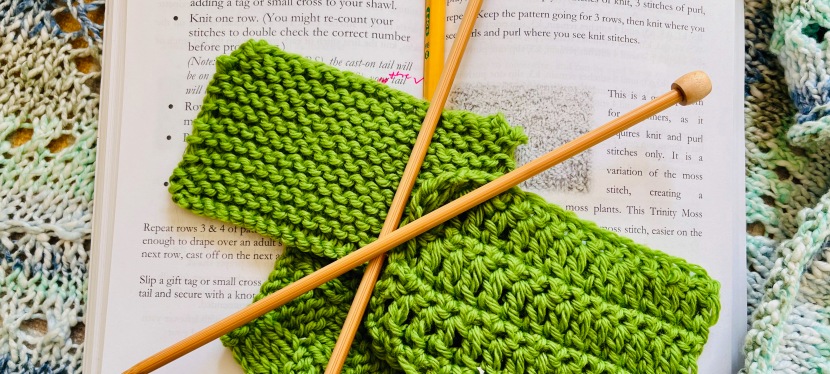
Beginner means knits and purls only!!! Nothing else! I mean it! Most beginners are still trying to make consistent stitches that don’t look like something the cat got ahold of. The beginner knitter wants to begin and end with the same number stitches on the needle. If you’re a pattern designer and call your pattern “beginner” level, don’t throw in slip stitches, yarnovers, or anything else that needs explaining. Think stockinette stitch and garter stitches, maybe a moss stitch. There’s a lot you can do with these.

Intermediate means a few tricks that don’t require excessive brain power. Intermediate means you’ve mastered the basic knit and purl stitches and can make a piece of fabric you’re not embarrassed to show other people. You’re now ready to throw in a few fancy stitches that will add texture and impress the heck out of your friends, but you do not have to count beyond the number 4.  For pattern designers, this means stuff like increases, decreases, slip stitches if you explain them properly, and yarnovers. If it’s a sweater pattern, you may ask the knitter to pick up stitches for the button band, but you better provide a video.

Advanced means the knitter will need to turn off the TV, mute the phone, and tell everyone to leave her alone for the next hour. For pattern designers, bring it. You may ask the knitter to count in sets of twelve if you want. You may ask the knitter to knit 9 tog with yarn so thin you have to squint to see it. You may include German short rows, whatever those things are. You may ask your knitter to turn the fabric upside down and flip it over twice every two rows. It’s fine. This knitter has been forewarned and is game for anything. 

Pattern designers, take note and proceed accordingly! Tell us what we’re getting into! And in plain English, please!

Love and kisses to designers who think I knit better than I do, Cindy

Cynthia Coe is the author of The Prayer Shawl Chronicles, a collection of interrelated short stories about knitters and those they meet through knitting and sharing prayer shawls. 

Be sure to check out my newly published A Prayer Shawl Handbook: Inspiration and Resources for Your Prayer Shawl Ministry, now available in paperback and e-book editions and included in Kindle Unlimited.
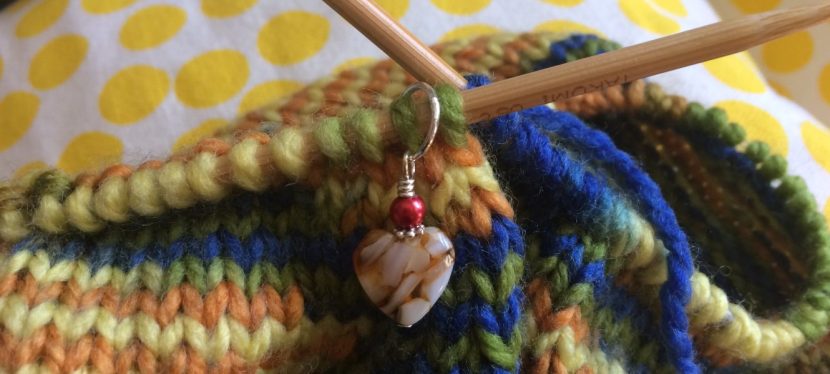
It’s All About Color: Crafting Color Symbolism in Every Stitch

Exploring Symbolic Colors in Prayer Shawl Design

When you embark on the journey of creating a prayer shawl – or any other crafting project – the choice of colors goes beyond aesthetics; it can carry profound symbolism. Across various traditions, colors have played a significant role in conveying concepts and stories. Whether you’re crafting for spiritual or personal reasons, understanding the symbolism of colors can add a meaningful layer to your prayer shawl design.

Here’s list of common colors and traditional symbolism associated with each:

  • Red: Passion, Love, and Energy
  • Red symbolizes passion, love, energy, courage, warning, power, celebration, and attention, with its meanings varying across cultures and contexts.
  • White: Celebration and Renewal
  • White, representing celebration and renewal, symbolizes purity, a fresh start, and the illuminating power of light.
  • Purple: Rich Emotions
  • Purple can evoke both warmth and calmness.
  • Blue: Calmness and Spirituality
  • Blue brings a sense of calmness. It suggests elements of water, peace, and the expansive sky.
  • Green: Growth and Abundance
  • The color of growth, green is used after Pentecost. It signifies nature, abundance, and tranquility.
  • Yellow and Gold: Warmth and Cheerfulness
  • Yellow suggests cheerfulness and sunshine, while gold brings a sense of coziness and warmth.
  • Pink: Joy and Playfulness
  • Pink represents joy, youthfulness, and cheerfulness.
  • Brown: Earthy Humility
  • Brown symbolizes humility, reminiscent of monk’s robes. It brings warmth through its connection to nature and soil.
  • Beige: Calming Desert Tones
  • A calming color reminiscent of sand, beige can symbolize time spent in the desert or on the beach.

In moments of uncertainty, neutral tones such as beige, cream, grey, taupe, and sand always make for a beautiful prayer shawl. Consider the soothing, cozy, and comfortable feelings these colors can evoke. After all, your hand-crafted work aims to embrace someone with a heartfelt hug.

Whether you find inspiration in religious symbolism or personal preferences, let your prayer shawl be a reflection of warmth, comfort, and love.

Happy knitting!

Cindy

Cynthia Coe is the author of The Prayer Shawl Chronicles, a collection of interrelated short stories about knitters and those they meet through knitting and sharing prayer shawls. 

Be sure to check out my newly published A Prayer Shawl Handbook: Inspiration and Resources for Your Prayer Shawl Ministry, now available in paperback and e-book editions and included in Kindle Unlimited.

The Rhythms of Knitting – Patterns Are Not Just For Show

Recently, I found myself happily knitting in a 1-2-3, 1-2-3 pattern. I had been a bit down in the dumps, but knitting in this simple pattern actually made me feel better.

In the world of knitting, there’s more to those numbers in your patterns than meets the eye. Beyond the stitch counts and repeats lies a fascinating realm of numerical rhythms that not only enhance the aesthetics of your creations but also contribute to a sense of calm and mindfulness.

Knitting has long been celebrated for its therapeutic qualities, and the incorporation of numerical patterns adds another layer to this experience. Engaging in rhythmic and repetitive activities, like following numerical patterns in knitting, induces a relaxation response. This effect is akin to the calm achieved through meditation. The focus required to execute a pattern, combined with the tactile experience of working with yarn, creates a meditative state that eases stress and fosters mindfulness.

The beauty of the rhythms we experience in knitting lies not just in its visual appeal but in the comfort it brings to the knitter. The predictability and order of this sequence provide a structured flow, allowing the mind to enter a state of relaxation. As you navigate through your project, the rhythmic counting becomes a soothing mantra, transforming the act of knitting into a mindful practice.

Whether you’re a seasoned knitter or just starting, exploring the world of numerical rhythms can add a new dimension to your crafting experience. So, the next time you find yourself immersed in the rhythm of your pattern – whether a simple 1-2-3, 1-2-3 or something far more complex – know that you’re not just creating a beautiful piece – you’re also weaving a tapestry of calmness and mindfulness.

Blessings on your knitting, Cindy

Cynthia Coe is the author of The Prayer Shawl Chronicles, a collection of interrelated short stories about knitters and those they meet through knitting and sharing prayer shawls. 

Be sure to check out my newly published A Prayer Shawl Handbook: Inspiration and Resources for Your Prayer Shawl Ministry, now available in paperback and e-book editions and included in Kindle Unlimited.

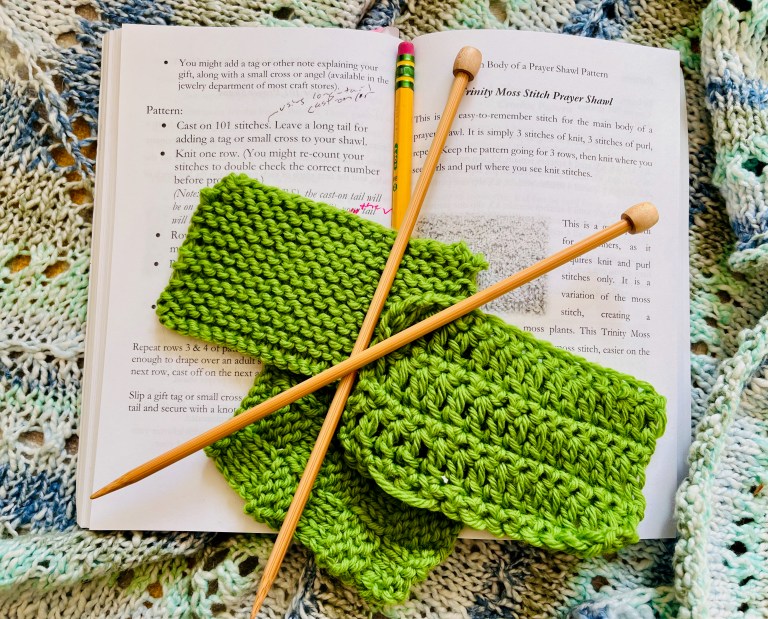
For an easy 1-2-3 pattern like the one described in this blog post, try the “Trinity Moss Stitch” pattern in my new book!

Crunch Time for Holiday Crafting – What To Do?

Finish, Don’t Finish, or….Another Option?

You’re knitting or crocheting a special gift for a special person in your life…and it’s a mere days (or hours) before Christmas, and you’re not even close to finishing. What to do? Friends, do not fret! You have options.

Option 1– Suck it Up and Finish the Thing. This is by far the most unpleasant option for holiday knitters, but it may be what you need to do. Just how close are you to finishing? If you can conceivably finish this sweater, hat, or pair of socks, you may feel a sense of accomplishment by simply staying up late, putting needles to work, and finish the thing. Compensate by promising yourself your next project will be slow, relaxing, and enjoyable.

Option 2 – Don’t Finish; They’ll Understand. This option relies on the fact that the special recipient of your special gift understands that you’re making this handcrafted gift out of love AND that it takes time. You’re not just going to the store and throwing the first thing you see into the shopping cart. You’re putting TIME – your precious and irreplaceable time – into this gift. Your person will value that more than anything. As a practical matter, you can wrap up your unfinished gift, a sketch or copy of the pattern, or simply a piece of yarn and a nice note explaining that the gift is still a work in progress. It’s okay. Really.

Option 3 – It’s Christmastide!!! You have 12 more days to finish!!! Remember that song, “The Twelve Days of Christmas”?  Friend, it’s a thing. The ancient Christian season of Christmastide lasts for twelve days, ending January 5. Most churches consider the celebration of Epiphany, January 6, as the official end to the Christmas season. And who doesn’t enjoy an unexpected Epiphany gift! If the Three Wise Men can present their gifts on January 6, so can you!!! (They in fact, it’s thought, didn’t actually show up until Jesus was a toddler, so that’s gives you…years!…to finish that gift, if you go this route.)

Whatever you decide, be kind to yourself this Christmas Knitting Season, my friends. We knit to relax, we knit to show our love to others, we often knit to keep ourselves sane. It’s all okay. Your loved ones will surely enjoy and be touched to the core that you have made something just for them. And showing your love from your heart is what Christmas is all about.

Christmastide Blessings, Cindy

Cynthia Coe is the author of The Prayer Shawl Chronicles, interrelated short stories woven around those who make and receive handmade, prayerfully crafted gifts of prayer shawls. Click this link to order or for more information. 

Cynthia Coe is the author of The Prayer Shawl Chronicles, a collection of interrelated short stories about knitters and those they meet through knitting and sharing prayer shawls. 

Be sure to check out my newly published A Prayer Shawl Handbook: Inspiration and Resources for Your Prayer Shawl Ministry, now available in paperback and e-book editions and included in Kindle Unlimited.
Write Your Own Knitting Patterns? Yes, You Can!

Inside: My story of how I wrote my first knitting patterns

You’ve made lovely hand-knitted sweaters and scarves. You have a go-to blanket pattern etched in your head. You constantly hear, “what pattern is that?” and you sheepishly say, “uh…I just made it up.” Then you hear, “no kidding? You should publish that!”

Yes, you should. And with a plethora of self-publishing and crafty platforms available to everyone, you absolutely can publish anything you want, including your own knitting patterns.

But how to get started?

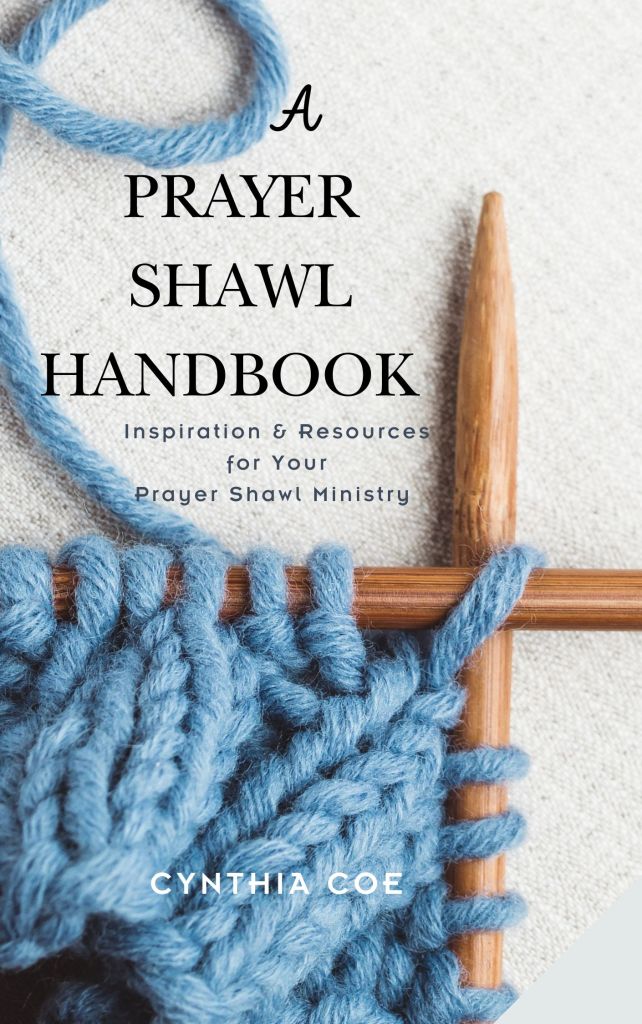
Reader, I faced this problem just a couple of months ago. In writing my upcoming new book, “A Prayer Shawl Handbook,” I knew I had to provide some basic prayer shawl patterns for my readers to truly call this book a comprehensive handbook for this crafting ministry. 

A Sneak Preview of Cindy’s Upcoming New Book, “A Prayer Shawl Handbook”

I have several “go-to” prayer shawl patterns in my head – patterns I don’t even think about and can simply cast-on and knit. But write these down???? Gasp. I’m not a technical writer by any stretch of the imagination. Fiction writing and knitting pattern writing are not, in my poor little mind, in the same skill set. 

How to get started? Try. Sit yourself down, pull out a pencil and a blank sheet of paper, and take your first stab at it. 

What about formatting your pattern?

Fortunately, a new book called “The Knitting Pattern Handbook: How to Write Great Patterns That Knitters Will Love to Make” by Kristina McGrath and Sarah Walworth has just been published, and I was fortunate enough to be given an advance copy for review by the publisher.  What timing! I gulped down this little book and decided, yes, I could do this.

I cast on my favorite memorized patterns and took notes as I went along. I ripped out, re-figured, crumbled up and tossed some early drafts in the trash can. But I persevered until I got some basic prayer shawl patterns knocked out, along with three prayer patch patterns. 

Yes, there are formats you need to use and abbreviations you need to adhere to. You probably recognized them from your own knitting projects you’ve made from other people’s patterns. You just need to focus on these things and make sure you’re consistent.

My tip: don’t skip steps or assume the reader of the pattern knows everything there is to know about knitting. Especially if your patterns are geared towards beginners (which mine are), something you think is obvious may not be. 

Get friends to help proof and test your draft patterns

This is where it gets really terrifying, in my experience. You hand off your draft pattern to a trusted fellow knitter and see if they come up with what you came up with. They may say, “this makes no sense whatsoever.” They may say, “I just don’t understand what you mean by a yarn-over. What is that?” You go back to the drawing board and explain the details you thought you included but didn’t. 

The authors of the new Knitting Pattern Handbook suggest that you hire technical editors and pay them for proofing and revising your patterns. Did I do this? No. I’m just starting out, and I can’t justify shelling out a lot of money for some basic patterns. Friends who knit told me what I needed to know. If I get the notion to start designing intricate sweaters in five different sizes, I’ll certainly re-think and probably get professional help. But as a newbie knitting designer, that’s not where I am.

Everybody starts with the basics

Where I am as a knitting designer is at the beginning. I have some basic patterns that are great for beginners and for simple “meditative” knitting. These are patterns I’d like to share with my readers, so I will. 

If you, too, have some basic knitting patterns you’d like to at least share with friends, go for it! If you’d like to get into the knitting design business and make a few bucks (or a lot!), go for that, too! Every knitting designer starts somewhere, likely with a nice, basic design. And you can, too!

Blessings on your knitting designs, no matter how intricate or basic! Cindy

Cynthia Coe is the author of The Prayer Shawl Chronicles, interrelated short stories woven around those who make and receive handmade, prayerfully crafted gifts of prayer shawls. Click this link to order or for more information. 

Follow me and subscribe for news of my upcoming new books!

As an Amazon Associate and Author, I provide links to products (including books I have written) and earn a very small fee if you click on the links and buy something. There is no additional charge to you!

What To Do with Leftover Luxury Yarn?

I don’t play yarn chicken. Life is too short for that kind of teeth grinding, blood pressure elevating stress in my life. If I’m knitting a nice sweater out of all-wool, cashmere, alpaca, or some other luxury yarn, I make sure I have enough yarn to make the best sweater I can make. 

That leaves a happier problem than running out of yarn (i.e., losing at yarn chicken – frantically trying to finish your project before you run out of yarn). You’re left with a skein or two of really nice yarn you don’t want to just toss in your stash.

What do you make out of just a small amount of luxury yarn? I usually make a simple scarf to go with my newly handknit sweater. A scarf makes a nice accessory for any outfit, and it gives a matching sweater that “wow” factor. Store-bought sweaters almost certainly do not come with matching scarves – only we hand knitters get these lux perks. If this scarf turns out a little short, no problem. Just stitch the ends together, and voila, you have a matching cowl instead. 

Here’s some other items I sometimes make with leftover luxury yarn:

  • Table runners
  • Coasters
  • Placemats or fabrics to place under plants or office items (pencil box, stapler, phone, etc.)
  • Bathmats 
  • For a larger amount of yarn, a shawl or throw blanket

I don’t overthink the design of these handknit extras. In fact, here’s my Go-To Pattern for scarves and any other rectangle-shaped small fabric:

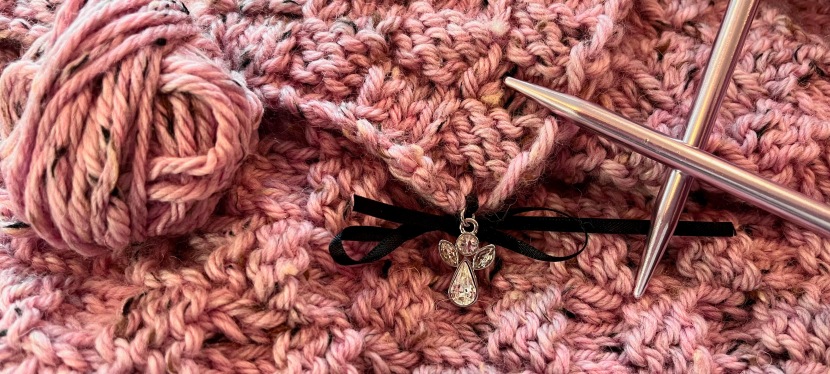
The Five by Five – a Simple Checkerboard pattern, pictured in this blog post.

  • Cast on 20 stitches (for larger items, cast on additional sets of 8 stitches)
  • Row 1: (K4, P4) x 2, K4
  • Row 2: (P4, K4) x 2, P4 
  • Rows 3 & 4: Repeat rows 1 & 2.
  • Row 5: (P4, K4) x 2, P4
  • Row 6: (K4, P4) x 2, K4
  • Rows 7 & 8: Repeat rows 5 & 6. 
  • Continue these 8 rows until you run out of yarn, cast off. 

For more simple patterns, follow me for news of my upcoming book, A Prayer Shawl Handbook, to be published in early December! 

What do YOU do with leftover yarn? Feel free to join the discussion by commenting on this blog or on my Facebook page! Share your great ideas!

Blessings, Cindy

Cynthia Coe is the author of The Prayer Shawl Chronicles, interrelated stories about knitters and those for whom they knit and love. The sequel to this book, The Knitting Guild of All Saints, has been released! Available in paperback and on Kindle, included in Kindle Unlimited. 
Copyright Cynthia Coe 2023. All Rights Reserved.

Confessions of a Hand Knitter: I Still Wear Store-Bought Sweaters

“Did you make that?” Someone asked me recently, admiring a new cardigan with intricate cable work, made of tiny laceweight yarn. “Uh, no,” I replied sheepishly. My admirer gasped. “YOU bought a sweater at a STORE?!”

Yes. I, an avid knitter and maker of pullover and cardigan sweaters, still buy sweaters at stores. 

It all goes down to eyesight. I’ve worn glasses since I was seven years old, moving from nearsightedness as a nerdy child with her head in a book, to a middle-aged woman needing “progressives” to see up close. Knitting with the fine weight yarns I prefer to wear has never been a good fit for me. 

Then there’s the time factor. In my experience, knitting a large garment using fingerling or lace weight yarn takes FOREVER. Between the frustration of squinting to see stitches and the difficulty of correcting mistakes while using threadlike yarn, I’m usually done with dealing with such yarns as the project extends beyond several weeks. 

But I do admire fine weight knitted fabrics, intricate patterns, and complicated cable work. I admire buttons sewn on just-so with an abundance of sturdy thread, ribbon backings on the button bands and perfect pockets. Could I make these garments with such advanced techniques myself? Maybe not. There’s a reason people started manufacturing sweaters, right?

Just last week, I bought a cardigan sweater at a well-known retailer while traveling to New Haven, Connecticut for my son’s wedding. I spied a cream-colored cardigan with abundant bobbles along the sides of the button bands, crisp ribbon facings, elegant gold buttons, and cables that would make me pull my hair out if I attempted to knit them myself. It fit perfectly and felt oh-so-luscious on my arms. So heck yeah, I bought it! 

As a knitter, I confess I am primarily a meditative knitter. I knit to zone out, to find a place and space of calm and peacefulness. I knit to keep my fingers from fidgeting when I want to think or pray or just take a break from the busy-ness of real life.

And I also confess to buying great knit pieces at the store…especially when they’re on sale and look terrific on me!

Peace, Cindy

Cynthia Coe is the author of The Prayer Shawl Chronicles, interrelated stories about knitters and those for whom they knit and love. The sequel to this book, The Knitting Guild of All Saints, has been released! Available in paperback and on Kindle, included in Kindle Unlimited. 

New Knitting & Crochet Books Coming Fall 2023

Hello Crafty Readers! I’m blogging for the first time in a while. I just finished the first draft of a new novel in The Prayer Shawl Chronicles series, so my head and heart have been preoccupied with that these past several months.

My new novel will probably come out some time in 2024, but in the meantime, there’s plenty of new knitting and crochet books to keep all of us occupied. 

I review books for NetGalley, and publishers kindly give me pre-publication peeks of their new books. Here’s what’s on tap for us crafty types (all available for pre-order; click the links for more info):

The Knitting Pattern Writing Handbook by Kristina McGrath and Sarah Walworth (Storey Publishing). Highly recommended if you write your own knitting patterns or plan to in the future. This little book tells you all you need to know to put your own patterns out into the world. Concise, plain language. Invaluable if you sell patterns online; helpful if you just want to share patterns with friends or understand what all those abbreviations mean. 

A Year of Knitting Stitches by Tabetha Hedrick (Globe Pequot, Stackpole Books). This is an excellent collection of knitting stitch patterns. I’ve used a couple in the past and always found several stitches that became “keepers.” This will definitely sit on my desk next year; the perfect gift for a knitter.

A Year of Crochet Stitches by Jill Wright (Globe Pequot, Stackpole Books). This is an equally excellent collection of crochet stitches for those of us who enjoy making up our own patterns or just want something different and all our own. In this collection, stitches are nicely organized by type of stitch (e.g. all kinds of bobble stitches). Perfect for the intermediate and advanced crocheter and an excellent gift idea.

Oversize Fashion Crochet by Salena Baca (Globe Pequot, Stackpole Books). This is a collection of only 6 patterns of oversized sweaters, a poncho, and other bulky garments. While this is a limited group of patterns, I found them all do-able and attractive for the average crafter. The schematics and drawings of how to assemble the garments were particularly good. 

More blogging to come, now that my next novel is on the back burner for a bit!

Happy Crafting, Cindy

Cynthia Coe is the author of The Prayer Shawl Chronicles, interrelated short stories woven around those who make and receive handmade, prayerfully crafted gifts of prayer shawls. Click this link to order or for more information. 

A Year in Knitting – Back to a New and Exciting “Normal”

Greetings, Knitters and Knit-Fiction Followers! Today, I’m taking a look back at my own year in knitting, and I imagine you might, too. Maybe you’re just starting out or even just thinking about taking up knitting, and this might be a year of new beginnings. Maybe you’ve knit for years and years, and knitting has been the constant that has kept you sane during these turbulent times.

For me, this has been year of “Getting Back to Something Called Normal.” As some of you may or may not know, 2020 and 2021 were years of immense change for me. My beloved husband, Tom, was diagnosed with bile duct cancer in May of 2020 and passed away in December of 2020. Throughout 2021, I sold my farm, moved and downscaled into a house in the suburbs, and bought a rental condo in Florida. My knitting (and writing) reflected all that change. I knitted just to have a few moments of Calm and get through the day. I scribbled a few lines in my journal and got back to packing, moving, and settling in.

This year, I’m fully settled into a new life. My new house is exactly the way I want it. My Florida Airbnb home is re-decorated and exactly how I want it, too. I’m writing again on a daily basis and recently published a new novel, “The Knitting Guild of All Saints.” I started a Prayer Shawl Ministry at my church and now share my love of knitting with all kinds of new people in my life. It’s a marvelous place to be – and a hard-won place to be as well. I’m glad to finally say, “this is my new normal.” 

Looking ahead to 2023, I’ve got big plans. My stash of lovely yarns is bigger than ever, in a not-so-great way. Before the pandemic, I ordered kits from Kitterly, Bluprint, and Knitcrate. I learned lots with every kit and truly advanced my knitting skills by leaps and bounds. As of this month, all of those companies are out of business. Through their clearance sales, and I bought huge amounts of high-quality yarns and even complete kits for pennies on the dollar. That makes me sad. But I treasure the skills I learned and the introduction to “luxury” yarns I’d never even know about otherwise. Now, it’s time to take another big leap and design new sweaters, prayer shawls, and who-knows-what other garments and projects all by myself. 

The new year looks a little scary, but exciting and full of possibilities. I’ve started a new novel in “The Prayer Shawl Chronicles,” and I hope to finish and publish it by this time next year. I’m also researching the history of knitting and trying my hand at designing knitwear for the first time. It will be exciting to see where my knitting journey takes me next, and I’m grateful for such a productive year in knitting and writing!

With hopes and dreams of wonderful knitting journeys for us all! Cindy

Cynthia Coe is the author of The Prayer Shawl Chronicles, interrelated stories about knitters and those for whom they knit and love. The sequel to this book, The Knitting Guild of All Saints, has been released! Available in paperback and on Kindle, included in Kindle Unlimited. 
The End of the Knitting World as We Know It?

Last fall, my knitting world was at its best. I attended a knitting convention with an abundance of yarn on offer. I had a terrific subscription service sending me luxurious yarns from Peru every month, and if I wanted anything at all knitting-related on short notice, I just jumped in my car and headed to a lovely local yarn store or took my pick from three big box craft stores near my home.

That was the best of times – knitwise – and now it’s looking like the worst of times. I can certainly place orders for yarn, but will I actually receive it? Who knows?  Some of the yarn I ordered during this quarantine took a month to arrive; other yarn has yet to arrive. One of the big box stores flat out cancelled my order. My go-to source for looking up unfamiliar techniques I needed for advanced projects, Bluprint, announced a shut-down in late May. Then, boom, yesterday the local yarn shop in my community announced its closing. 

Will we ever get back to the “normal” ways we purchased yarn and learn new knitting techniques? Even in the last two weeks, I’ve changed how I buy yarn and from whom. Most of my yarn purchases had moved to online purchases anyway, but I’m finding myself looking closely at which sellers actually have yarn in stock and which do not. I’m delighted to have found a yarn store in South Carolina that seems to have lots of yarn on hand and gets my yarn shipped to my door in two days. If it weren’t for all this change, I would never have ordered from them.

Despite this rapidly changing economy, the knitting world will eventually settle out. There WILL be changes, and some of those changes WILL be for the better. Though we’ll mourn the loss of our favorite local stores, we may well celebrate finding new purveyors of yarn we’d never heard of before. 

Knitting has been around for hundreds of years, if not longer. Whatever happens to our favorite knitting suppliers, we will still manage to get hold of some kind of fiber and make something beautiful with it. The world will go on, change and all, and we will keep on knitting through the good times and the bad. 

Blessings, Cindy

This is my first blog post in a couple of months. I’ve been homeschooling and caring for a family member with a serious illness. Thanks to everyone who has checked out my older posts and read my books!!! Much appreciated!!!

Cynthia Coe is the author of The Prayer Shawl Chronicles, a collection of interrelated short stories about knitters and those they meet through knitting and sharing prayer shawls.