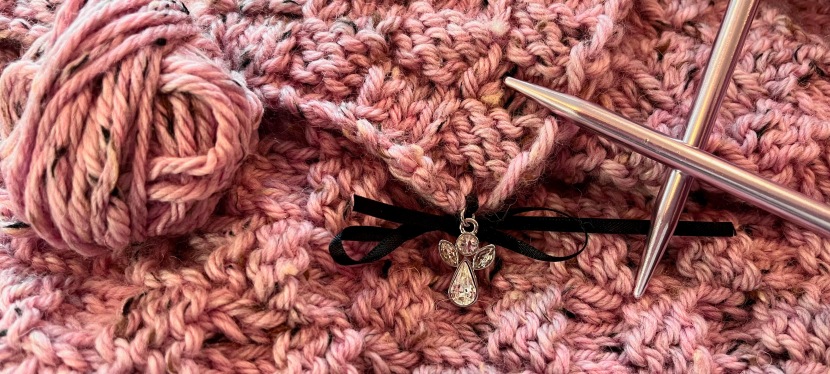
The Rhythms of Knitting – Patterns Are Not Just For Show

Recently, I found myself happily knitting in a 1-2-3, 1-2-3 pattern. I had been a bit down in the dumps, but knitting in this simple pattern actually made me feel better.

In the world of knitting, there’s more to those numbers in your patterns than meets the eye. Beyond the stitch counts and repeats lies a fascinating realm of numerical rhythms that not only enhance the aesthetics of your creations but also contribute to a sense of calm and mindfulness.

Knitting has long been celebrated for its therapeutic qualities, and the incorporation of numerical patterns adds another layer to this experience. Engaging in rhythmic and repetitive activities, like following numerical patterns in knitting, induces a relaxation response. This effect is akin to the calm achieved through meditation. The focus required to execute a pattern, combined with the tactile experience of working with yarn, creates a meditative state that eases stress and fosters mindfulness.

The beauty of the rhythms we experience in knitting lies not just in its visual appeal but in the comfort it brings to the knitter. The predictability and order of this sequence provide a structured flow, allowing the mind to enter a state of relaxation. As you navigate through your project, the rhythmic counting becomes a soothing mantra, transforming the act of knitting into a mindful practice.

Whether you’re a seasoned knitter or just starting, exploring the world of numerical rhythms can add a new dimension to your crafting experience. So, the next time you find yourself immersed in the rhythm of your pattern – whether a simple 1-2-3, 1-2-3 or something far more complex – know that you’re not just creating a beautiful piece – you’re also weaving a tapestry of calmness and mindfulness.

Blessings on your knitting, Cindy

Cynthia Coe is the author of The Prayer Shawl Chronicles, a collection of interrelated short stories about knitters and those they meet through knitting and sharing prayer shawls. 

Be sure to check out my newly published A Prayer Shawl Handbook: Inspiration and Resources for Your Prayer Shawl Ministry, now available in paperback and e-book editions and included in Kindle Unlimited.

For an easy 1-2-3 pattern like the one described in this blog post, try the “Trinity Moss Stitch” pattern in my new book!

What To Do with Leftover Luxury Yarn?

I don’t play yarn chicken. Life is too short for that kind of teeth grinding, blood pressure elevating stress in my life. If I’m knitting a nice sweater out of all-wool, cashmere, alpaca, or some other luxury yarn, I make sure I have enough yarn to make the best sweater I can make. 

That leaves a happier problem than running out of yarn (i.e., losing at yarn chicken – frantically trying to finish your project before you run out of yarn). You’re left with a skein or two of really nice yarn you don’t want to just toss in your stash.

What do you make out of just a small amount of luxury yarn? I usually make a simple scarf to go with my newly handknit sweater. A scarf makes a nice accessory for any outfit, and it gives a matching sweater that “wow” factor. Store-bought sweaters almost certainly do not come with matching scarves – only we hand knitters get these lux perks. If this scarf turns out a little short, no problem. Just stitch the ends together, and voila, you have a matching cowl instead. 

Here’s some other items I sometimes make with leftover luxury yarn:

  • Table runners
  • Coasters
  • Placemats or fabrics to place under plants or office items (pencil box, stapler, phone, etc.)
  • Bathmats 
  • For a larger amount of yarn, a shawl or throw blanket

I don’t overthink the design of these handknit extras. In fact, here’s my Go-To Pattern for scarves and any other rectangle-shaped small fabric:

The Five by Five – a Simple Checkerboard pattern, pictured in this blog post.

  • Cast on 20 stitches (for larger items, cast on additional sets of 8 stitches)
  • Row 1: (K4, P4) x 2, K4
  • Row 2: (P4, K4) x 2, P4 
  • Rows 3 & 4: Repeat rows 1 & 2.
  • Row 5: (P4, K4) x 2, P4
  • Row 6: (K4, P4) x 2, K4
  • Rows 7 & 8: Repeat rows 5 & 6. 
  • Continue these 8 rows until you run out of yarn, cast off. 

For more simple patterns, follow me for news of my upcoming book, A Prayer Shawl Handbook, to be published in early December! 

What do YOU do with leftover yarn? Feel free to join the discussion by commenting on this blog or on my Facebook page! Share your great ideas!

Blessings, Cindy

Cynthia Coe is the author of The Prayer Shawl Chronicles, interrelated stories about knitters and those for whom they knit and love. The sequel to this book, The Knitting Guild of All Saints, has been released! Available in paperback and on Kindle, included in Kindle Unlimited. 

Copyright Cynthia Coe 2023. All Rights Reserved.

Designing the Perfect Beach Cover-Up

Before I went to the beach this summer, I dreamed of the perfect beach cover-up. It would be all cotton and a light color for high temperatures on the coast of South Carolina in June. It would be mini-skirt length and have kicky vents on the sides to show off my legs and for freedom of movement when I went on one of my long and meditative walks on the beach. It would cover my shoulders and prevent sunburn. It would have a rounded but modest neckline. It would feel loose and free and fit me perfectly.

Alas, I looked and looked through umpteen pattern books and magazines but found nothing even close to what I wanted. So, I designed my own. I’ve been knitting since I was a teenager, usually easy patterns that allow me to watch TV or just sit and think while I knit. I don’t go for anything complicated or patterns that have me glued to an incomprehensible piece of paper or that gives me eye strain.

Much to my surprise, for my first beach cover-up design, I came up with an incredibly simple pattern that fits me perfectly, covers my shoulders, and is flowy and comfortable to wear. Here’s the pattern (such as it is – it’s in plain English, no abbreviations, challenging techniques, or anything a moderately experienced knitter couldn’t pull off):

The “Cindy” Beach Cover-Up

General Concept:Knit two large rectangles and a drawstring. Knit holes below the bustline to insert the drawstring.  Adjust measurements to fit yourself. (I’m 5’4” and wear US dress sizes 10-12.)

Materials:

Bernat Handicrafter Cotton Yarn(Two 12 ounce skeins, you’ll have lots left over)

-Size 9 circular needles

-stitch holder for neckline

Front: 

-Cast on 84 stitches (more or less if you’re bigger or smaller)

-Knit until you’ve got 21 inches (again, adjust if your waistline if longer or shorter)

-Put in holes in the next row. (I used a pattern of knit two + yarnovers to accomplish this)

-Knit until you’ve got a total of 30” (more or less, adjusting for your size)

-To make a simple rounded neckline, bind off about 20 stitches in the middle of the garment, decrease on each side of the neckline until you have about 22 stitches on each side

-Bind off each side

Back:

-Cast on 84 stitches (or same number you cast on for the front)

-Knit until you’ve got 21 inches (or same length to drawstring row as the front)

-Put in a row of holes for the drawstring (Knit Two + yarnovers)

-Knit until you’ve got a total of 31” (more or less depending on depth of back neckline)

-Cast off about 20 stitches, decrease each side until you’ve got 22 stitches on each side

-Bind off each side

Drawstring:

-Cast on 3 stitches, make an I-cord (look online for how to do this; use double pointed needles or circular needles – it’s easy)

-Make the drawstring as long as you want it (I’d make it 70” to 80”, depending on your waistline)

-Cast off

Construction:

-attach the front to the back by putting seams on each side between the drawstring row and about 8-10” from the bottom (leaving vents for ease of movement)

-if neckline is floppy, crochet one row around it to cinch it up a bit

-sting the drawstring through the holes and cinch for comfort

Extras: (These are what I did to personalize my own beach cover-up)

-for a cooler garment, make rows of holes (simple knit two + yarnover pattern) along the bottom few rows

-to add texture to the bottom of the garment, I used this pattern: Knit rows 1, 3, & 4; purl row 2

-to add texture to the top of the garment, I used this pattern: on reverse side, purl two, yarnover, purl 2 more, pull yarnover stitch over the last two purls (I added this pattern about every 4 rows)

For more info on basic stitches and construction of garments, I highly recommend the new Vogue Knitting book. It’s a huge book that covers it all.  If you had to buy one book on knitting, this would be the one. Available at: https://amzn.to/2sImZ7W

If you like to design your own projects, a good comprehensive stitch dictionary is invaluable. You might try Debbie Tomkies’ Knit Stitch Dictionary: 250 Essential Knit Stitches, available affordably in both paperback and Kindle editions at: https://amzn.to/2JzCJjS

Blessings, Cindy

Copyright 2018 Cynthia Coe. All rights reserved!