Your Crafting Supplier Goes Out of Business. What do you do?

Many of us have recently learned that a major crafting retailer is going out of business for good, nationwide. And many of us wonder, what to do? Here are tips.

Here we go again: another round of business closings, and this time it affects our beloved hobbies of knitting, sewing, crocheting, jewelry making, and many other crafts. Those of us using these hobbies to keep our sanity, calm down, express creativity, or just make something nice for ourselves or loved ones might wonder how we get the basic supplies for these crafts.

We’ve been here before. During the pandemic, ALL of the online retailers supplying my yarns for knitting eventually went out of business. And reader, I got some huge bargains on top quality yarns, which I’m still using and expect to use for many years to come. Here’s what I learned:

  • Don’t fret about where to buy your next yarn stashes just yet. Nature abhors a vacuum. Supply markets naturally fill gaps when they arise. If you don’t have a nice place to buy crafting materials in the near future, again, Patience! Work through your stash. If you have indeed bought plenty of yarns or other materials from the big going-out-of-business sales, you’ll have plenty to do. If you must, order online or visit a locally owned shop. At some point, if there’s demand, another business will snatch up the market for reasonably priced crafting materials!
  • Deep Clearance Sales WILL Happen. You’re about to scoop up some deals on crafting supplies, but you may need to be patient. Businesses handle these closure sales different ways. One retailer suddenly had huge sales BEFORE announcing a closure. If you see this, read the red flags and move! On the other hand, other businesses may keep trying to sell merchandise they think they can squeeze more money out of before they are finally forced to go to deep discounts. If you KNOW a business is closing and still has vast quantities of yarns or other craft supplies on hand, wait. Then, when those discounts finally happen, pounce!
  • Buy plenty of yarn or other supplies you absolutely know you will use. If you knit sweaters or blankets, there will be no way to get more skeins if you run out. Buy at least as much as you think you’ll need for a project, plus extra. (You can always make something small, like a cowl or coasters, with the spare materials after you finish your big project.)
  • On the other hand, DON’T buy yarn you know deep in your heart you’ll never use. Just because something is 90% off doesn’t mean it’s a great deal for you. Only buy yarns you would have bought or strongly considered buying if not on sale. If you see something at 75-90% off that you think you might want to try for a small project, go ahead if you have the spare cash. Otherwise, don’t buy something that will be sitting in a closet ten years from now.
  • Think about storage and future plans. During the pandemic, I bought huge amounts of all-wool yarns in my favorite colors and weights. I was also in the process of moving and downsizing. Given that I will (and already have) put these yarns to good use at some point, I ended up re-purposing a china cabinet for these yarns. I ditched a bunch of things that cabinet used to hold – items I never used. Before you buy huge amounts of yarn or other crafting supplies, think: where will I store it, what can I get rid of to free up storage, and do my future plans allow for this? (Pssst…you might get storage bins on sale, too, if you have room for them.)
  • If you’re buying wool yarns, think about preservation. Moths just love wool. They love to eat it, especially if hidden away in quiet, dark places. So if your yarn-buying spree involves wool or other such yarns, be prepared to seal up your purchases in large plastic bags. Save yourself future heartbreak.

In the meantime, happy retail therapy at bargain prices!!! Cindy

Cynthia Coe is the author of The Prayer Shawl Chronicles, a collection of interrelated short stories about knitters and those they meet through knitting and sharing prayer shawls. 

Be sure to check out my newly published A Prayer Shawl Handbook: Inspiration and Resources for Your Prayer Shawl Ministry, now available in paperback and e-book editions and included in Kindle Unlimited.

Cynthia Coe is a writer, book reviewer, and avid knitter. Her books and blog posts can be found on her Amazon Author Page

Ten Reasons to Teach Knitting or Crochet in Summer Kids’ Programs

Those of you planning summer youth camps are undoubtedly thinking about what activities you’ll offer in your programs this year. You’ll want something fun and engaging, something parents will talk about favorably and youth will remember fondly. 

Why not teach life skills that will equip them to find their own sense of peace and calm in their lives, as well as serve as an outlet for personal expression? Why not teach crafts that have helped people make useful items for centuries? Here’s ten reasons to teach tried and true crafts – like knitting or crochet – this summer:

Ten Reasons To Teach Traditional Crafts To Young People This Summer

  1. You’re teaching something young people can practice and enjoy for the rest of their lives.
  2. You’re teaching “real” life skills, not an “arts & crafts” project they’ll trash as soon as they get home.
  3. Crafts help young people calm down and get away from their phones.
  4. It’s perfectly acceptable for both boys and girls to engage in crafts we previously thought of as “women’s” or “men’s” crafts. Boys can knit, and girls can do woodworking.
  5. Finishing a challenging craft project gives you a huge sense of accomplishment and self-esteem.
  6. You can make your own clothes, hats, scarves, and blankets, furniture, kitchen items, or other useful things you’ll treasure always.
  7. If you all-natural materials, you’re introducing a sustainability lesson, too.
  8. You can engage members of your community as teachers and create bonds between generations.
  9. Local crafters might donate a lot of the materials you need. All of us crafters have “stashes” of leftover and spare materials and tools we’d like to share. 
  10. Your young people will remember “the summer I learned to knit/whittle/basketweave/crochet” as one of their best memories of summer camp. 

Tips for Teaching Young People How to Knit:

  • Start Small: Go with a small piece of knitting or crochet for kids’ “First Project.” It can be a coaster or a “prayer patch.”
  • Consider casting on in advance for your students. Let kids get the feel for actual knitting before overwhelming them with too many skills to learn too soon.
  • Patience counts! Everyone’s first piece of knitting or crochet will likely look wonky. That’s fine.
  • Have plenty of volunteers available to help kids one-on-one.
  • Consider making short videos of your lessons, so kids can refer back to them later on their phones.

Need a pattern? My new book A Prayer Shawl Handbook has plenty of patterns for simple patterns for prayer shawls and small, quick prayer patches.

A Prayer Shawl Handbook,
available in paperback and e-book editions

Cynthia Coe is the author of The Prayer Shawl Chronicles, a collection of interrelated short stories about knitters and those they meet through knitting and sharing prayer shawls. 

Be sure to check out my newly published A Prayer Shawl Handbook: Inspiration and Resources for Your Prayer Shawl Ministry, now available in paperback and e-book editions and included in Kindle Unlimited.

It’s All About Color: Crafting Color Symbolism in Every Stitch

Exploring Symbolic Colors in Prayer Shawl Design

When you embark on the journey of creating a prayer shawl – or any other crafting project – the choice of colors goes beyond aesthetics; it can carry profound symbolism. Across various traditions, colors have played a significant role in conveying concepts and stories. Whether you’re crafting for spiritual or personal reasons, understanding the symbolism of colors can add a meaningful layer to your prayer shawl design.

Here’s list of common colors and traditional symbolism associated with each:

  • Red: Passion, Love, and Energy
  • Red symbolizes passion, love, energy, courage, warning, power, celebration, and attention, with its meanings varying across cultures and contexts.
  • White: Celebration and Renewal
  • White, representing celebration and renewal, symbolizes purity, a fresh start, and the illuminating power of light.
  • Purple: Rich Emotions
  • Purple can evoke both warmth and calmness.
  • Blue: Calmness and Spirituality
  • Blue brings a sense of calmness. It suggests elements of water, peace, and the expansive sky.
  • Green: Growth and Abundance
  • The color of growth, green is used after Pentecost. It signifies nature, abundance, and tranquility.
  • Yellow and Gold: Warmth and Cheerfulness
  • Yellow suggests cheerfulness and sunshine, while gold brings a sense of coziness and warmth.
  • Pink: Joy and Playfulness
  • Pink represents joy, youthfulness, and cheerfulness.
  • Brown: Earthy Humility
  • Brown symbolizes humility, reminiscent of monk’s robes. It brings warmth through its connection to nature and soil.
  • Beige: Calming Desert Tones
  • A calming color reminiscent of sand, beige can symbolize time spent in the desert or on the beach.

In moments of uncertainty, neutral tones such as beige, cream, grey, taupe, and sand always make for a beautiful prayer shawl. Consider the soothing, cozy, and comfortable feelings these colors can evoke. After all, your hand-crafted work aims to embrace someone with a heartfelt hug.

Whether you find inspiration in religious symbolism or personal preferences, let your prayer shawl be a reflection of warmth, comfort, and love.

Happy knitting!

Cindy

Cynthia Coe is the author of The Prayer Shawl Chronicles, a collection of interrelated short stories about knitters and those they meet through knitting and sharing prayer shawls. 

Be sure to check out my newly published A Prayer Shawl Handbook: Inspiration and Resources for Your Prayer Shawl Ministry, now available in paperback and e-book editions and included in Kindle Unlimited.

Snow-Bound? Stranded? Time for Creative Yarn De-Stashing

I’ve found myself in Florida much longer than expected, and I’m a knitter stranded alone with a “mystery stash” of yarn. What to do???

It’s a great luxury to plan a project, decide exactly what yarn to use, and even mull over exactly what color you’ll use from a wide selection available. It’s nice to make a few swatches and decide which size knitting needles to use. 

But what if you can’t? 

I checked into a condo in Florida at the end of December, and I’m still here. With Tennessee closed for snow for the foreseeable future, I’ll be here for a while. Fortunately, I had ordered a “mystery stash” of clearance sale yarn shipped to me before I arrived, so I’m not exactly hurting for high quality yarn to knit with.

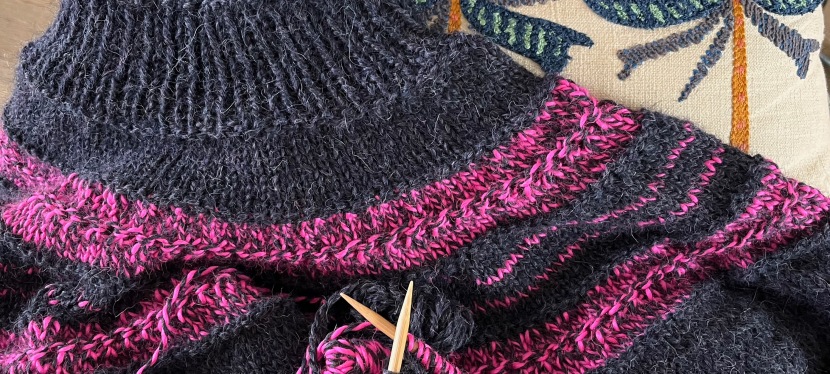
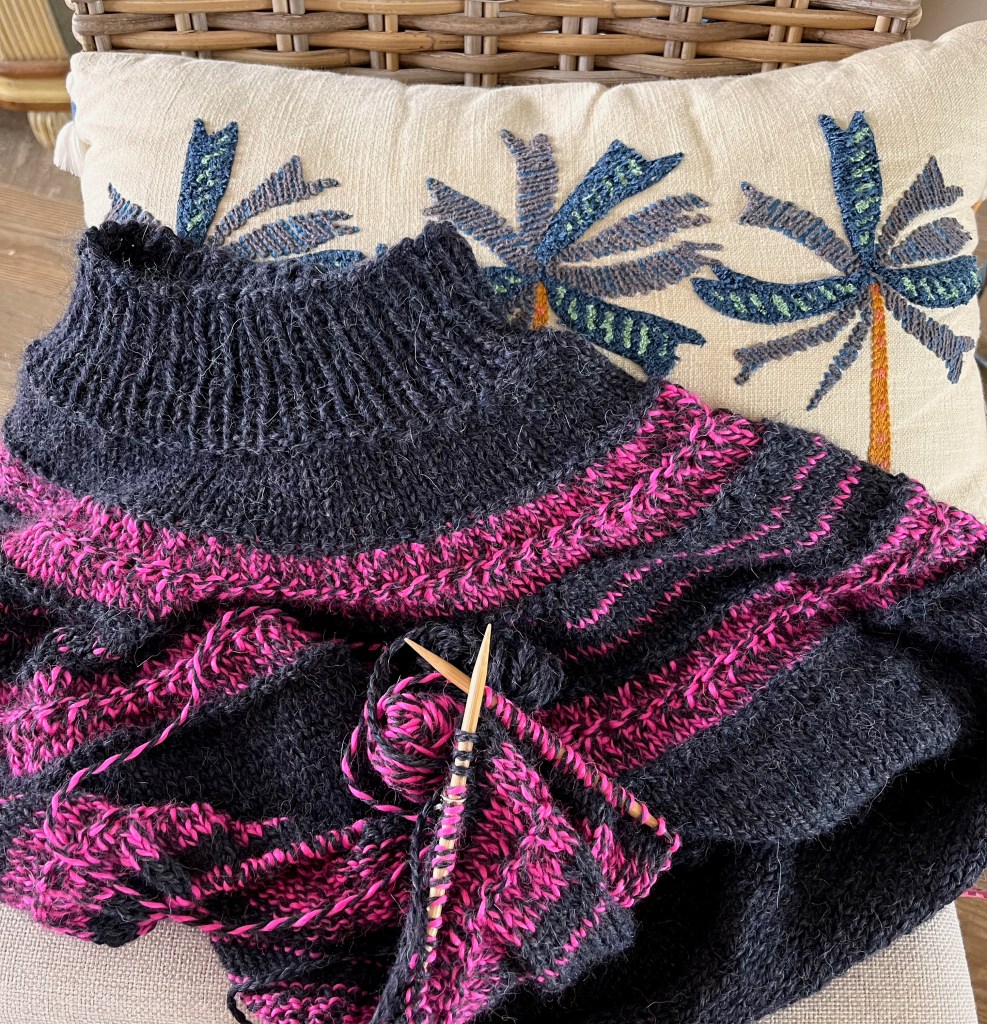
The problem is, I received 4 skeins of two different yarns from this mystery box – 4 skeins of a dark grey yarn, and 4 skeins of a bold pink and grey striped yarn. From past experience, I know it usually takes 5 skeins of these kinds of yarn to make a sweater (which I need; it’s 34 degrees here in paradise today). I puzzled over these yarns and made a swatch with the only needles I’ve got on hand. Mercifully, the needles will work with the yarn. But what to do with an underabundance of one or the other color of each yarn?

This is where necessity becomes creativity’s best friend. Like it or not, I’m looking at stripes. With the loud pink, I could end up with a sweater I wouldn’t be caught dead in. Or I could end up with a sweater I never would have planned but turns out better than expected. So I cast on and see how it goes.

I’ve ended up with a sweater with more texture and interest than I would have designed if I’d had my pick of materials. It’s mostly dark grey, in a heavy wool and alpaca, with pink and grey stripes that pop…but not too much.  Heck, it might be one of my favorite sweaters!

And all because I’m stranded and used what I had. Sometimes maybe we need to look at what’s in front of us and work out a solution we wouldn’t have even considered otherwise. Maybe that’s what makes the best crafting – letting necessity befriend and collaborate with the creativity that needs a little shove before it kicks into action. 

Blessings to those who are snowed in or stranded this winter day!

Cindy

Cynthia Coe is the author of The Prayer Shawl Chronicles, interrelated short stories woven around those who make and receive handmade, prayerfully crafted gifts of prayer shawls. Click this link to order or for more information. 

Cynthia Coe is the author of The Prayer Shawl Chronicles, a collection of interrelated short stories about knitters and those they meet through knitting and sharing prayer shawls. 

Be sure to check out my newly published A Prayer Shawl Handbook: Inspiration and Resources for Your Prayer Shawl Ministry, now available in paperback and e-book editions and included in Kindle Unlimited.

What To Do with Leftover Luxury Yarn?

I don’t play yarn chicken. Life is too short for that kind of teeth grinding, blood pressure elevating stress in my life. If I’m knitting a nice sweater out of all-wool, cashmere, alpaca, or some other luxury yarn, I make sure I have enough yarn to make the best sweater I can make. 

That leaves a happier problem than running out of yarn (i.e., losing at yarn chicken – frantically trying to finish your project before you run out of yarn). You’re left with a skein or two of really nice yarn you don’t want to just toss in your stash.

What do you make out of just a small amount of luxury yarn? I usually make a simple scarf to go with my newly handknit sweater. A scarf makes a nice accessory for any outfit, and it gives a matching sweater that “wow” factor. Store-bought sweaters almost certainly do not come with matching scarves – only we hand knitters get these lux perks. If this scarf turns out a little short, no problem. Just stitch the ends together, and voila, you have a matching cowl instead. 

Here’s some other items I sometimes make with leftover luxury yarn:

  • Table runners
  • Coasters
  • Placemats or fabrics to place under plants or office items (pencil box, stapler, phone, etc.)
  • Bathmats 
  • For a larger amount of yarn, a shawl or throw blanket

I don’t overthink the design of these handknit extras. In fact, here’s my Go-To Pattern for scarves and any other rectangle-shaped small fabric:

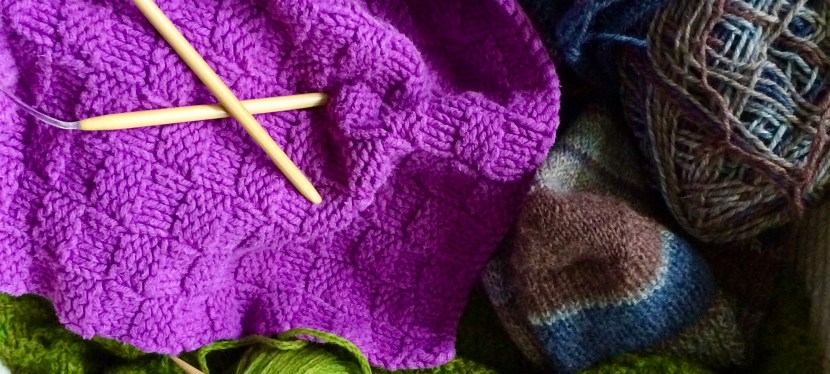
The Five by Five – a Simple Checkerboard pattern, pictured in this blog post.

  • Cast on 20 stitches (for larger items, cast on additional sets of 8 stitches)
  • Row 1: (K4, P4) x 2, K4
  • Row 2: (P4, K4) x 2, P4 
  • Rows 3 & 4: Repeat rows 1 & 2.
  • Row 5: (P4, K4) x 2, P4
  • Row 6: (K4, P4) x 2, K4
  • Rows 7 & 8: Repeat rows 5 & 6. 
  • Continue these 8 rows until you run out of yarn, cast off. 

For more simple patterns, follow me for news of my upcoming book, A Prayer Shawl Handbook, to be published in early December! 

What do YOU do with leftover yarn? Feel free to join the discussion by commenting on this blog or on my Facebook page! Share your great ideas!

Blessings, Cindy

Cynthia Coe is the author of The Prayer Shawl Chronicles, interrelated stories about knitters and those for whom they knit and love. The sequel to this book, The Knitting Guild of All Saints, has been released! Available in paperback and on Kindle, included in Kindle Unlimited. 

Copyright Cynthia Coe 2023. All Rights Reserved.

RIP Knit Club Kits – But I’m Still Enjoying You Lots

Back in a different time and place  – 2018 – I discovered Knitting kits. These high quality knitting kits opened a whole new world of knitting for me. I started using real wool and other “luxury” all-natural fibers for the first time, and my knitting skill increased by leaps and bounds. 

My late husband gifted me my first kit for Christmas at the end of 2018 (after a helpful nudge from me, of course). I blogged about this kit in 2019, “Knitting Kits – Worth the Money?” I learned a new and previously-unknown-to-me technique, mosaic knitting, along with several other more advanced techniques.

Reader, I fell in love. I went on to purchase several more kits from Kitterly and learned to make Raglan sweaters, additional mosaic colorwork techniques, and even German short rows (gasp!). Having achieved at least an “advanced intermediate” level of knitting, I proceeded on, discovering kits and videos on Bluprint and monthly subscription kits with Knitcrate. Oh my, did my knitting skills level up! 

Then 2020 happened. The bottom fell out of all these lovely knitting kit companies. Kitterly quietly went out of business – or at least they quit sending out ads and emails. Bluprint’s more publicized demise suddenly put me in the position of “buy them now or not at all,” and I quickly purchased a number of high quality kits at pennies on the dollar. My stash went from one basket to three baskets to a situation of wondering where I would even store all these kits I knew I wouldn’t get to for a long time.

Knitcrate hung in until just last month. I think most of its customers saw the handwriting on the wall, with an astonishing 80% clearance sale in late 2022 signaling that the end was nigh. Like with Bluprint, I recognized this was crunch time. I could get terrific deals on gorgeous alpaca, wool, and even silk-blend yarns. Then, it would all be gone.

So here I am, in early 2023, finally getting to one of those Bluprint kits I bought for next-to-nothing over two years ago. I’m still learning lots and increasing my skills, making an oversized Raglan sweater with complicated cables and a shawl collar. It’s sad, seeing references to “online resources” through my former Bluprint account. Those online resources just aren’t there anymore. I’m really, really glad I bought so many kits when I did and even more glad I have the print copies of the patterns in my hands. 

Meanwhile, I’ve got an entire cabinet of yarns I’ve purchased through Knitcrate over the last couple of years. While those yarn purchases seemed extravagant at the time, I rationalized that I was getting high quality products at terrific deals. Yes, I was. That fact is truer now than when I made the purchases in the first place.

RIP Kitterly, Bluprint, and especially Knitcrate, with its monthly surprise packages and friendly online community of crafters. I’m still enjoying your kits. I’m still enjoying your yarns. And with a mammoth stash of clearance sale kits stocked up, I will continue to enjoy and learn from you for several years to come. 

Cynthia Coe is the author of The Prayer Shawl Chronicles, interrelated stories about knitters and those for whom they knit and love. The sequel to this book, The Knitting Guild of All Saints, has been released! Available in paperback and on Kindle, included in Kindle Unlimited. 

Are you using a kit subscription or other knitting kit you love? Feel free to give them a shout-out in the comments. I have no dog in the hunt, and I’m happy to help out knit companies who need the business! 

A Year in Knitting – Back to a New and Exciting “Normal”

Greetings, Knitters and Knit-Fiction Followers! Today, I’m taking a look back at my own year in knitting, and I imagine you might, too. Maybe you’re just starting out or even just thinking about taking up knitting, and this might be a year of new beginnings. Maybe you’ve knit for years and years, and knitting has been the constant that has kept you sane during these turbulent times.

For me, this has been year of “Getting Back to Something Called Normal.” As some of you may or may not know, 2020 and 2021 were years of immense change for me. My beloved husband, Tom, was diagnosed with bile duct cancer in May of 2020 and passed away in December of 2020. Throughout 2021, I sold my farm, moved and downscaled into a house in the suburbs, and bought a rental condo in Florida. My knitting (and writing) reflected all that change. I knitted just to have a few moments of Calm and get through the day. I scribbled a few lines in my journal and got back to packing, moving, and settling in.

This year, I’m fully settled into a new life. My new house is exactly the way I want it. My Florida Airbnb home is re-decorated and exactly how I want it, too. I’m writing again on a daily basis and recently published a new novel, “The Knitting Guild of All Saints.” I started a Prayer Shawl Ministry at my church and now share my love of knitting with all kinds of new people in my life. It’s a marvelous place to be – and a hard-won place to be as well. I’m glad to finally say, “this is my new normal.” 

Looking ahead to 2023, I’ve got big plans. My stash of lovely yarns is bigger than ever, in a not-so-great way. Before the pandemic, I ordered kits from Kitterly, Bluprint, and Knitcrate. I learned lots with every kit and truly advanced my knitting skills by leaps and bounds. As of this month, all of those companies are out of business. Through their clearance sales, and I bought huge amounts of high-quality yarns and even complete kits for pennies on the dollar. That makes me sad. But I treasure the skills I learned and the introduction to “luxury” yarns I’d never even know about otherwise. Now, it’s time to take another big leap and design new sweaters, prayer shawls, and who-knows-what other garments and projects all by myself. 

The new year looks a little scary, but exciting and full of possibilities. I’ve started a new novel in “The Prayer Shawl Chronicles,” and I hope to finish and publish it by this time next year. I’m also researching the history of knitting and trying my hand at designing knitwear for the first time. It will be exciting to see where my knitting journey takes me next, and I’m grateful for such a productive year in knitting and writing!

With hopes and dreams of wonderful knitting journeys for us all! Cindy

Cynthia Coe is the author of The Prayer Shawl Chronicles, interrelated stories about knitters and those for whom they knit and love. The sequel to this book, The Knitting Guild of All Saints, has been released! Available in paperback and on Kindle, included in Kindle Unlimited. 

The Beautiful Simplicity of One Knitting Project At A Time

I’ve often had as many as four or five knitting projects going at a time. I’ve had my “main” knitting project (usually a sweater) and my “travel” knitting project (something simple and mindless – usually a dishcloth or place mat I can work on in the school pick-up line).  I might have another project or two that involve lots of counting or an intricate pattern that requires complete silence and absence of all distraction, something you can’t work on while maintaining any social skills at all. 

But lately, I’ve discovered the beautiful simplicity of only having one knitting project going at a time. Maybe it’s the revived pandemic scares. Maybe it’s the implosion of the schools (again). Maybe I’m just figuring out that focusing on one thing at a time is crucial to my emotional well-being during this stressful time.

Whatever the reason, I’ve quite enjoyed working on one knitting project, rather than have several knitting projects scattered all over the house and in my car. I seem to enjoy knitting more when I don’t feel like I’m struggling to get one project moving along, with six others in an unfinished state. And – duh! – I get projects finished much, much faster when I direct all my efforts towards one project. This gives me a sense of accomplishment, seeing a completed sweater, shawl, or cowl I can immediately wear and enjoy, and on a regular basis of every week or so.

We’ve all seen the memes online, ridiculing ourselves for having way too many knitting projects (or WIPs – works-in-progress). Maybe it’s time to listen to ourselves and realize that more is not always more. For every WIP that’s left languishing in a work basket, there are unfulfilled aspirations and a sense of giving up. You don’t need that, not when you have enough stress in other areas of your life.

Enjoy your knitting. Enjoy that one project you chose and for which you have high hopes. Feel good in a few short days or weeks about what a great job you did on that one sweater you worked on to the exclusion of all other crafting projects.

Appreciate the simplicity and quiet time of meditative crafting that knitting gives you.

Blessings, Cindy

Cynthia Coe is the author of The Prayer Shawl Chronicles, a collection of interrelated short stories about knitters and those they meet through knitting and sharing prayer shawls. 

Knitting in Florida

After a long, long hiatus from blogging, I’m back! After some major upheavals in my life*, I’m now a proud parttime resident of Florida – and still knitting. My knitting projects have given me an hour or so of quiet, peaceful, solace every day during this past awful year, and for that, I’m profoundly grateful.

As I packed my car for the trip down to Florida this past week, I – of course – made sure I had enough knitting projects for my time here. I had just gotten two project kits, bulky weight yarn for a cowl and a scarf. Those would be good, easy, do-able projects for my time in Florida – or so I thought.

But when I arrived, knitting scarves and cowls in bulky weight yarns was the last thing I wanted to do. The temperature was in the high 70s here in Florida, with the sun shining and the beach waiting for me to take a nice long walk in my bathing suit. I didn’t even want to touch heavy wool, much less hold it in my lap while I knitted. Those projects got stuffed back in my suitcase within minutes.

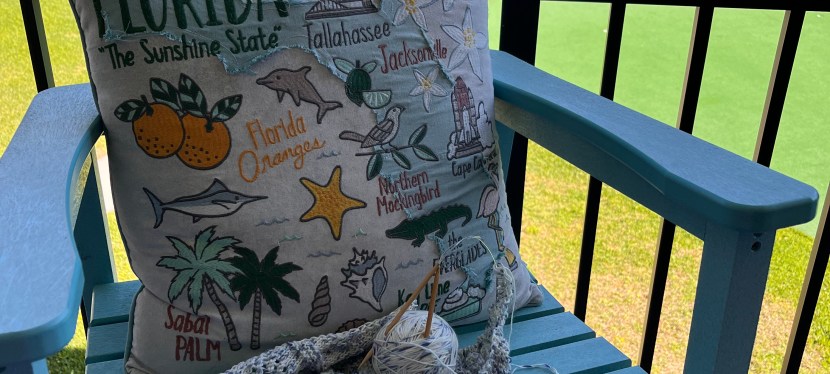
But I still wanted to knit – just something light and at least somewhat “beachy.” I settled on some lightweight, DK weight wool yarn in a cream color with blue speckles. I started a shawl project, but really, I’m “knitting-just-to-knit” with this project. I want something that weighs next to nothing, can be tucked into a beach bag, and requires little or no thinking on my part. 

So I’ve happily worked on this small, lightweight project for a week…until this morning. The temperature dropped like a brick. As I walked along the beach this afternoon, hugging myself against the cold wind, the cold water licking at my bare feet, I thought, “maybe that scarf project with bulky weight yarn might not be such a bad idea.”

Stay warm and keep knitting, Cindy

Cynthia Coe is the author of The Prayer Shawl Chronicles, a collection of interrelated short stories about knitters and those they meet through knitting and sharing prayer shawls. 

*My husband of 37 years was diagnosed with stage 4 cancer in May of 2020 and died in December of 2020. I sold the family farm, moved, and had huge responsibilities to deal with. And…I suffered writer’s block for the first time ever. Back in the saddle, I hope!

How Many Knitting Projects Do You Need? 3. You Need 3.

How many knitting WIPs (works-in-progress) do you currently have going? In looking at the online knitting forums, the answers vary widely. 

Most of us knit for several reasons. It calms us down in an overly busy, wired world. It gives us something to do while we’re waiting to see the doctor, waiting in the pick-up line for kids to come out of school, waiting for a meeting to start or the bus to come. Most of us start with something simple, but eventually, we need to bump up our skills and learn something new. Portable projects are great for on-the-go knitting, but many of us will want to knit a blanket, sweater, or other project that takes up to half a room. 

So for those flummoxed by why some of us have several projects going on at one time, here’s (generally) the three kinds of knitting projects most of us really need in our lives:

  1. A Meditative Knitting Project (also known as “Medknitation”): Mindless knitting just to knit and unwind requires something simple, something we don’t have to think about. Prayer shawls, simple blankets, scarves, or even a simple placemat can fill the bill. The idea here is to tune out, knit, and rest your mind. Repetitive patterns requiring little or no counting work best. Knitting while watching TV is included.
  2. A More Challenging Knitting Project: Meditative knitting can get monotonous, so we need something to challenge us once and awhile. Everybody needs to keep growing and expanding their skills.  Working on a new knitting technique or stitch keeps us mentally fit and interested in the craft. These projects might include learning to make socks, learning mosaic or brioche knitting, or making a sweater with challenging stitches or techniques new to you.
  3. A Portable Project Kept in Your Purse or Car: For a knitter, nothing is worse than finding yourself in a waiting room for more than ten minutes without a knitting project to work on. No, you don’t want to read the magazines on offer. You want your knitting needles!!!! So most of us keep a small project in our purse, tote bag, or even in the car for such modern inconveniences.  Personally, I keep a placemat project in my tote bag, using circular needles (harder to lose than straight needles) and cheap cotton yarn. If it gets stained, dirty, or lost, it’s no big deal. 

Many of us, of course have lots more projects than three on the needles. There’s that project you lost interest in, the one you ran out of yarn for, the one you somehow misplaced or forgot about. No judgements!  

And if you just have one project on your needles, consider another one. For those who do meditative knitting, try something challenging. As if you’re lost in a difficult project, slow down and knit something simple. But always have a project you can pick up and take wherever you go!

Knitting Blessings, Cindy

Cynthia Coe is the author of The Prayer Shawl Chronicles, a collection of interrelated short stories about knitters and those they meet through knitting and sharing prayer shawls.