Temperature Blankets – Marking the Days With a Knitting Ritual

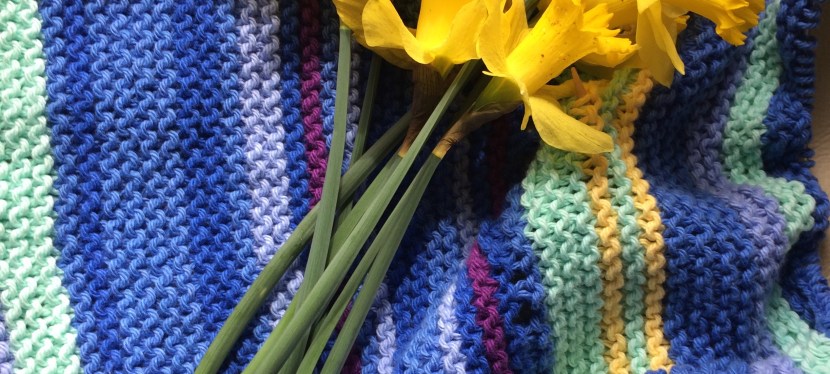
Intrigued by the idea of a “temperature blanket,” I began my first one on New Year’s Eve by casting on with a bright yellow to celebrate the gorgeous 70 degree day here in Tennessee. My temperature blanket soon became a mosaic of blues for our normal cool January, sprinkled with some pale greens for warmer 60 degree days and a few purple rows for crisper cold days. We have a saying here in the Smoky Mountains – “if you don’t like the weather here, stick around; it’ll change.” It’s the perfect climate for a temperature blanket.

Mostly to remember to work on my temperature blanket each day, I began a ritual of knitting my one garter ridge each night, right after dinner as my family watched a TV show together. I didn’t mean to start a new daily ritual, but that’s what it’s become. When I sit down in my favorite chair to work on my temperature blanket each evening, it’s as if I’m marking the end of a day, a time of peace and quiet. It’s a time to think, for better or for worse, I’ve done what I could do today. It’s time to relax and put all worries aside.
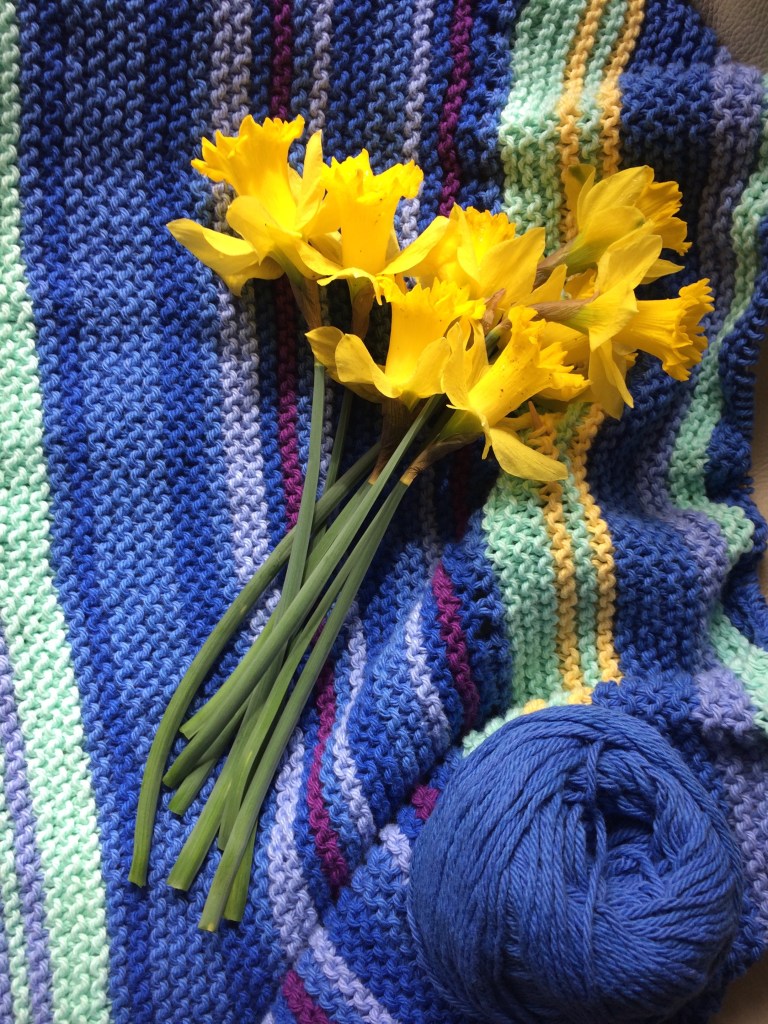
I’ve noticed I work my temperature blanket more slowly than my other works in progress. Perhaps that’s because, by definition, I only knit two rows a day, making a loop from one side to the other and back. The point of this knitting is to mark an occasion, not necessarily to “make” a finished garment. This knitting mimics the movement of the earth, making a loop each and every day. As I knit through the seasonal cycles of nature, my knitting reflects the cold days giving way to the warm, the short days turning into longer late spring days of bright yellow and orange sunshine. It shows the process in rich colors I can touch and feel. 

Marking these daily changes grounds me in nature and in the cycles of life. It’s a simple thing, knitting these two daily rows. But this daily ritual has become a little celebration of life ever moving forward, ever renewing. 

My Temperature Blanket Pattern:

-Cast on 100 stitches

-Knit 2 rows each day (one garter pattern), using a color to mark the temperature of the day

-At the beginning of each month, I knit one row of K2, YO. I knit the number of stitches for the number of the month (e.g. 4 stitches for the 4thmonth of April, 5 for the 5thday of May), then do the same number of K2, YO and repeat this pattern down the row. I knit the second row of this garter ridge as usual to keep the pattern on track for the rest of the month.

Blessings on your knitting rituals! Cindy

Cynthia Coe is a writer and avid knitter based in the Smoky Mountains of Tennessee. Visit her Author Page on Amazon by clicking this link.
What to Do with All Those Knitted Shawls?

Knitted Shawls are all the rage at the moment, and for good reason. They’re fun to knit – projects that are not too small, not too overwhelming, and you don’t have to stitch them together or make fit any particular size. You can knit fairly plain shawls or jazz them up with fancy lacework or colorwork, as you choose.

But after knitting one or two shawls (or two dozen), you begin to wonder, what do I do with all these shawls? You could always wear them, of course. But in warmer times of the year, you don’t exactly need a sprawling piece of wool knitwear draped across your shoulders. It’s already 80 degrees during the days here in Tennessee, so my shawl wearing is confined to early mornings and the odd cool evening. 

After going on a shawl-knitting kick last summer, I couldn’t stand to simply put away all my pretty shawls until January. After displaying a couple of brightly colored shawls across chairs, I decided to leave them there on a more or less permanent basis. Textiles make a home, I decided. It’s the soft textures, bright colors, and our own personal touches that make a home feel comfy, cheerful,  and totally our own. 

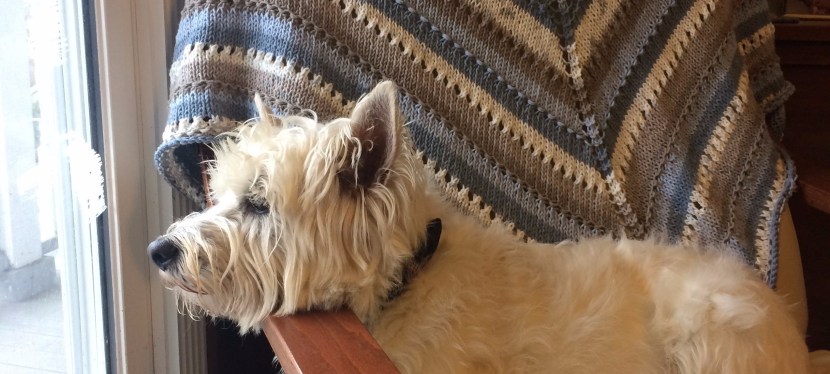
So in my home, you’re likely to see shawls adding a pop of color and an inviting place to sit on many of my chairs and sofas. Even the dog gets his own shawl for lounging and keeping an eye out for passing wildlife. Shawls as housewares get more use this way than actually wearing them!

What do you do with your knitted shawls?

Happy Shawl Knitting, Cindy

Cynthia Coe knits as some sort of meditative thing before sitting down to write (or do anything else, for that matter). Check out her Author Page on Amazon to buy one of her novels or spiritual resources. 

Get news of new publications by following this blog or any of her social accounts, all listed on the right sidebar of this page. 

Getting More Knit From The Kit – Using Leftover Yarn From Knitting Kits

Have you finished a knitting project and had yarn left over? This happens frequently to me. If it’s inexpensive yarn, I usually put it in a bin I keep for donations. Once a year, I give this bin to a school, camp, or summer program for crafting by children. But if it’s expensive yarn I really like, I want to make something else from it.

I recently began knitting from kits ordered online. I’ve done two kits by Kitterly (www.Kitterly.com), and I just started my first kit by KnitCrate (www.KnitCrate.com). When I first started knitting from kits, I feared I’d get to the end of a pricey project and not have enough yarn to finish. Happily, I can now report that both of the Kitterly kits I’ve done left me with plenty of leftover yarn. (The verdict’s still out on KnitCrate, but so far, so good. I’m impressed with all the extra patterns I get with their kits.)

What do you do with a good hank of expensive, high-quality yarn that’s too big to simply toss out? After working through a Kitterly shawl kit, I had enough to make both a narrow runner for use on a credenza and a large coaster. I also re-used the colorwork pattern on my “extra” items, since the pattern was still in my head. These small projects made nice transitions after spending a couple of weeks on the main shawl project. I also felt better getting three projects out of an expensive kit, instead of just one. (Honestly, I may end up using the runner and coaster more than the shawl!)

Knitting is a frugal craft. We make high quality items rather than buy cheap ones at the store. Knitters are the kind of people who look for good value for their money and don’t like to see nice materials go to waste. By getting “more knit for the kit,” knitters both use their awesome creativity to make something useful and get maximum value for their purchases. 

What do you do with leftover yarn?

Happy Crafting! Cindy

Cynthia Coe is a writer, book reviewer, and avid knitter. Her books and blog posts can be found on her Amazon Author Page.

Knitting & Cats Don’t Mix – Or Do They?

 Sitting down for a nice, calming session of knitting, and who turns up to “help”? The cat, of course. When my cats Scamper and Milo see me sit down in my favorite chair with a wooly skein of yarn beside me, to them, it’s an invitation to play. 

Knitting with cats is both the most wonderful thing in the world and the most annoying. A soft, furry creature with big yellow eyes plops down on your lap and purrs right as you take out your knitting needles. What a knitter to do? You want to knit, but you don’t want to run off the cutie pie sitting on your work-in-progress, either. Eventually, the cat gets exasperated by those sharp sticks waved in front of his face, and he moves along. Or you push him.

A ball of yarn is the ultimate temptation to cause mischief for a cat. My cats usually know not to mess with my knitting yarn, fearing an almighty tongue-lashing that comes with batting around a yarn ball attached to a sweater under construction. But sometimes, a cat just needs to play with what is obviously a toy provided for a cat’s pleasure. Occasionally, I let the cat play…until the ball of yarn is roped around six pieces of furniture and knotted into a mess requiring a half hour of untangling. Then it’s time to “re-think” my policy of cats and yarn.

The problem with cats and knitting is that many of us seriously love them both. Both are warm, fuzzy, and lovely to look at. Both knitting and cats require attention from our hearts and our hands. Cat People are often Knitting People. And in those moments when the two clash and chaos breaks out, I hope we’ll remember that really, what’s a little frayed yarn and knots when you have the pleasure of seeing a cute little kitten batting about a “just right” ball of yarn?

Blessings on your cats (and yarn), Cindy

New Resources of the Week:

Knitted Animal Friends: Knit 12 Well-Dressed Animals, Their Clothes and Accessories by Louise Crowther. This charming new book tells you how to knit and construct adorable animal toys. There’s a cat pattern, of course, along with other critters including a dog, mouse, hedgehog, and clothes for all of them. Perfect for making gifts for children or for trying something new and fun. Coming on May 7, available for pre-order at a good discount

Jill’s Beaded Knits Bitshas some new Abacus Counting Bracelets, along with some cute new stitch markers. She handmakes her products and ships them out pronto. I recently treated myself to some new stitch markers, but I’ve not tried the abacus counting bracelets yet. I’d love to hear from anyone who has.

P.S. This blog is completely independent! I recommend books and other items I’ve read/used and like. Books are usually provided to me free through NetGalley and their publishers. 

Putting Away the Winter Stash

Springtime has come to Sycamore Cove in a sudden burst of green leaves, yellow buttercups, violets and azalea blossoms. Winter is good and gone. It’s time to put up the winter knitting supplies.

My jewel-toned yarns of burgundy, teal, dark blue, and greys go to the zipped-up bin in the upstairs closet where I won’t use them until autumn. My “works-in-progress” baskets scattered around the house now hold yarns in pastel pinks, spring greens, and cheerful yellows.

Putting up the winter stash elicits mixed emotions. Thinking of the Christmas gifts, winter hats, and warm sweaters I made last season gives me a satisfied sense of accomplishment. But then there’s the projects I planned to make and didn’t, the yarns I had pegged for sweaters or hats or lap blankets that just plain didn’t get made. I wonder if I’ll get to them next year. I wonder where I’ll be in my life, whether that yarn will “speak” to me like it did last year, or whether I’ll come up with some new and unexpected use for those unused skeins.

Life is sometimes like that unused winter stash – projects you planned don’t pan out, you don’t have time for them, or you lost interest in them. Maybe you’ll get back to them, maybe you won’t. Maybe you’ll surprise yourself with a great new idea next year that just hadn’t occurred to you this year. You feel good about what you did accomplish and give yourself a pat on the back for completed and successful items that gave joy to others or served some useful purpose.

But for now, it’s a new season. New yarns mean new projects, new opportunities, new possibilities. It’s springtime – a time for new beginnings in life and in knitting.

Cynthia Coe is a writer, book reviewer, and avid knitter. Her books and blog posts can be found on her Amazon Author Page

Knitting Kits – Worth The Money?

My knitting skills hit a plateau recently, and I decided to try one of the new knitting kits now available through the miracles of online shopping. I’ll admit, I was wary. Would I really get everything I needed for a finished piece of knitting in one shipment? Scarred by childhood memories of cheap craft kits that didn’t have enough paint or whatever to actually finish a project – leaving me with an unfinished and totally wasted craft – I nevertheless jumped into the new world of knitting kits.

My husband actually pushed me into my first knitting kit with a pricey shawl kit for Christmas. At around $80, it impressed me as a rather lavish gift for two skeins of yarn and a pattern I had to print out myself. But the yarn turned out to be quite nice – 100% wool, generously large skeins, and no kinks or knots that you usually get with yarn from the big box stores. And lo and behold, the kit included more than enough to finish my project. I even had enough of the contrast color to use in another project.

More importantly, I upped my knitting skills significantly. I learned a new way to make shawls, a new way to use colorwork in my knitting, and mastered the picot bind-off (which I wouldn’t have dared tackle of my own accord). I impressed myself with how well and how much I learned in the course of one project.

So was it worth the eighty bucks? Maybe so. Instead of aimless shopping for a massive bag of yarn at the big box store, I got just enough for the project, with no random skeins left over and wasted. In the long run, I could see spending less on kits overall than on the impulse purchases of yarn that sit in a closet for years. But what sold me on the kit was that I actually learned a lot and became a better knitter. That’s worth a lot. I just started my second kit, and I’m growing more confident with new skills already.

For me, the knitting kits are a lot like the meal kits – Blue Apron, Plated, etc. You get just what you need, and you don’t have a lot of leftovers to deal with. Best yet, at the end of the process, you’ll look like a star.  

Cynthia Coeis a writer, book reviewer, and avid knitter. Her books and blog posts can be found on her Amazon Author Page.

The Perils of Knitting the Stash

Some say buying yarn is as much of a hobby as actually knitting yarn. I’m guilty of that myself.

You go to the yarn store and see those lovely skeins calling your name. You only have a vague idea of what you will realistically do with that lovely yarn. You buy it on faith…or maybe hope…or maybe just sheer avarice. You take it home and maybe leave it in your “to do” basket of planned or unplanned knitting projects.

But there those lovely skeins of yarn sit for weeks. Or months. Or even years. 

My longest running member of my yarn stash is a bag of undyed cotton yarn I bought on vacation in Monserrat years ago. Who has yarn purchased on a Caribbean island?! I had to have it. I had misty plans of making a summer sweater from that yarn. After the island was nearly obliterated by a volcano, I kept that yarn around just to remember a wonderful place I had once visited. I now have a more solid plan to knit a shawl with it.  We’ll see.

The perils of keeping a stash is that you, ultimately and inevitably, have more yarn that you’ll probably use. If you completely knit through your stash on a regular basis, you’re a better person than I. But most of us over-buy yarn with nothing more than hopes and dreams. If we do use skeins from the stash, we often have too much yarn and skeins left over, too little to use for something else. Or worse, we haven’t bought enough for a project, finding that out long after the yarn is available. 

So what’s a knitter to do? Keep feeding the stash? Put yourself on a yarn diet? 

I’m challenging myself to donate unused yarn to schools or children’s summer programs. I’ve got a big bag for some lucky organization! But in the meantime, I’m eyeing that lovely new yarn I just spotted in the craft store….

Happy Knitting (and Stashing!), Cindy

Cynthia Coe is a writer, book reviewer, and avid knitter. Her books and blog posts can be found on her Amazon Author Page.

An Ode to Garter Stitch

The humble garter stitch: knit-stitch-only for row after row, with not a single purl or other embellishment to break the so-called monotony. It’s likely the first “pattern” we learn to knit, often left behind as we learn to yarn-over, knit-two-tog, and slip stitches for jazzier and more impressive knitting.

But lately, I’ve embraced the garter stitch as the ultimate in meditative, no-brainer knitting. Once you’ve mastered it (which can be done in an afternoon), you can mindlessly let your fingers work while you carry on a conversation, watch a TV drama, or just zone out. If you do make a mistake, rip it out and start over. It’s not like you’ve messed up some intricate lace work. You just get more knitting in.

Better yet, beginners and experts alike can make practically anything out of garter stitch – a simple bulky weekend sweater, a scarf, a placemat, a coaster. I once stayed at a beach house that didn’t have coasters for cold, icy drinks. Our family didn’t want to ruin the furniture, so I whipped out a set of coasters lickety split, leaving them in the house for the next vacationers. Garter stitch gets it done. 

Here’s my no brainer coaster pattern:

  • With cotton yarn and size 8 or 9 needles, cast on about 20 stitches (as you choose; I don’t micromanage these things).
  • Knit in garter stitch for about 20 rows (or about 4 inches), cast off
  • Add glass of cold iced tea. 

Happy Knitting! Cindy

Cynthia Coe is a blogger, avid knitter, and author of several books. Visit her Author Page on Amazon for more information and a complete list of her books.

Knitting in Public

Knitting in public cures a host of social awkwardness ills. If you’re waiting for a plane, waiting for a doctor’s appointment, or just find yourself in a place with nothing much to do, knitting fills the gap. 

This morning, I found myself in one of these places, waiting as my son got his hair cut. I hadn’t had my morning quiet time yet, so I pulled out my small on-the-go knitting project out of my tote bag and got a few rows in while I waited. But looking around me as I waited, I noticed something different.

Usually, when I knit in public, at least a couple of people will come up to me and strike up a conversation.  “What are you making?” they usually ask. “I’d love to learn to knit,” they occasionally say. Or maybe they wistfully remember a mom or grandmother who used to knit.

But this morning, no one said a word. They all focused solely on their phones. I felt like I was the only one in the waiting area truly getting “me time.”

Hoping you’re getting some knitting “me time” today! Cindy

Just published! 

Coffehouse Knits: Knitting Patterns and Essays with Robust Flavor, edited by Kerry Bogert. Classic sweaters, cowls, shawls, socks, and even a nice pair of cozy mittens. This book has a nice collection of patterns plus several essays on knitting and community. The authors evoke a warm coffeehouse oozing with friendship and wooly knitting projects. This would be a nice gift book for the knitters in your life. On sale in hardback for about $18; Kindle for about $15

Beginner’s Guide to Colorwork Knitting by Ella Austin. Everything you could possibly need to know about colorwork knitting. Numerous techniques and projects included. The website on Amazon has a nice preview of the book. Available in paperback and Kindle and on sale for about $18 paperback and $14 Kindle.

Top Down Knitted Sweaters – Where Have You Been All My Life?

For knitters, there’s no greater joy than wearing your favorite hand-knitted sweater, knowing that you made it yourself.  And if the sweater fits perfectly, looks terrific, and gets you lots of compliments, you feel a special kind of pride.

Up until the last year or so, I stayed away from making my own sweaters. I learned to knit sweaters the “flat” way, making four pieces (front, back, two arms) from the bottom up and stitching the pieces together at the end, putting in a neckline by picking up stitches and hoping I had enough yarn left to finish the project. My necklines never looked professional. My efforts looked amateur. 

Then came all those pretty “cake” or “sweet roll” yarns with the lovely colors and inviting rounds rolls begging me to knit something marvelous. I made the big switch to top-down knitting and circular needles. Much to my surprise, I came out with a sweater I wear at least once a week, proudly and confidently that it’s a great looking and fitting garment. (And the sweater’s “done” as soon as I’ve finished knitting – no tedious mattress stitching and few loose ends to tie up.)

This leaves me thinking, “where have top-down knitted sweaters been all my life?” I’m guessing it’s all about the new widespread availability of circular needle sets, along with a plethora of new yarns made for the self-striping colors that make a top-down knitted sweater pop. In any case, I’m so glad I made the switch. I may never buy another store-bought sweater again.

Here’s what I’m using for my top-down sweaters:

Pattern bookThe Knitter’s Handy Book of Top-Down Sweatersby Ann Budd. (I’m using the chart for the “Seamless Yoke Sweaters” on page 23.)

YarnCaron Cakes (I’ve needed three cakes to make a sweater. You’ll have a good bit left over for a matching scarf.)

NeedlesClover Takumi Circular Needle Set(available online for about half the retail price) I’ve used size 8 needles with the Caron Cake yarn.

MarkersJill’s Beaded Knit Bits. I love these markers, handmade and sold by the artisan online. You’ll need at least one marker for yoke sweaters, a set for raglan designs. Jill also carries row counters and other useful jeweled tools.

Happy Sweater Knitting!

Feel free to comment if you have projects to show off or tips for new knitters!

Blessings, Cindy