Knitting didn’t arrive in the Americas by accident—it traveled hand to hand, carried by women across oceans and generations.
As knitters, we know that techniques don’t live in books alone. They live in muscle memory, in watching someone else’s hands, in doing the same small motions over and over until they become part of us. Long before knitting patterns were printed or standardized, knitting moved through the world the same way people did—by necessity, memory, and care.
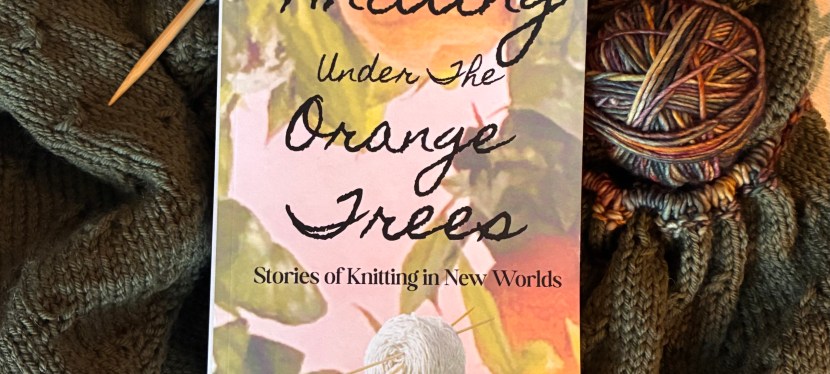
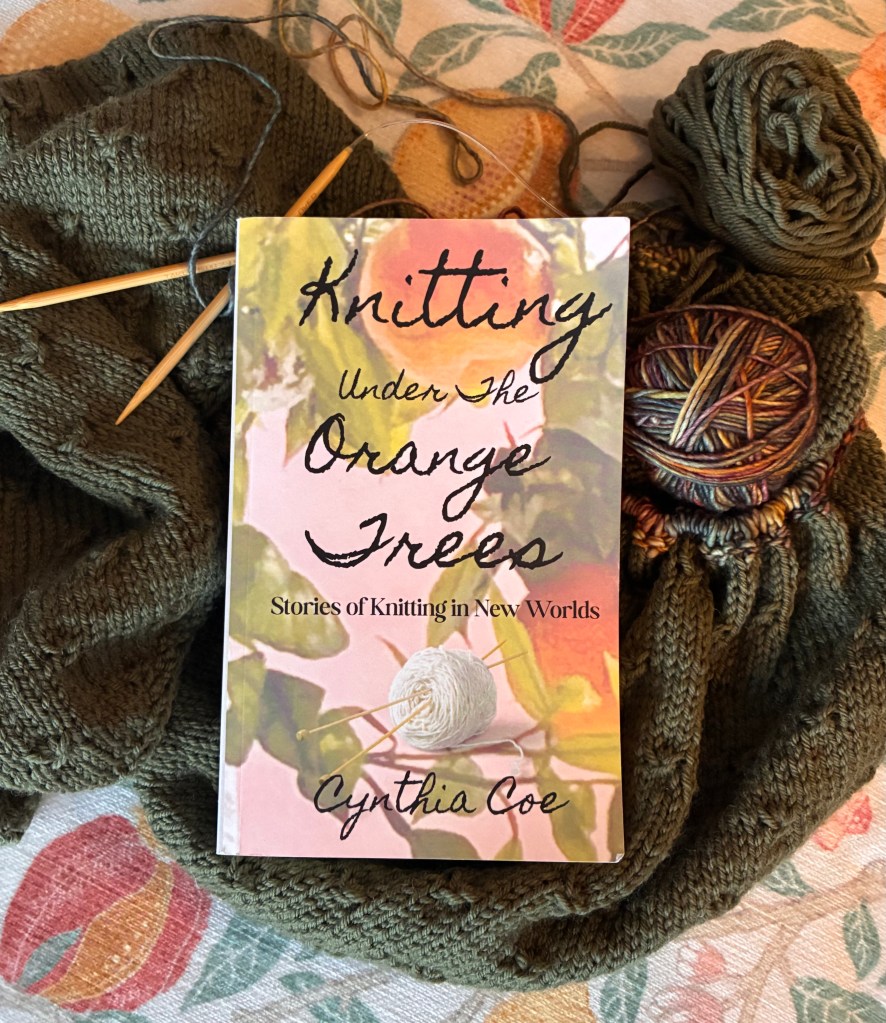
The story imagines how knitting traveled from Europe to the Americas during the sixteenth century—not through official records or trade documents, but through the daily lives of women. Women who packed little more than what they could carry. Women who brought practical skills with them: how to make clothing, how to keep others warm, how to create something familiar in an unfamiliar place.
In Knitting Under the Orange Trees, knitting is not a hobby. It is essential work. It happens in homes, convents, on ships, and in new settlements where warmth and clothing could mean survival. The novel explores how textile knowledge—quiet, often overlooked—helped shape early communities in the New World.
If you’ve read Knitting Through Time, this novel continues that world and deepens its history. If you haven’t, you can enter the series here, just as you would a new project: by picking up the needles and beginning.
Knitting has always been more than yarn and stitches. It is a way women have cared for one another, preserved knowledge, and carried home with them—no matter how far they traveled.
I hope you enjoy this book! I truly LOVED writing it!
Blessings, Cindy
Cynthia Coe is an author, blogger, and avid knitter. Her books are available in paperback and e-reader edition on Amazon.com. Visit her Author page and follow this blog for more info and news.
How did human beings learn to knit? Historians have no idea! So I made up a whole book of stories -based on historical facts- to suggest how we as a civilization learned how to make fabric from two sticks and a ball of yarn.
Who invented knitting? No one has any idea. Knitting first appeared in Egypt, as far we can tell. It next showed up in Spain, then spread throughout western Europe and onto the Americas as Europeans settled and colonized the New World. But how exactly did all that happen? What’s the story?
Those are the questions I set about answering in my latest novel, Knitting Through Time. As a fan of early Christian history and of the “Desert Mothers,” I had to think these women could have had a hand in the development of knitting. After all, they lived in Egypt about the time knitting developed, had lots of time on their hands, and did in fact do a bit of crafting to support themselves. So of course, one of my main characters is an aristocratic woman from Rome, Seraphina, who goes out into the Egyptian desert (wearing a blue silk dress, servants in tow) and has a fortuitous accident that just might have invented our beloved craft of knitting. (She also grows spiritually by leaps and bounds and befriends one of the famous saints.)
The action of my novel also takes place in Toledo, Spain, as the Moorish invasion of this region almost certainly brings knitting to Europe. But how exactly did that happen? In my imagined version of history, a young Visigoth girl named Hilda learned about knitting after the Moors put her to work washing their socks. Her descendants then took knitting to Bruges, Belgium and beyond as the Spanish court set up shop in Northern Europe. From there, the Dutch knitters of the Netherlands may very well have taken knitting to New Amsterdam and the Americas. A storyline featuring Anna, a young widow begrudgingly living with a community of Beguines in Amsterdam, shows how she and her knitting needles ended up in what is now New York City. (Who are the Beguines? You’ll find out!)
And how is this all connected to the first two novels in the Prayer Shawl Chronicles? Remember Nan, the “Quiet One” in book one and a late addition to the Prayer Shawl Guild of All Saints Church in book two? She takes center stage in book 3 and tells us how she learned to knit at the famous Woodstock festival in 1969 and what happened next. She ends up in Amsterdam, Bruges, Paris, and Egypt, too! How? You’ll have to read the book.
Tying all these stories together is a fun twist I wove throughout the book. You won’t know exactly what it is until the last couple of pages. So if you read something in the book and think, “that’s weird,” stay tuned! It will make sense at the end. (And…pssst!…if you read the thumbnail histories in the very back of the book, you MIGHT get a glimmer of this mysterious twist I put in the book.)
As a history major at the University of Tennessee a long, long time ago, I absolutely LOVED writing this book. With all the new online tools available now, I could research all kinds of obscure facts easy, peasy and within moments. I have actually visited almost all of the locations in this book (Toledo, Bruges, Amsterdam, New York, Paris), so it was a pleasure to write a book that tied together all these journeys made over a lifetime.
I hope you enjoy reading my new book as much as I enjoyed writing it! If you’re part of a book club or church group, there’s Questions for Discussion at the end of the book. (I’m a former Christian education curriculum developer; it’s what I do.) If you’re a history buff, I’ve also included a section at the back of the book giving brief descriptions of what was going on at the times and places portrayed in the book, along with a discussion of the Desert Mothers and Fathers of Egypt and the Beguines of western Europe.
Inside: My story of how I wrote my first knitting patterns
You’ve made lovely hand-knitted sweaters and scarves. You have a go-to blanket pattern etched in your head. You constantly hear, “what pattern is that?” and you sheepishly say, “uh…I just made it up.” Then you hear, “no kidding? You should publish that!”
Yes, you should. And with a plethora of self-publishing and crafty platforms available to everyone, you absolutely can publish anything you want, including your own knitting patterns.
But how to get started?
Reader, I faced this problem just a couple of months ago. In writing my upcoming new book, “A Prayer Shawl Handbook,” I knew I had to provide some basic prayer shawl patterns for my readers to truly call this book a comprehensive handbook for this crafting ministry.
A Sneak Preview of Cindy’s Upcoming New Book, “A Prayer Shawl Handbook”
I have several “go-to” prayer shawl patterns in my head – patterns I don’t even think about and can simply cast-on and knit. But write these down???? Gasp. I’m not a technical writer by any stretch of the imagination. Fiction writing and knitting pattern writing are not, in my poor little mind, in the same skill set.
How to get started? Try. Sit yourself down, pull out a pencil and a blank sheet of paper, and take your first stab at it.
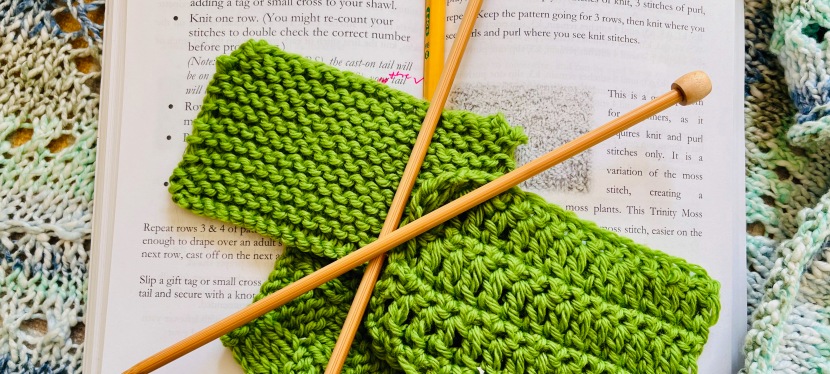
I cast on my favorite memorized patterns and took notes as I went along. I ripped out, re-figured, crumbled up and tossed some early drafts in the trash can. But I persevered until I got some basic prayer shawl patterns knocked out, along with three prayer patch patterns.
Yes, there are formats you need to use and abbreviations you need to adhere to. You probably recognized them from your own knitting projects you’ve made from other people’s patterns. You just need to focus on these things and make sure you’re consistent.
My tip: don’t skip steps or assume the reader of the pattern knows everything there is to know about knitting. Especially if your patterns are geared towards beginners (which mine are), something you think is obvious may not be.
Get friends to help proof and test your draft patterns
This is where it gets really terrifying, in my experience. You hand off your draft pattern to a trusted fellow knitter and see if they come up with what you came up with. They may say, “this makes no sense whatsoever.” They may say, “I just don’t understand what you mean by a yarn-over. What is that?” You go back to the drawing board and explain the details you thought you included but didn’t.
The authors of the new Knitting Pattern Handbook suggest that you hire technical editors and pay them for proofing and revising your patterns. Did I do this? No. I’m just starting out, and I can’t justify shelling out a lot of money for some basic patterns. Friends who knit told me what I needed to know. If I get the notion to start designing intricate sweaters in five different sizes, I’ll certainly re-think and probably get professional help. But as a newbie knitting designer, that’s not where I am.
Everybody starts with the basics
Where I am as a knitting designer is at the beginning. I have some basic patterns that are great for beginners and for simple “meditative” knitting. These are patterns I’d like to share with my readers, so I will.
If you, too, have some basic knitting patterns you’d like to at least share with friends, go for it! If you’d like to get into the knitting design business and make a few bucks (or a lot!), go for that, too! Every knitting designer starts somewhere, likely with a nice, basic design. And you can, too!
Blessings on your knitting designs, no matter how intricate or basic! Cindy
Cynthia Coe is the author of The Prayer Shawl Chronicles, interrelated short stories woven around those who make and receive handmade, prayerfully crafted gifts of prayer shawls. Click this link to order or for more information.
Follow me and subscribe for news of my upcoming new books!
As an Amazon Associate and Author, I provide links to products (including books I have written) and earn a very small fee if you click on the links and buy something. There is no additional charge to you!
Do you write knitting patterns? Do you love the process or – like me – feel your soul enter a state of utter dread when you even ponder such a thing?
As I prepare the final draft of a new book, I know I need to include at least a few knitting patterns in this book (it’s a non-fiction how-to book). I know this, but I have yet to put pattern to paper. And yes, this is supposed to be a “final” draft.
In writing terms, I’m a total “pantser.” This means I generally fly by the seat of my pants when I work on creative projects. This process works beautifully for some of us.( Just start typing and feel awe and wonder at what appears on the screen!!!) Other writers are “plotters.” They plan out every single step of their writing projects, complete with detailed outline (or so I’m told).
As a knitting designer, I’m a “pantser” as well. People ask what I’m making, and I say, “a prayer shawl, I hope.” I cast on a hundred or so stitches and see what happens. I usually come up with an interesting pattern with texture, contrasting elements, whimsy – all that stuff. But if asked to duplicate what I’ve done…that’s a problem.
I’ve discerned that pattern writing and “pantsing” are not compatible. And yet, I really need to share my prayer shawl patterns. As I’ve recruited fellow church members to knit or crochet prayer shawls for our parish ministry, they inevitably ask, “got a pattern for me?”
I got my hands on a soon-to-be published pattern writing handbook and eagerly jumped in, hoping for some inspiration. I felt filled with growing confidence for a couple of chapters. Then, the authors tell me I need to find “beta testers” and “tech editors.” Really???? Just for a simple prayer shawl pattern I could do in my sleep?
As I begin to work on my new book, I hear a song playing in the background. “Don’t worry about a thing,” the lyrics tell me. I proceed in hope.
Do you write knitting patterns? Tips or tricks? Feel free to drop them in the comments!
Be sure to check out The Knitting Pattern Writing Handbook, scheduled for publication on October 31 and available for pre-order. A great resource, especially for newbies and pattern-writing wanna be’s like me.
As an Amazon Associate and Author, I provide links to products (including books I have written) and earn a very small fee if you click on the links and buy something. There is no additional charge to you!
As a writer and lifelong bookworm, I love finding a new knitting book, newly published and on display in the bookstore. But lately, I’m finding myself less and less enthusiastic about newly published collections of knitting patterns, even if they are beautifully designed hardbacks with full color illustrations and photos. Nice to look at, but…?
As some of you know, I often have the special treat of reviewing brand new books digitally, well before they hit the market. In reviewing new knitting books, I’m seeing a trend that makes my eyes glaze over. Many – if not all – of these new knitting books assume I’ve never picked up a pair of knitting needles in my life. These books offer voluminous tips on how to get started, what tools I need, how to choose yarn, and even how to make the most basic of stitches. Lord knows I’ve covered that territory umpteen times before.
So when I eagerly pick up a new knitting book, I inevitably skip large chunks of introductory material and skip straight to the new patterns. The patterns are usually fine; but do I want to buy an entire book just for a few patterns?
In the meantime, a plethora of interesting and innovative patterns are now available on multiple platforms for just a few bucks a piece. Why buy a book of info you don’t need, when you can buy only what you want for much less?
And as for instructions on how to knit, it’s all about video these days. I rarely figure out a new stitch from two-dimensional illustrations on paper. But show me a quick video, and I’ve got it under my belt in no time.
I’m going to make a pronouncement (because it’s my blog and I can): Knitting instruction books are obsolete. If you want to learn how to knit, do a search and find a video. If you want a pattern, check out Ravelry, Etsy, or who knows what other platforms are out there in cyberspace.
I love books, but time and innovation move forward.
Happy Knitting! Cindy
Cynthia Coe is the author of The Prayer Shawl Chronicles, a collection of interrelated short stories about knitters and those they meet through knitting and sharing prayer shawls.
As an Amazon Associate and Author, I provide links to products (including books I have written) and earn a very small fee if you click on the links and buy something. There is no additional charge to you!
Greetings, Knitters! I hope you are having a wonderful summer (or winter, for friends Down Under) and getting in some good knitting time.
Do you get patterns from knitting books? Personally, I get my patterns from a variety of sources – online patterns sold individually, magazines I pick up in the grocery store, and a handful of go-to and much used knitting books. I know online patterns bought digitally from Ravelry, Etsy, or other websites are all the rage, but believe or not, some good knitting pattern books are still being published (and you can keep them all in one place on your bookshelf).
Sycamore Cove Knitting reviews the new ones in advance of publication and gives you the scoop on what’s new and worthwhile. Here’s what new and just published in knitting books for June-July 2019:
Big Yarn, Beautiful Lace Knits by Barbara Benson. A very nice pattern book for the coming cool weather season. The concept of this book is lace knitting with larger sized needles and bulkier weights. The results? Quicker projects with more intricate, showier designs than you normally see with bulky yarns.
The Art of Circular Yokes by Kerry Bogert. This book of yoke sweater patterns give the advanced knitter plenty to sink her teeth into. The designs are lovely and intricate. Most of them are designed for small needles and fairly fine yarn. These are projects that will take a lot of skill, time, and concentration.
One Stitch Baby Knits by Val Pierce. This is a nice collection of baby knit patterns. They are intended as “beginner” level patterns, but I would rate them as more “advanced beginner” or even “intermediate” level patterns. This is by a British knitting expert, and I appreciate that she took the trouble to translate some of the British knitting terms into American English. However, many of the yarns listed are those available in Britain; I only recognized one yarn readily available in the U.S.
The Prayer Shawl Chronicles by Cynthia Coe: Set in an Episcopal parish in Tennessee, hear the stories of women who knit and donate prayer shawls and the remarkable and remarkable connections with those who receive them. A fairly quick read of short stories, this book is great for taking along on vacation.
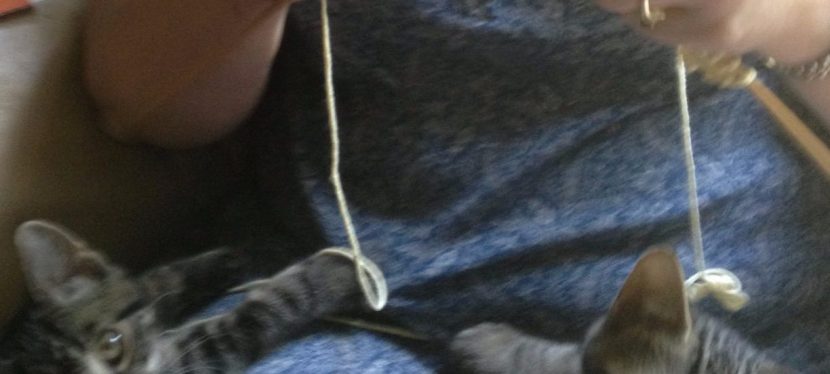
Sitting down for a nice, calming session of knitting, and who turns up to “help”? The cat, of course. When my cats Scamper and Milo see me sit down in my favorite chair with a wooly skein of yarn beside me, to them, it’s an invitation to play.
Knitting with cats is both the most wonderful thing in the world and the most annoying. A soft, furry creature with big yellow eyes plops down on your lap and purrs right as you take out your knitting needles. What a knitter to do? You want to knit, but you don’t want to run off the cutie pie sitting on your work-in-progress, either. Eventually, the cat gets exasperated by those sharp sticks waved in front of his face, and he moves along. Or you push him.
A ball of yarn is the ultimate temptation to cause mischief for a cat. My cats usually know not to mess with my knitting yarn, fearing an almighty tongue-lashing that comes with batting around a yarn ball attached to a sweater under construction. But sometimes, a cat just needs to play with what is obviously a toy provided for a cat’s pleasure. Occasionally, I let the cat play…until the ball of yarn is roped around six pieces of furniture and knotted into a mess requiring a half hour of untangling. Then it’s time to “re-think” my policy of cats and yarn.
The problem with cats and knitting is that many of us seriously love them both. Both are warm, fuzzy, and lovely to look at. Both knitting and cats require attention from our hearts and our hands. Cat People are often Knitting People. And in those moments when the two clash and chaos breaks out, I hope we’ll remember that really, what’s a little frayed yarn and knots when you have the pleasure of seeing a cute little kitten batting about a “just right” ball of yarn?
Jill’s Beaded Knits Bitshas some new Abacus Counting Bracelets, along with some cute new stitch markers. She handmakes her products and ships them out pronto. I recently treated myself to some new stitch markers, but I’ve not tried the abacus counting bracelets yet. I’d love to hear from anyone who has.
P.S. This blog is completely independent! I recommend books and other items I’ve read/used and like. Books are usually provided to me free through NetGalley and their publishers.
Knitting in public cures a host of social awkwardness ills. If you’re waiting for a plane, waiting for a doctor’s appointment, or just find yourself in a place with nothing much to do, knitting fills the gap.
This morning, I found myself in one of these places, waiting as my son got his hair cut. I hadn’t had my morning quiet time yet, so I pulled out my small on-the-go knitting project out of my tote bag and got a few rows in while I waited. But looking around me as I waited, I noticed something different.
Usually, when I knit in public, at least a couple of people will come up to me and strike up a conversation. “What are you making?” they usually ask. “I’d love to learn to knit,” they occasionally say. Or maybe they wistfully remember a mom or grandmother who used to knit.
But this morning, no one said a word. They all focused solely on their phones. I felt like I was the only one in the waiting area truly getting “me time.”
Hoping you’re getting some knitting “me time” today! Cindy
It’s all in the color, I often tell people who admire my knitting.
I’m a “process knitter,” I’ll admit. I like fairly simple, easy-to-remember patterns. I like to sit and let my mind go vacant as I concentrate on nothing but whether I need to knit or purl the next row. It’s my “me time.” It’s my meditative time.
But I get bored with simple stockinette or garter stitches for inches on end. Even as I zone out, I need a sense of change. I get a sense of accomplishment from finishing a section of one color and moving on to the next.
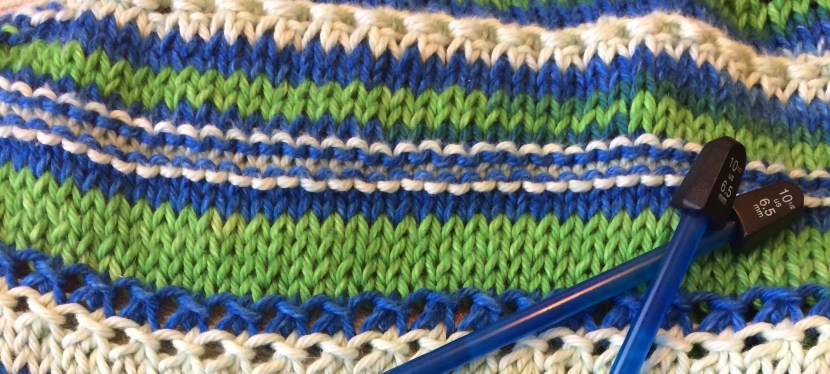
With the many self-striping and variegated yarns now available, it’s easy to give your otherwise plain, straightforward stockinette pops of color that make you look like a star. People who don’t knit will think you’re over-the-top talented if you display a knitwork with lots of intricate color. People will think you’re a genius if you add a few rows of yarn-overs to make a lacey pattern along with the colorwork knitting.
Colors give us a sense of accomplishment, give depth to our work – often without even changing skeins.
Several new books on colorwork in knitting have recently come out! Be sure to check them out:
Gradient Style: Color-Shifting Techniques & Knitting Patterns, edited by Kerry Bogert (Interweave): Specifically for knitters, this book helps crafters take advantage of the wide range of gradient colored yarn sets currently on the market. Some basics of using the color wheel are included in the introduction, followed by a good number of projects patterns using gradient colors: socks, sweaters, shawls, and mittens. The editor wisely advises knitters to go to the yarn shop and physically mix and match colors for new projects, rather than simply buying materials online. This book is great for anyone who wants to give their flat knitting some kick by using gradient color combinations. Currently on sale, in paperback and Kindle.
Beginner’s Guide to Colorwork Knitting by Ella Austin. Despite the title, this book would best be used by advanced beginners or intermediate knitters. The photographs do an excellent job of showing exactly what is meant by each color work technique, but I think you would have to go to YouTube videos to be able to actually learn these techniques. If you are comfortable working with charts, this is the book for you. Just Published! Available in paperback and Kindle on March 19, 2019.
Love Color: Choosing Colors to Live Withby Anna Starmer: This gorgeous book by a color expert gives you lots of excellent ideas for choosing color schemes. I appreciated that the author urges readers to start with items of sentimental significance in creating color design choices. Many palettes are featured in the book, with tips on contrasting colors, working with textures, and use of lighting. The author does a great job of bolstering readers’ confidence in making bolder uses of color and incorporating colors that simply put them in a good mood. Available in hardback and Kindlefor less than $20.






 Sycamore Cove Knitting