How Did You Learn to Knit? There’s a Story There

My own story of learning to knit is a story of learning a few basics from my mother, then learning so much more on my own and from other women.

How did you learn to knit? You likely could tell the story of a fundamental relationship in your life in answering this question. You may have learned from your mother, your grandmother, or another relative who took the time to spend with you, teaching something that stick with you the rest of your life. Or if you’re younger, this may be a story of finding yourself bored during the pandemic and using tech tools, like an online course, to teach yourself an ancient craft. In any case, as a novelist, I can assure there’s a rich story there.

My own story of learning to knit begins in Kingsport, Tennessee, as a teenager. I learned to cast on, knit, and cast off. She told me the story of making one and only one knitted blanket while my father had surgery on his lung, to remove inhaled debris from his childhood. I imagine her knitting away during the long hours of his surgery and recovery. 

My mother only knew the knit stitch, so I didn’t learn to purl until much later. My mother taught me what she knew, which she almost certainly learned from her own mother. I imagine this grandmother I never knew knitting to calm her fears while my grandfather, a doctor, served in a medical unit in Europe during World War II. 

I continued learning to knit as an undergraduate at the University of Tennessee. I struggled with anxiety and figured out that knitted helped to calm me. I sought out more advanced knitting skills from a local knit shop in Knoxville, The Knit Wits. There, two elderly women taught me how to purl, increase and decrease, and eventually to make an actual sweater. I never looked back. This was a story of finding myself and learning to seek out guidance and knowledge from those outside my own family, as I did elsewhere in my life during those college years. 

By my mid-twenties, I became fully autodidactic. I learned to learn all kinds of things all by myself. That’s one thing I learned in law school – if you’re trying a case on something you know nothing about (medical procedures, auto parts, you name it), you hit the books and figure it out. Knitting was no different. While snowed in from law school one winter, I figured out how to knit cables. I became a self-learning student for life.

What’s your knitting story? What does your story tell you about yourself? 

Stay tuned for my next book in The Prayer Shawl ChroniclesKnitting Through Time: Stories of How We Learned to Knit. In this novel, I imagine how we as a civilization learned to knit over the centuries. This is my first foray into historical fiction, and I’ve had a ball with it. I hope you’ll enjoy it, too! 

Blessings, Cindy

Cynthia Coe is the author of The Prayer Shawl Chronicles, interrelated short stories woven around those who make and receive handmade, prayerfully crafted gifts of prayer shawls. Click this link to order or for more information. 

Ten Reasons to Teach Knitting or Crochet in Summer Kids’ Programs

Those of you planning summer youth camps are undoubtedly thinking about what activities you’ll offer in your programs this year. You’ll want something fun and engaging, something parents will talk about favorably and youth will remember fondly. 

Why not teach life skills that will equip them to find their own sense of peace and calm in their lives, as well as serve as an outlet for personal expression? Why not teach crafts that have helped people make useful items for centuries? Here’s ten reasons to teach tried and true crafts – like knitting or crochet – this summer:

Ten Reasons To Teach Traditional Crafts To Young People This Summer

  1. You’re teaching something young people can practice and enjoy for the rest of their lives.
  2. You’re teaching “real” life skills, not an “arts & crafts” project they’ll trash as soon as they get home.
  3. Crafts help young people calm down and get away from their phones.
  4. It’s perfectly acceptable for both boys and girls to engage in crafts we previously thought of as “women’s” or “men’s” crafts. Boys can knit, and girls can do woodworking.
  5. Finishing a challenging craft project gives you a huge sense of accomplishment and self-esteem.
  6. You can make your own clothes, hats, scarves, and blankets, furniture, kitchen items, or other useful things you’ll treasure always.
  7. If you all-natural materials, you’re introducing a sustainability lesson, too.
  8. You can engage members of your community as teachers and create bonds between generations.
  9. Local crafters might donate a lot of the materials you need. All of us crafters have “stashes” of leftover and spare materials and tools we’d like to share. 
  10. Your young people will remember “the summer I learned to knit/whittle/basketweave/crochet” as one of their best memories of summer camp. 

Tips for Teaching Young People How to Knit:

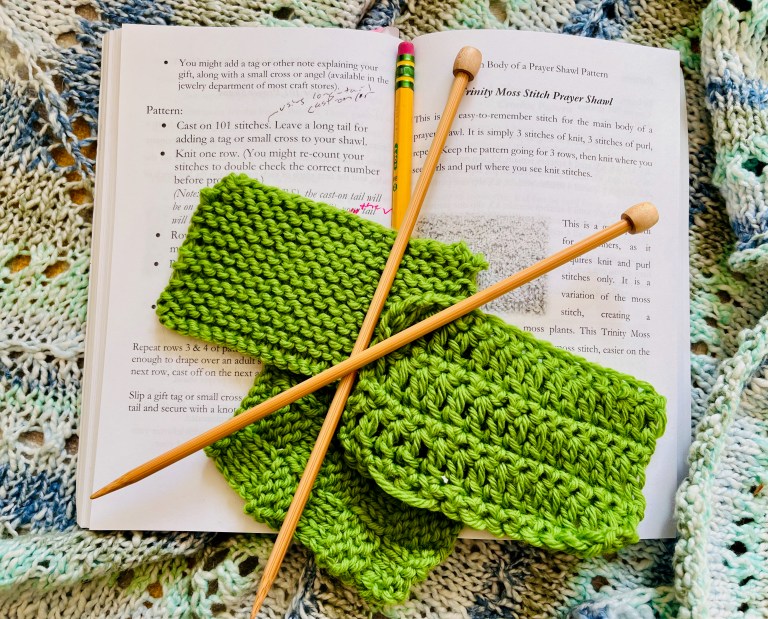
  • Start Small: Go with a small piece of knitting or crochet for kids’ “First Project.” It can be a coaster or a “prayer patch.”
  • Consider casting on in advance for your students. Let kids get the feel for actual knitting before overwhelming them with too many skills to learn too soon.
  • Patience counts! Everyone’s first piece of knitting or crochet will likely look wonky. That’s fine.
  • Have plenty of volunteers available to help kids one-on-one.
  • Consider making short videos of your lessons, so kids can refer back to them later on their phones.

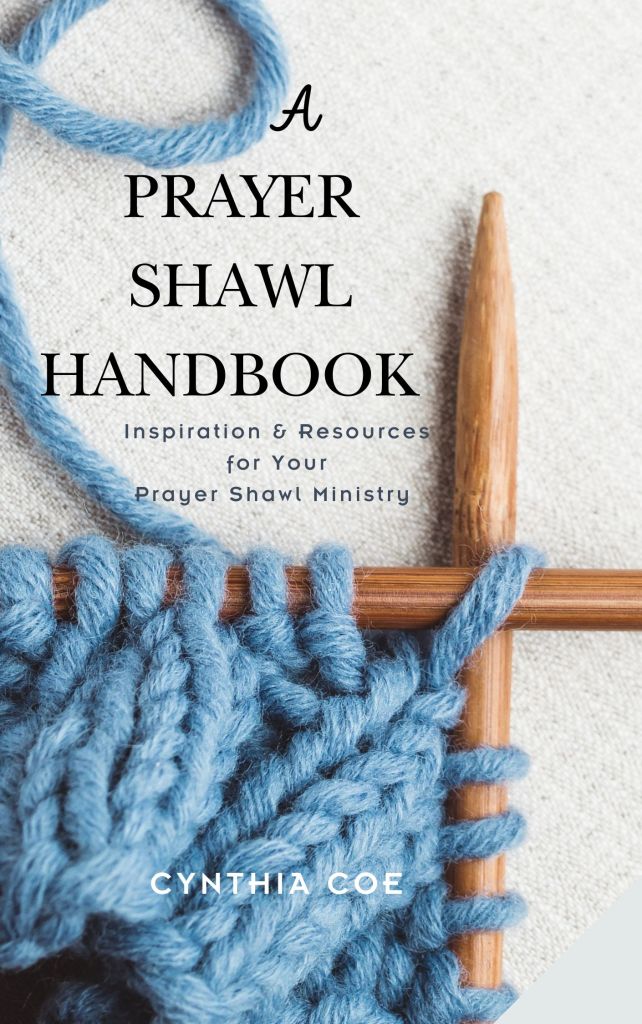
Need a pattern? My new book A Prayer Shawl Handbook has plenty of patterns for simple patterns for prayer shawls and small, quick prayer patches.

A Prayer Shawl Handbook,
available in paperback and e-book editions

Cynthia Coe is the author of The Prayer Shawl Chronicles, a collection of interrelated short stories about knitters and those they meet through knitting and sharing prayer shawls. 

Be sure to check out my newly published A Prayer Shawl Handbook: Inspiration and Resources for Your Prayer Shawl Ministry, now available in paperback and e-book editions and included in Kindle Unlimited.

Patterns in Nature, Patterns in Fiber Arts

Why do some knitting patterns just “look right”? Where could you find inspiration for designing your next fiber arts project?

Look no further than Mother Nature herself! Certain patterns are found time and time again in nature. Intuitively, we are already hard-wired and attuned to recognizing these patterns. So if you find yourself stumped for design ideas or a pattern that’s sure to please, here are design elements found in nature and their knitting or other fiber arts equivalents.

The Wave: This pattern lends itself easily to the inherently linear nature of knitting. Most knitting patterns are done in rows, and rows are akin to long, thin waves. These waves can have crests and dips, interruptions and smooth sections – just like many knitting or crochet rows.  If you’re knitting in any kind of garter stitch pattern or with other repetitive lines, you’ve got your wave.

A pattern in nature related to the Wave includes the Meander pattern. Think a pathway, river, or snake. Though our finished products in knitting and other fiber arts usually no longer meander, our yarns certainly meander from our skeins to our needles as we’re working!

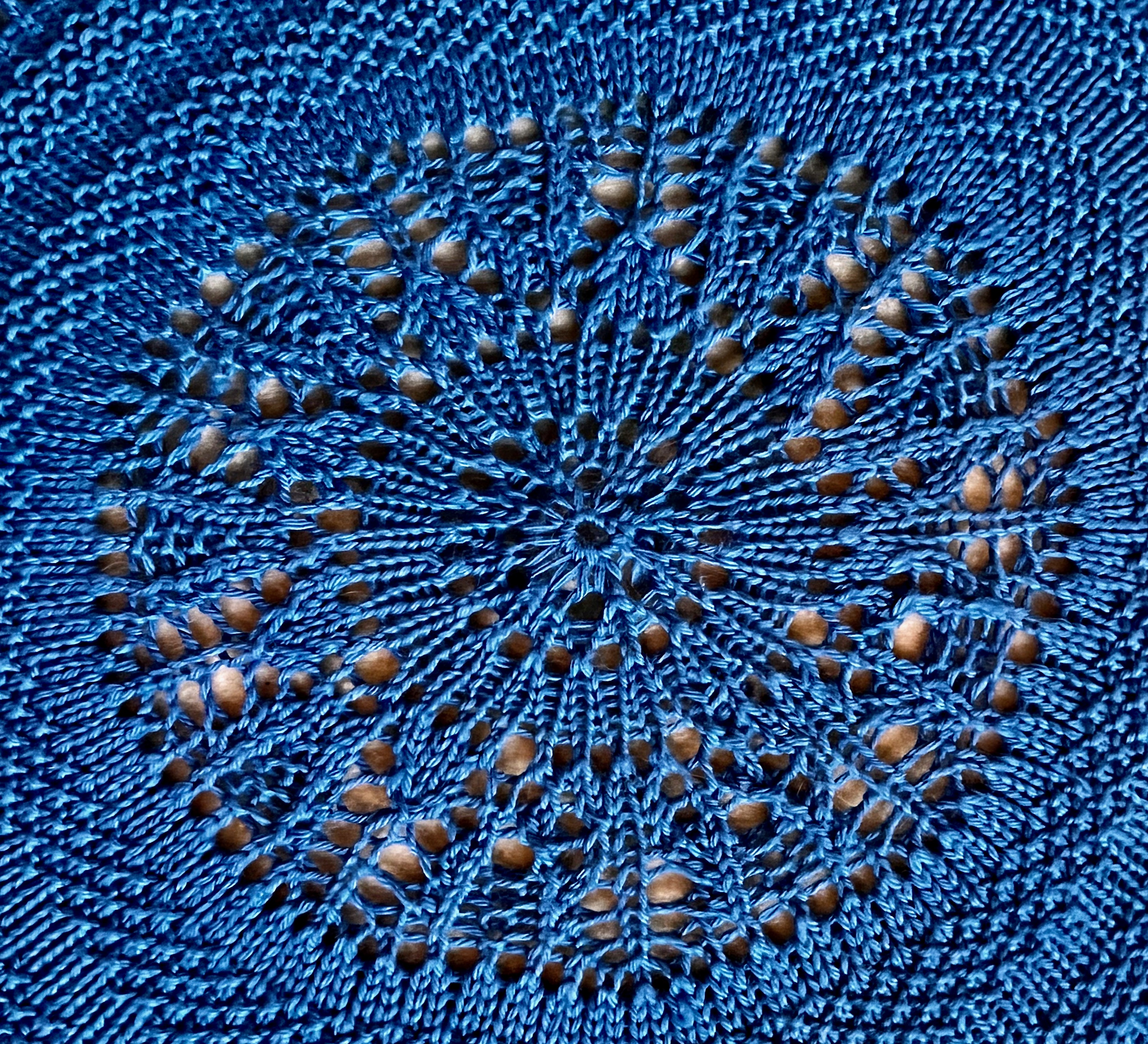
The Burst: Think of the iconic photograph of a drop of milk making a round, crown shaped pattern. Or the shape of a daisy or other flowers or plants “bursting” with a central point. This circular pattern is a bit trickier for knitters. Making a circular pattern with double pointed needles can be fiddly and, in my opinion, is a rather advanced skill. But if you want to knit to impress, this would be your “wow” pattern. This pattern is much easier in crochet, and many crochet patterns feature increasing numbers of stitches starting from a small space. 

The Spiral pattern is similar to the Burst pattern. Both are round patterns, with the spiral meandering around and around instead of making a round burst from a central point. Spirals are more often found in crochet patterns than knitting. 

Fractals: Think branches of a tree or other plant, fractals branch out from a central line, just as tree limbs or leaves branch out from a stem or trunk. We see a lot of fractals in embroidery and other fiber arts using decorative stitches. Many more advanced knitting stitches do feature fractals that mimic plant leaves. These are sure to give your design a nod to nature.

Cells and Bubbles: Cells are the building block of nature, so cell-like designs are often found in all finds of knitting, crochet, and other fiber arts. They may take the form of holes or spaces in our stitches, or we may make block-like patterns in our colorwork or stitching. Think moss stitch in knitting or even basketweave. Bubbles are similar to cell patterns and can give a pattern the feel of fun and joy. 

These patterns are all around us – in our own bodies, in plants, and in the heavens. We know these patterns; we recognize these patterns. Take a look at your favorite fiber arts patterns some time. What do you recognize from the natural world?

Enjoy Your Fiber Arts Designing…and Time in Nature! Cindy

Cynthia Coe is the author of The Prayer Shawl Chronicles, a collection of interrelated short stories about knitters and those they meet through knitting and sharing prayer shawls. 

Be sure to check out my newly published A Prayer Shawl Handbook: Inspiration and Resources for Your Prayer Shawl Ministry, now available in paperback and e-book editions and included in Kindle Unlimited.

It’s All About Color: Crafting Color Symbolism in Every Stitch

Exploring Symbolic Colors in Prayer Shawl Design

When you embark on the journey of creating a prayer shawl – or any other crafting project – the choice of colors goes beyond aesthetics; it can carry profound symbolism. Across various traditions, colors have played a significant role in conveying concepts and stories. Whether you’re crafting for spiritual or personal reasons, understanding the symbolism of colors can add a meaningful layer to your prayer shawl design.

Here’s list of common colors and traditional symbolism associated with each:

  • Red: Passion, Love, and Energy
  • Red symbolizes passion, love, energy, courage, warning, power, celebration, and attention, with its meanings varying across cultures and contexts.
  • White: Celebration and Renewal
  • White, representing celebration and renewal, symbolizes purity, a fresh start, and the illuminating power of light.
  • Purple: Rich Emotions
  • Purple can evoke both warmth and calmness.
  • Blue: Calmness and Spirituality
  • Blue brings a sense of calmness. It suggests elements of water, peace, and the expansive sky.
  • Green: Growth and Abundance
  • The color of growth, green is used after Pentecost. It signifies nature, abundance, and tranquility.
  • Yellow and Gold: Warmth and Cheerfulness
  • Yellow suggests cheerfulness and sunshine, while gold brings a sense of coziness and warmth.
  • Pink: Joy and Playfulness
  • Pink represents joy, youthfulness, and cheerfulness.
  • Brown: Earthy Humility
  • Brown symbolizes humility, reminiscent of monk’s robes. It brings warmth through its connection to nature and soil.
  • Beige: Calming Desert Tones
  • A calming color reminiscent of sand, beige can symbolize time spent in the desert or on the beach.

In moments of uncertainty, neutral tones such as beige, cream, grey, taupe, and sand always make for a beautiful prayer shawl. Consider the soothing, cozy, and comfortable feelings these colors can evoke. After all, your hand-crafted work aims to embrace someone with a heartfelt hug.

Whether you find inspiration in religious symbolism or personal preferences, let your prayer shawl be a reflection of warmth, comfort, and love.

Happy knitting!

Cindy

Cynthia Coe is the author of The Prayer Shawl Chronicles, a collection of interrelated short stories about knitters and those they meet through knitting and sharing prayer shawls. 

Be sure to check out my newly published A Prayer Shawl Handbook: Inspiration and Resources for Your Prayer Shawl Ministry, now available in paperback and e-book editions and included in Kindle Unlimited.

Snow-Bound? Stranded? Time for Creative Yarn De-Stashing

I’ve found myself in Florida much longer than expected, and I’m a knitter stranded alone with a “mystery stash” of yarn. What to do???

It’s a great luxury to plan a project, decide exactly what yarn to use, and even mull over exactly what color you’ll use from a wide selection available. It’s nice to make a few swatches and decide which size knitting needles to use. 

But what if you can’t? 

I checked into a condo in Florida at the end of December, and I’m still here. With Tennessee closed for snow for the foreseeable future, I’ll be here for a while. Fortunately, I had ordered a “mystery stash” of clearance sale yarn shipped to me before I arrived, so I’m not exactly hurting for high quality yarn to knit with.

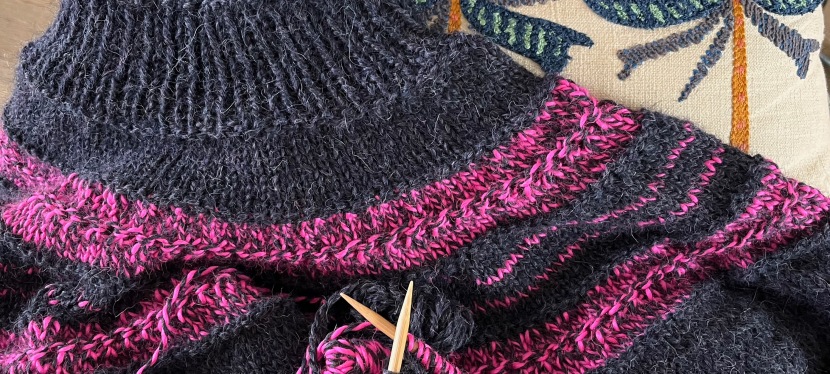
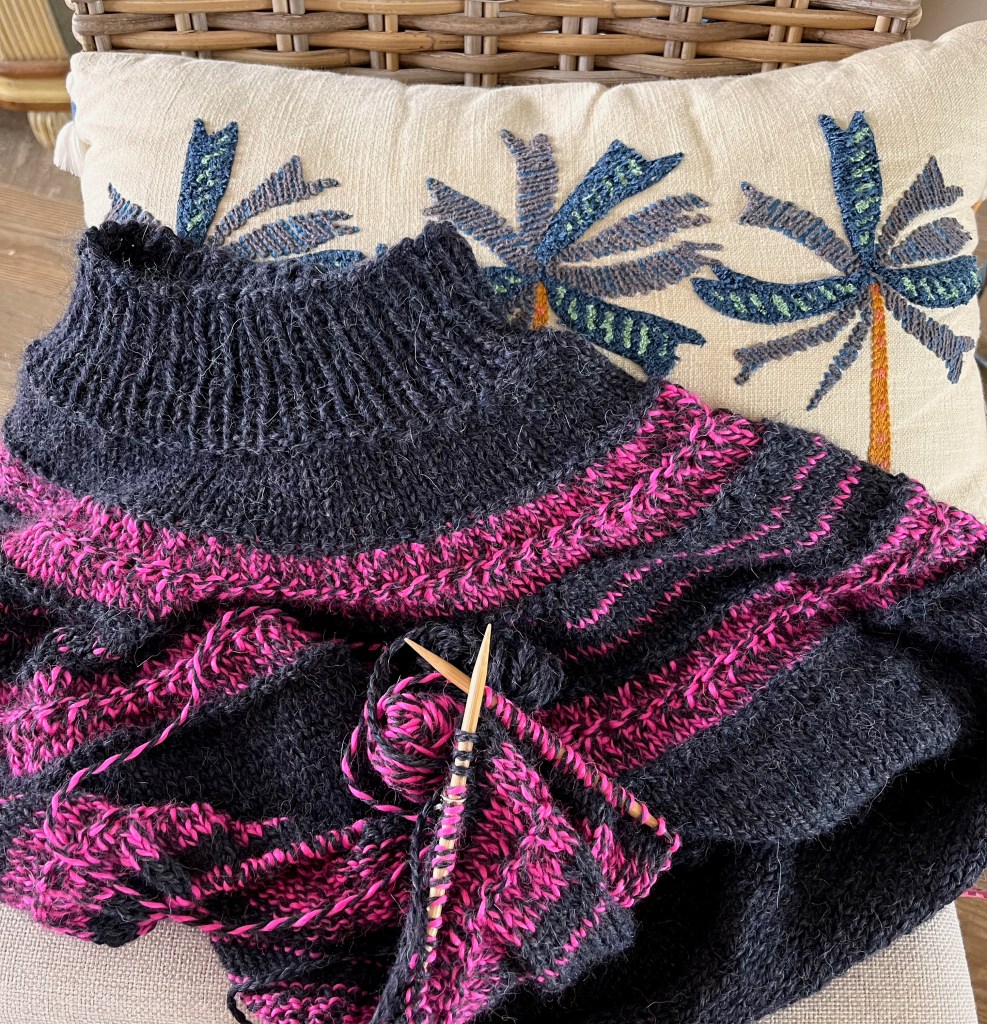
The problem is, I received 4 skeins of two different yarns from this mystery box – 4 skeins of a dark grey yarn, and 4 skeins of a bold pink and grey striped yarn. From past experience, I know it usually takes 5 skeins of these kinds of yarn to make a sweater (which I need; it’s 34 degrees here in paradise today). I puzzled over these yarns and made a swatch with the only needles I’ve got on hand. Mercifully, the needles will work with the yarn. But what to do with an underabundance of one or the other color of each yarn?

This is where necessity becomes creativity’s best friend. Like it or not, I’m looking at stripes. With the loud pink, I could end up with a sweater I wouldn’t be caught dead in. Or I could end up with a sweater I never would have planned but turns out better than expected. So I cast on and see how it goes.

I’ve ended up with a sweater with more texture and interest than I would have designed if I’d had my pick of materials. It’s mostly dark grey, in a heavy wool and alpaca, with pink and grey stripes that pop…but not too much.  Heck, it might be one of my favorite sweaters!

And all because I’m stranded and used what I had. Sometimes maybe we need to look at what’s in front of us and work out a solution we wouldn’t have even considered otherwise. Maybe that’s what makes the best crafting – letting necessity befriend and collaborate with the creativity that needs a little shove before it kicks into action. 

Blessings to those who are snowed in or stranded this winter day!

Cindy

Cynthia Coe is the author of The Prayer Shawl Chronicles, interrelated short stories woven around those who make and receive handmade, prayerfully crafted gifts of prayer shawls. Click this link to order or for more information. 

Cynthia Coe is the author of The Prayer Shawl Chronicles, a collection of interrelated short stories about knitters and those they meet through knitting and sharing prayer shawls. 

Be sure to check out my newly published A Prayer Shawl Handbook: Inspiration and Resources for Your Prayer Shawl Ministry, now available in paperback and e-book editions and included in Kindle Unlimited.

New Year, New Stitches: Crafting Daily Knitting Rituals

It’s a brand new year! Looking for a new way to find a sense of calm and grounding each and every day? Think about starting a daily knitting ritual. By taking up a daily knitting ritual, you are invited to weave the threads of your daily life into a tangible tapestry—a daily celebration in which you find a sense of calm and grounding. 

You can do a temperature blanket, a prayer shawl, or any kind of project that involves a set number of rows or a set time period in which you calmly knit and leave the rest of the world behind. The point is to take a little time each day for quiet – even silent – time of meditative knitting that reminds you to slow down and forget your worries. 

I first began a daily knitting ritual with a “temperature blanket” in 2019. I knitted one ridge of garter stitch each evening without fail, showing the high temperature of the day. What began as a simple commitment to my temperature blanket evolved into a nightly time of peacefulness. Seated in my favorite chair, surrounded by loved ones, I marked the close of each day—a time to reflect, acknowledging that I’ve given my best today, and it’s time to unwind.  

As I knit through the seasons, my knitting echoed the transitions from cold to warm, from short days to the long, sun-soaked afternoons of late spring, then back to cool and later cold days of autumn and early winter. These daily stitches grounded me in the natural rhythms of life—a simple yet profound celebration of life’s perpetual forward motion and renewal.

If you need a pattern, here’s my own…

Temperature Blanket Pattern: 

Materials: I use inexpensive cotton yarn from the big box craft stores, in the same colors for temperatures used by the television weather reports. I use size 8 or 9 knitting circular knitting needles to deal with the large number of stitches used. 

-Cast on 100 stitches, knit one row using the color of January 1

-At the beginning of each month, I knit one row of Yarnovers followed by the number of the month. For instance, for my first row, I would knit: [K2tog, Yarnover, knit 1 stitch]. In February, it would be [K2tog, YO, knit 2]…and so on. I continue this pattern until the end of the row. (You’ll have a couple extra stitches or be short a couple of stitches some months.)

-For the second row of the first day of the month (wrong side), knit using the same color

-For each succeeding day in the month, knit two rows in your chosen color for the temperature of the day. (I used the high temperature. You can use the low temperature, a median temp, or whatever you choose.)

-Your project will be quite long if you continue for 12 months, using worsted weight or larger. You might consider binding off and starting a second blanket after six months. 

And speaking of new creations, I invite you to explore the soothing art of prayer shawl knitting, using my brand new book, “A Prayer Shawl Handbook.” Discover the therapeutic joy of crafting these beautiful shawls, with each stitch infused with intention and care. May “A Prayer Shawl Handbook” inspire you to embark on a heartwarming journey of creating not just garments but moments of solace and connection.

Blessings on your knitting rituals! Cindy

Cynthia Coe is the author of The Prayer Shawl Chronicles, interrelated short stories woven around those who make and receive handmade, prayerfully crafted gifts of prayer shawls. Click this link to order or for more information. 

Crunch Time for Holiday Crafting – What To Do?

Finish, Don’t Finish, or….Another Option?

You’re knitting or crocheting a special gift for a special person in your life…and it’s a mere days (or hours) before Christmas, and you’re not even close to finishing. What to do? Friends, do not fret! You have options.

Option 1– Suck it Up and Finish the Thing. This is by far the most unpleasant option for holiday knitters, but it may be what you need to do. Just how close are you to finishing? If you can conceivably finish this sweater, hat, or pair of socks, you may feel a sense of accomplishment by simply staying up late, putting needles to work, and finish the thing. Compensate by promising yourself your next project will be slow, relaxing, and enjoyable.

Option 2 – Don’t Finish; They’ll Understand. This option relies on the fact that the special recipient of your special gift understands that you’re making this handcrafted gift out of love AND that it takes time. You’re not just going to the store and throwing the first thing you see into the shopping cart. You’re putting TIME – your precious and irreplaceable time – into this gift. Your person will value that more than anything. As a practical matter, you can wrap up your unfinished gift, a sketch or copy of the pattern, or simply a piece of yarn and a nice note explaining that the gift is still a work in progress. It’s okay. Really.

Option 3 – It’s Christmastide!!! You have 12 more days to finish!!! Remember that song, “The Twelve Days of Christmas”?  Friend, it’s a thing. The ancient Christian season of Christmastide lasts for twelve days, ending January 5. Most churches consider the celebration of Epiphany, January 6, as the official end to the Christmas season. And who doesn’t enjoy an unexpected Epiphany gift! If the Three Wise Men can present their gifts on January 6, so can you!!! (They in fact, it’s thought, didn’t actually show up until Jesus was a toddler, so that’s gives you…years!…to finish that gift, if you go this route.)

Whatever you decide, be kind to yourself this Christmas Knitting Season, my friends. We knit to relax, we knit to show our love to others, we often knit to keep ourselves sane. It’s all okay. Your loved ones will surely enjoy and be touched to the core that you have made something just for them. And showing your love from your heart is what Christmas is all about.

Christmastide Blessings, Cindy

Cynthia Coe is the author of The Prayer Shawl Chronicles, interrelated short stories woven around those who make and receive handmade, prayerfully crafted gifts of prayer shawls. Click this link to order or for more information. 

Cynthia Coe is the author of The Prayer Shawl Chronicles, a collection of interrelated short stories about knitters and those they meet through knitting and sharing prayer shawls. 

Be sure to check out my newly published A Prayer Shawl Handbook: Inspiration and Resources for Your Prayer Shawl Ministry, now available in paperback and e-book editions and included in Kindle Unlimited.

What To Do with Leftover Luxury Yarn?

I don’t play yarn chicken. Life is too short for that kind of teeth grinding, blood pressure elevating stress in my life. If I’m knitting a nice sweater out of all-wool, cashmere, alpaca, or some other luxury yarn, I make sure I have enough yarn to make the best sweater I can make. 

That leaves a happier problem than running out of yarn (i.e., losing at yarn chicken – frantically trying to finish your project before you run out of yarn). You’re left with a skein or two of really nice yarn you don’t want to just toss in your stash.

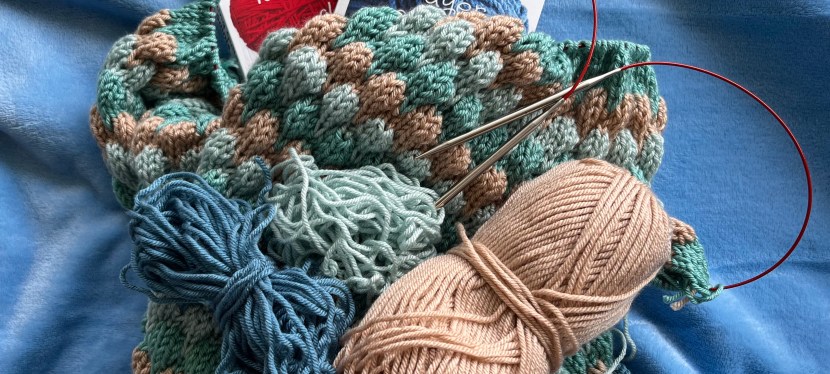
What do you make out of just a small amount of luxury yarn? I usually make a simple scarf to go with my newly handknit sweater. A scarf makes a nice accessory for any outfit, and it gives a matching sweater that “wow” factor. Store-bought sweaters almost certainly do not come with matching scarves – only we hand knitters get these lux perks. If this scarf turns out a little short, no problem. Just stitch the ends together, and voila, you have a matching cowl instead. 

Here’s some other items I sometimes make with leftover luxury yarn:

  • Table runners
  • Coasters
  • Placemats or fabrics to place under plants or office items (pencil box, stapler, phone, etc.)
  • Bathmats 
  • For a larger amount of yarn, a shawl or throw blanket

I don’t overthink the design of these handknit extras. In fact, here’s my Go-To Pattern for scarves and any other rectangle-shaped small fabric:

The Five by Five – a Simple Checkerboard pattern, pictured in this blog post.

  • Cast on 20 stitches (for larger items, cast on additional sets of 8 stitches)
  • Row 1: (K4, P4) x 2, K4
  • Row 2: (P4, K4) x 2, P4 
  • Rows 3 & 4: Repeat rows 1 & 2.
  • Row 5: (P4, K4) x 2, P4
  • Row 6: (K4, P4) x 2, K4
  • Rows 7 & 8: Repeat rows 5 & 6. 
  • Continue these 8 rows until you run out of yarn, cast off. 

For more simple patterns, follow me for news of my upcoming book, A Prayer Shawl Handbook, to be published in early December! 

What do YOU do with leftover yarn? Feel free to join the discussion by commenting on this blog or on my Facebook page! Share your great ideas!

Blessings, Cindy

Cynthia Coe is the author of The Prayer Shawl Chronicles, interrelated stories about knitters and those for whom they knit and love. The sequel to this book, The Knitting Guild of All Saints, has been released! Available in paperback and on Kindle, included in Kindle Unlimited. 

Copyright Cynthia Coe 2023. All Rights Reserved.

That Liberating Feeling of Ripping Out Your Knitting Project

We’ve all been there. You start a knitting or crochet project. You’re well underway with it. And you hate it. What do you do? Soldier on, or rip it out and start over?

I found myself in this place with a knitted sweater recently. I had designed it myself, using expensive alpaca and wool yarn, in a deep red color. Since the yarn was a delicate fingerling weight using tiny needles, I had put hours upon hours of work into it. But I could tell it would be way, way too small for me.  What to do? 

Reader, I ripped out the entire project. All of it. And I felt liberated. Instead of keeping myself in a rut I couldn’t get out of, I got to re-think and start an entirely new project. 

When I ripped out my former sweater, I honestly did not regret the time I spent on it. As with all knitting projects, I enjoyed pleasant, restorative quiet time while making this sweater. I enjoyed knitting along while watching and listening to my favorite shows. Was this wasted time? Absolutely not. In fact, I considered the ripping out process as getting double the value for the money spent on this particular yarn. 

My former knitted sweater is now in the process of becoming a crocheted prayer shawl I’m making as a prototype for a new book. I have no regrets. Instead of suffering through a project I would never wear, I’m making something that will wrap around someone’s shoulders and fit perfectly, no matter the size of the person. 

Other crafters – woodworkers, painters, metal workers – may have to throw away or destroy projects that don’t work. I imagine that must hurt and be costly. As knitters and crocheters, we get to do something most people can’t do. We get a do-over. If a project isn’t working for us – for whatever reason – all we have to do is pull that piece of yarn and keep pulling until the project literally doesn’t exist anymore. Our flexible yarns give us the possibility of release from our mistakes and the possibility of a brand new start. 

Blessing for all the do-overs in your life, Cindy

Cynthia Coe is the author of The Prayer Shawl Chronicles, interrelated stories about knitters and those for whom they knit and love. The sequel to this book, The Knitting Guild of All Saints, has been released! Available in paperback and on Kindle, included in Kindle Unlimited. 

Yarn – It’s Fundamental to Human Culture

We’ve all seen the memes. “My other hobby is buying yarn.” “My yarn stash exceeds my expected lifespan.” “Yarn is like chocolate; you can never have too much.” 

We treat yarn as if there’s an abundant worldwide stash ready for us to buy, in any amount. Craft stores literally stock enough yarn to reach the ceiling. You can obtain yarn for any project you have in mind with a couple of clicks on your phone.

This wasn’t always the case. In researching for my next book in The Prayer Shawl Chronicles, I’ve been shocked to learn how much time women have spent over the centuries making yarn and thread. Before industrialization, if you were a human being and a woman, you would spend a good part of your waking hours making yarn or thread. If you were a Neanderthal woman, you would have used fibers from the inner bark of conifer trees to make string for fishing lines and nets, to hang food to dry, to set traps for small animals, and to sew together animal hides for clothes and shelter. If you lived in Europe up until the industrial revolution, you would carry around a spindle and a fist full of wool, and you would make yarn while you watched the kids, walked, talked, and generally while you kept an eye on whatever else went on in your life. You would know how to work a spinning wheel as well as you knew how to cook. It’s what your family needed to survive.

Why don’t we study this in history class? Why don’t we see remnants of these time-consuming tasks featured in museums? Think about it – yarns, threads, and cloths eventually deteriorate and rot. These cushy, soft products don’t survive as long as items made of metal, stone, or even wood. So our foremothers’ efforts put into anything woven, knitted, or sewn have largely faded (or rotted) away from the saved artifacts of human culture.

The next time you pick up a skein of yarn to knit your next project, consider yourself blessed. Thanks to human ingenuity, all you had to do to get that yarn was click buttons on your phone or make a craft store run, which you probably enjoyed. Appreciate that you, as a 21st century woman, have the leisure to simply sit and knit for the sheer pleasure of it. 

Blessings, Cindy

Recommended Reading:

The Fabric of Civilization: How Textiles Made the World, by Virginia Postrel

Women’s Work: The First 20,000 Years, by Elizabeth Wayland Barber 

Cynthia Coe is the author of The Prayer Shawl Chronicles, interrelated stories about knitters and those for whom they knit and love. The sequel to this book, The Knitting Guild of All Saints, has been released! Available in paperback and on Kindle, included in Kindle Unlimited. 

As an Amazon Associate and Author, I provide links to products (including books I have written) and earn a very small fee if you click on the links and buy something. There is no additional charge to you!