What to do With All That Clearance Yarn?

Tis the season when the Big Box stores run their yarn clearance sales. We’re all enticed with clearance sales notices popping up in our emails and texts, letting us know of the 70% off sales we likely won’t be able to resist.

So more than a few of us head off (or sneak off) to the yarn store and stock up. If we’re lucky, we pick up that yarn we found too pricey a couple of months ago and get to work on that sweater we envisioned. Or we might find some colors that will work for the fall and winter, and we happily get to work on Christmas gifts.

But what about that yarn at the unbelievable price, in bright summer colors? Well, some of us buy it anyway and figure out what to do with it later. If you’re like me, you can’t just pass it up.

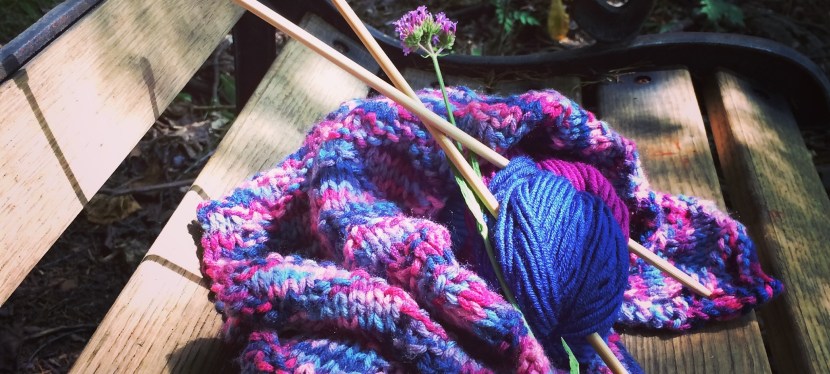
You’ve got a problem on your hands: what to do with all that clearance yarn? I’ve found myself in this dilemma lately. In knitting through my stash, I’ve come up against a plethora of bright, happy colored yarns – bought on clearance in years past – and no discernable plan for any of it. Here’s what I’m doing with it:

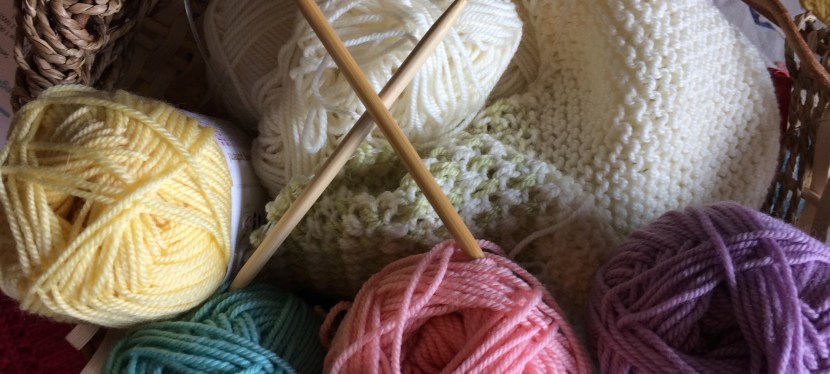
  • A Sampler Shawl. I’ve got six skeins of pastel colored cake-type yarn that looked good in the store but turned out scratchy and not-so-nice. I’m using it to try out some new stitches. This shawl may look okay when it’s finished; it might not. That’s okay.  I’ve tried out lots of new techniques and stitches I’ll use in other projects.
  • Mini Prayer Shawls. I’ve used up the Caron x Pantone mini-skeins to make small, coaster-sized squares to hand out as “thank you” gifts. I’ve been asked to speak at a local Book Club, and I’m planning to hand out these mini Prayer Shawls to those lovely ladies who bought and read my latest book. They could probably be used as coasters, phone charging pads, or some other household use.
  • Something wonderful and unexpected. Several years ago, I bought a huge plastic bag full of blue, green, and white yarn at a big box sale of manufacturer rejects and remainders. Just for kicks, I made a long and skinny shawl that’s become my favorite go-to early morning wrap. The yarn tuned out super soft, and the shawl is vibrant and looks terrific. Who knew?

I know you creative knitters will have many other uses for clearance yarn. Feel free to drop a comment to share your ideas with me and other readers!

Happy Knitting, Cindy

Cynthia Coe is the author of The Prayer Shawl Chronicles, a collection of interrelated short stories about knitters and those they meet through knitting and sharing prayer shawls. 
Psssst! The e-book edition of The Prayer Shawl Chronicles will soon be on sale! On Tuesday and Wednesday, August 13 & 14, The Prayer Shawl Chronicles will be on sale for only $1.99 at this link from 8 a.m. Eastern Time on Tuesday until 11 p.m. on Wednesday night. Give it a try and help me out by reviewing it on Amazon!

Stressed? Sit and Knit Awhile

It’s been a bad week here in America. Two mass shootings, stock market volatility, and the usual political divisiveness. Nerves are frayed, and many of us feel the stress.

For those of us who knit, a breather is just a couple of knitting needles and a ball of yarn away. If you’re suffering from jangled nerves, facing personal challenges, or just dealing with ordinary stress, pick up those needles and knit. You can knit anything – it’s doesn’t matter. The easier the project, the better. The point is to take a few minutes for yourself and your own mental health, check out from the rest of the world, and enjoy the peace and quiet for a while. 

In times of deep stress, I’ve always turned to my knitting needles. Several years ago, as I waited to travel to another part of the world to adopt my youngest child, I learned that the children in his orphanage could use handknitted hats and scarves. Delighted to hear this, I used this knitting time to soak up my stress and calm my nerves. When it came time to finally travel, I had an entire suitcase full of warm knitted hats and scarves for children who had no personal possessions, plus scarves for all their caretakers. 

Knitting can heal. Knitting is our own little time and space where we can re-group, re-think, and prepare to face the realities of the world once again.

Blessings for peace and resilience, Cindy

Cynthia Coe is the author of The Prayer Shawl Chronicles, fictional short stories about knitters of prayer shawls and how their gifts bless people they know or have never even met. The story “Hats for Orphans” is based on her own knitting of hats while an expectant adoptive mother. Available in e-book and paperback at this link.

Show Your Knitting Love With A Prayer Patch

Want to show someone some love through your knitting, but you don’t have time to knit an entire blanket or sweater? Try giving your loved one a “prayer patch.” 

A Prayer Patch is a small piece of knitting you give someone to simply show you care about them. Much like a full-blown Prayer Shawl, a Prayer Patch might be given to someone facing surgery, someone grieving a family member, or someone just going through a tough time. You could even give a Prayer Patch to someone simply to let them know you’re thinking about them. 

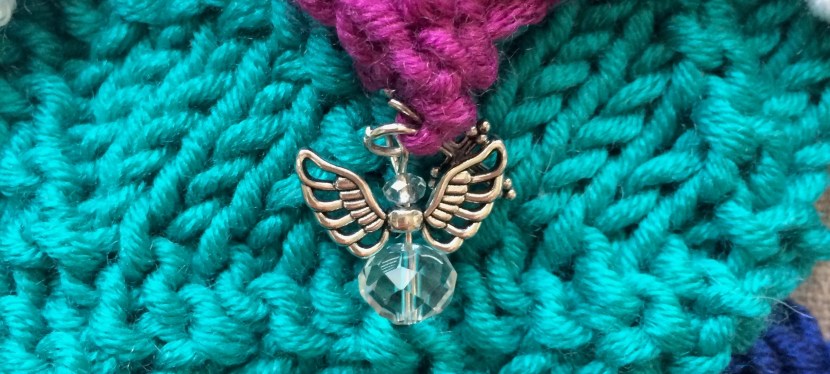
To make a Prayer Patch, you can use yarn leftover from a favorite project. You might even use a favorite stitch or pattern that’s so stuck in your head you can make it without thinking. You might even attach a small charm to your Prayer Patch, such as an angel, cross, or other symbol meaningful to your spiritual life. (I’ve found it’s easiest to leave a long tail when you cast off, then you have something ready-made for attaching the charm.)

Some churches, I hear, offer Prayer Patches to newcomers or those attending services who need a small token of their faith community’s love and care for them. (Psssst…in my new book, The Prayer Shawl Chronicles, a newcomer receives a Prayer Patch. Her life is changed forever, and she learns to knit – not necessarily in that order.)

What do you do with a Prayer Patch? You could tuck it into a purse or backpack. You could use it on your desk as a coaster or under your phone while it charges. It’s so small, you could keep it almost anywhere to remind you that someone loves you. Churches or other faith communities might send it along with a flower delivery or include it with a get-well card. It could even be a miniature version of a Prayer Shawl for the recipient to keep with them on-the-go. 

And for the knitter herself, making a Prayer Patch gives you space and time to be quiet, collect your thoughts, and perhaps remember a loved one in prayer. It’s an easy project, perfect for taking a half hour or so to simply and silently send your hopes and prayers to someone who needs them. 

Here’s a favorite Prayer Patch pattern I’d like to share with you:

The “Diamond of Hope” Prayer Patch

(I used the Caron x Pantone mini-skeins and size 10 needles. You can get two prayer patches out of each of these small skeins. You could use whatever yarn you have handy with appropriate sized needles.)

Cast on 17 Stitches.

Knit one row for a nice border.

Row 1 (Right Side): (P1, K7) x 2, P1

Row 2 (Wrong Side): K2, P5, K3, P5, K2

Row 3: K1, P2, K3, P2, K1, P2, K3, P2, K1

Row 4: P2, K2, P1, K2, P3, K2, P1, K2, P2

Row 5: K3, P3, K5, P3, K3

Row 6: P4, K1, P7, K1, P4

Row 7: Repeat Row 5

Row 8: Repeat Row 4

Row 9: Repeat Row 3

Row 10: Repeat Row 2

Repeat Rows 1-10, then Repeat Row 1 once more

Knit one row for a border.

Bind off. 

Leave a long tail for tying on a symbolic charm, such as an angel, cross or other sign of hope. 

This is easier than it looks! Once you get the pattern in your head, you can do it in your sleep. You’re always moving out from a point or in towards a point. 

The pattern makes one large diamond with 4 smaller diamonds inside it and 8 triangles around it, for a total of 12 spaces on the piece. (Twelve apostles total, with 4 writers of the Gospels, if you’re into symbolism.)

Blessings on your Prayer Patches, Cindy

Cynthia Coe is the author of The Prayer Shawl Chronicles, a book of related short stories in which prayer shawls end up in unlikely places, friendships are made through knitting, and people in need receive unexpected gifts. Available in e-book and paperback and included in Kindle Unlimited

Frogging Just Creates New Opportunities

This past week, I gasped in horror as my cat leapt into my lap, pulling apart a delicate piece of knitting I held in my hands. I couldn’t blame Scamper the Cat. He just wanted to sit in momma’s lap and purr. It’s not like he intended to make me lose several stitches that proved impossible to get back on the knitting needles.

I had to admit, I didn’t like the design of the intricate lacing of the shawl I was working on. The middle of the work looked messy, and I didn’t realize how bad it looked until I had progressed far beyond the point of fixing it. I played with the idea of frogging (“rip it, rip it, rip it out” for those not familiar with the knitting term for unravelling your work and starting over). But I couldn’t bear to tear out several inches of work. I had dithered back and forth for days, unhappy with my design and wondering if I should rip it.

Scamper the Cat made the decision for me. As I looked at the hopeless state of my knitting work, I realized he had actually done me a favor. Taking a deep breath, I pulled out several days worth of knitting and got the work back to a place where I could both re-do my design and get the stitches back on my needles. (Yarnovers and frogging don’t mix, I’ve discovered.) My evening of knitting turned out much more relaxing than I intended; ripping out is pretty mindless work.

We knitters are lucky. For those of us who knit, there are do-overs in life. Not many crafts allow you the opportunity to completely start over on a failed project with the same materials and without having to throw out pricey supplies. In fact, if you’re a “process knitter” like me, you just get more knitting time in with the same skein of yarn.

So if you have to frog your work, just remember it’s no big deal. Your work might look better in the end, and for once in your life, you get a do-over.

Blessings, Cindy

Cynthia Coe is the author of The Prayer Shawl Chronicles, a collection of interrelated short stories about knitters and those they meet through knitting and sharing prayer shawls. 

Craft Dates – Will Someone Have One and Invite Me?

Hi Friends! A new book came out today, and I want to share the basic idea of it with you: a Craft Date– a party to get together with friends and make a craft within the space of a couple of hours, plus refreshments. 

The concept of a craft date is to have a get-together with friends, have some food and drinks, and everybody makes a craft together. Every attendee is given a kit of supplies with everything you need to make a craft during the party – yarn, needles, pattern, or whatever supplies needed to do the craft at one sitting. The hostess has everything ready to go when the party-goers arrive, so that everyone can get going on the craft, help each other, and have a good time.

I would love to attend a craft date, and on a regular basis. Of course, I realize someone needs to put in a good amount of work to plan a craft date, gather and purchase supplies, provide refreshments, and host the party. But I’m thinking what a great idea for women’s clubs of all kinds, church groups, and local yarn shops. As a former church program planner, I’m thinking this would be a great way to get people together, perhaps monthly, to form connections and invite new people into a community. The effort would be well worth the time spent planning and rounding up materials. 

Would I pay a fee to participate? Oh yes. Instead of attending a “class” at a yarn store, I would much rather pay to attend a “date” or “party” with an emphasis on building friendships and learning a skill I could complete and take home with me in the space of a couple of hours. Why didn’t somebody think of this before?!

In our polarized, often over-digitalized world, knitting and crafting offer a chance for people of all walks of life to sit down and get to know each other in a pleasant, non-threatening, enjoyable, and welcoming community setting. As an added bonus, craft dates – duh – teach people the crafts we love so much and open them up to newcomers.

So I hope those of you who own yarn stores, plan events, or host women’s groups will consider sponsoring a craft date soon. (And I hope you’ll invite me!)

Blessings, Cindy

A Year of Creativity: A Craft Date Planner to Meet, Share, and Createby Petra Hoeksema; Lidy Nooij; Miriam Catshoek; and Bregje Konings, is available on Amazon in paperbackonly, currently on sale for $14.01 in the U.S. I especially liked the usefulness and practicality of the crafts featured. All of the crafts can be done in the space of a couple of hours. A few recipes are featured, as well. I hope this idea catches on! Thanks to the publisher, Quarto Publishing Group, and NetGalley for an advance digital copy of this beautiful book.

Cynthia Coe is the author of The Prayer Shawl Chronicles, a collection of interrelated short stories about knitters and those they meet through knitting and sharing prayer shawls. Available in e-book for US $4.99 and in paperback for $14.99. Read it for free if you have Kindle Unlimited! 
Your First Piece of Knitting Will Be Awful, And That’s Okay

I don’t know how many people have told me, “I tried to knit a scarf (or sweater, hat, blanket, sock), and it was awful.” They never try knitting again, and it’s a shame. I want to take such people by the hand, sit them down, and patiently ask them to at least try a second knitting project. It will be better, I would promise them.

When you learn to do something for the first time, you WILL make mistakes. That’s okay. It’s part of the learning process. I seriously doubt that anyone in the history of knitting (or any other craft) started and finished a project without at least a half dozen visible, obvious, and potentially disastrous mistakes. I now tell new knitters that they should plan to put their first project in the trash. If they do come up with something worth saving, we’ll all be happy and surprised. 

Do you remember your first knitted garment? I sure do. The first knitting project I tackled was a big orange and white blanket made solely with garter stitch, because my mom didn’t know how to purl. She didn’t know how to tie up loose ends either, apparently. That first blanket I made (now enjoyed by my dog) has less-than-charming little pieces of loose ends hanging out on every side and seam. 

As a twenty-something, I took up knitting again, this time asking help from the experts at my local yarn store, The Knit Wits. The elderly ladies who worked at the shop patiently taught me how to purl, increase, decrease, and properly sew my pieces together and tie up loose ends. I’m eternally grateful to those ladies. The sweater they had me knit ended up kinda messy, but that’s okay. My skills increased by leaps and bounds. My next sweater looked terrific, and I was well on my way to the ranks of “accomplished knitter.”

So if you’re just learning to knit or still a beginner, give yourself a break. If your knitting isn’t perfect, know that we’ve all been there at some point. I would guess that all knitters have an awful mess of a first project they’ll never forget. But those of us who love knitting so much eventually tackled a second project and maybe even a project down the road we consider a minor masterpiece. And we all hope you’ll try that second project, too. 

Knitting blessings, Cindy

Cynthia Coe is the author of the just-published book, The Prayer Shawl Chronicles. This fictional collection of short stories includes tales of several newbie knitters and those saintly women who mentor them, forging friendships and incredible connections. Available at this link in paperback and e-book edition. Included in Kindle Unlimited.

Let’s Talk Needles – What Do You Really Need?

Knitting needles come in all materials, brands, and sizes. But what do we really need in our “must have” toolkit? 

Recently, I cleaned out my drawers of unused knitting needles and donated them to my child’s school. The librarian had a knitting elective for the middle school students and needed starter needles. (Wish I had gone to that school!) I learned a lot myself, seeing what I kept and what I donated.

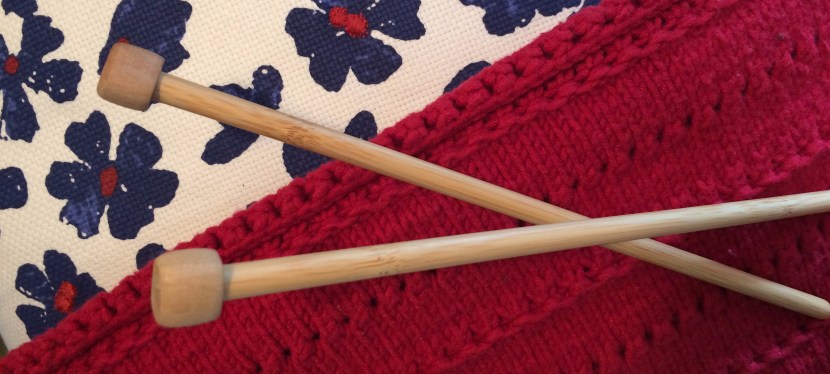
I’ve gone to almost exclusively bamboo or wood needles. Maybe it’s all in my head, but I seem to be able to knit longer and more comfortably with bamboo needles. However, I had a surplus of my favorite size, 8, and still had to go to the craft store when I needed yet another size I didn’t have. I finally purchased a set of interchangeable bamboo needles. Not only are my knitting needles much more organized and in one place, I have just about every size I could possibly ever need. It was a good investment.

And then I took up sock knitting, which I quickly learned needed a whole new set of knitting tools. I’m adverse to double pointed needles, so I got myself a teeny-tiny set of interchangeables just for socks. They came in a cute little cloth pouch that’s handy when travelling and includes teeny-tiny markers I didn’t know I needed until I began using them. Once I got to the toes of my first socks, I grudgingly realized I did need a set of double pointed needles. Having read reviews saying the small wooden double points tend to snap in two, I got an inexpensive set of metal double points to cover most projects. They get the job done. 

Despite the cost, I’ve become a fan of sets of needles sold in organized, built-to-last packaging. I’ve ultimately saved a lot of time scrounging around my needle supply drawer, wondering if I have the right sized needles for a new project. Now I know I’m set for life (I hope). Are the sets more expensive? Yes. I wish I had started out with sets years ago, but they weren’t available back then. 

And is my beloved craft of knitting worth an investment in the most effective and comfortable knitting needles I can afford? You bet!

Happy Knitting, Cindy

Cynthia Coe is the author of The Prayer Shawl Chronicles, a book of interrelated short stories and women who knit and those who receive their wonderful gifts, mostly out of the blue. The first chapter of The Prayer Shawl Chroniclesis available to read as a free sample by clicking “Look Inside” at this link

Knit Generously – Knitting for Charity

I was in a fabric shop recently when I heard a woman at the cutting counter say this to the clerk: “I want something as cheap as possible. It’s just for charity.”

My immediate reaction was “ugghhhh.” In one respect, I get it. You have your own bills to pay, but you still want to donate your crafting skills to a good cause. You may need to spend as little as possible to make a gift for someone else. But it’s all in the tone of voice, and I had the distinct impression that this woman thought those on the receiving end of her charity crafting didn’t quite deserve anything but the cheapest, lowest quality materials for her project.

It all goes back to the purpose and intention of a gift. Do we go cheap and give as little as possible, even if we could afford much more and much better? Or do we give the best we can afford, thinking about what those receiving our gifts will appreciate?

This is not to say that inexpensive yarns can’t make great charity gifts. I’ve knitted numerous hats, scarves, and prayer shawls using clearance sale yarn or even remnants from other projects. But each of these items were gifts I could be proud to share and present to someone, anyone. I’ve knitted little hats for kids in an orphanage in a cold place, so they could go outside wearing cute, cheerful knitwear that might help them feel good about themselves and let them know that someone, somewhere, cares about them. I’ve knitted prayer shawls for cancer patients and nursing home patients in bright colors to cheer them up and help lighten their emotional burdens. 

My rule of thumb for all of these projects: knit generously. Make a knitted project someone else would truly love to receive and wear. Use yarn you’d use in making something for yourself or a loved one. Because when we knit for charity, we knit for someone who needs to be loved. That homeless person receiving the hat, that nursing home patient receiving a shawl might not have anyone else but you to knit for them and show them someone cares.

Blessings, Cindy

Cynthia Coe is the author of the newly published book The Prayer Shawl Chronicles. The story “Hats for Orphans” in this book is based on her experience in knitting hats for children in Arkhangelsk, Russia.  Available in paperback and on Kindle, included in Kindle Unlimited

New Knitting Books for Summer 2019

Greetings, Knitters! I hope you are having a wonderful summer (or winter, for friends Down Under) and getting in some good knitting time. 

Do you get patterns from knitting books? Personally, I get my patterns from a variety of sources – online patterns sold individually, magazines I pick up in the grocery store, and a handful of go-to and much used knitting books. I know online patterns bought digitally from Ravelry, Etsy, or other websites are all the rage, but believe or not, some good knitting pattern books are still being published (and you can keep them all in one place on your bookshelf).

Sycamore Cove Knitting reviews the new ones in advance of publication and gives you the scoop on what’s new and worthwhile. Here’s what new and just published in knitting books for June-July 2019:

Big Yarn, Beautiful Lace Knits by Barbara Benson. A very nice pattern book for the coming cool weather season. The concept of this book is lace knitting with larger sized needles and bulkier weights. The results? Quicker projects with more intricate, showier designs than you normally see with bulky yarns.

The Art of Circular Yokes by Kerry Bogert. This book of yoke sweater patterns give the advanced knitter plenty to sink her teeth into. The designs are lovely and intricate. Most of them are designed for small needles and fairly fine yarn. These are projects that will take a lot of skill, time, and concentration.

 One Stitch Baby Knits by Val Pierce. This is a nice collection of baby knit patterns. They are intended as “beginner” level patterns, but I would rate them as more “advanced beginner” or even “intermediate” level patterns. This is by a British knitting expert, and I appreciate that she took the trouble to translate some of the British knitting terms into American English. However, many of the yarns listed are those available in Britain; I only recognized one yarn readily available in the U.S.

 A Year of Creativity by Petra Hoeksema, Lidy Nooij, Miriam Catshoek, and Bregje Konings. This books is all about “craft dates” for knitters and other crafty people. The idea is to get friends together, share some snacks, have fun, and everybody makes a craft together. I quite like this idea, and it’s a beautiful book. Coming July 23.

And now time for the shameless plug:

The Prayer Shawl Chronicles by Cynthia Coe: Set in an Episcopal parish in Tennessee, hear the stories of women who knit and donate prayer shawls and the remarkable and remarkable connections with those who receive them. A fairly quick read of short stories, this book is great for taking along on vacation.

Enjoy your Summer Knitting! Cindy

Cynthia Coe is the author of The Prayer Shawl Chronicles: Stories of Unlikely Connections & Unexpected Gifts. Available worldwide exclusively on Amazon and included in Kindle Unlimited. Paperback edition coming very soon.

Designing the Perfect Beach Cover-Up

Before I went to the beach this summer, I dreamed of the perfect beach cover-up. It would be all cotton and a light color for high temperatures on the coast of South Carolina in June. It would be mini-skirt length and have kicky vents on the sides to show off my legs and for freedom of movement when I went on one of my long and meditative walks on the beach. It would cover my shoulders and prevent sunburn. It would have a rounded but modest neckline. It would feel loose and free and fit me perfectly.

Alas, I looked and looked through umpteen pattern books and magazines but found nothing even close to what I wanted. So, I designed my own. I’ve been knitting since I was a teenager, usually easy patterns that allow me to watch TV or just sit and think while I knit. I don’t go for anything complicated or patterns that have me glued to an incomprehensible piece of paper or that gives me eye strain.

Much to my surprise, for my first beach cover-up design, I came up with an incredibly simple pattern that fits me perfectly, covers my shoulders, and is flowy and comfortable to wear. Here’s the pattern (such as it is – it’s in plain English, no abbreviations, challenging techniques, or anything a moderately experienced knitter couldn’t pull off):

The “Cindy” Beach Cover-Up

General Concept:Knit two large rectangles and a drawstring. Knit holes below the bustline to insert the drawstring.  Adjust measurements to fit yourself. (I’m 5’4” and wear US dress sizes 10-12.)

Materials:

Bernat Handicrafter Cotton Yarn(Two 12 ounce skeins, you’ll have lots left over)

-Size 9 circular needles

-stitch holder for neckline

Front: 

-Cast on 84 stitches (more or less if you’re bigger or smaller)

-Knit until you’ve got 21 inches (again, adjust if your waistline if longer or shorter)

-Put in holes in the next row. (I used a pattern of knit two + yarnovers to accomplish this)

-Knit until you’ve got a total of 30” (more or less, adjusting for your size)

-To make a simple rounded neckline, bind off about 20 stitches in the middle of the garment, decrease on each side of the neckline until you have about 22 stitches on each side

-Bind off each side

Back:

-Cast on 84 stitches (or same number you cast on for the front)

-Knit until you’ve got 21 inches (or same length to drawstring row as the front)

-Put in a row of holes for the drawstring (Knit Two + yarnovers)

-Knit until you’ve got a total of 31” (more or less depending on depth of back neckline)

-Cast off about 20 stitches, decrease each side until you’ve got 22 stitches on each side

-Bind off each side

Drawstring:

-Cast on 3 stitches, make an I-cord (look online for how to do this; use double pointed needles or circular needles – it’s easy)

-Make the drawstring as long as you want it (I’d make it 70” to 80”, depending on your waistline)

-Cast off

Construction:

-attach the front to the back by putting seams on each side between the drawstring row and about 8-10” from the bottom (leaving vents for ease of movement)

-if neckline is floppy, crochet one row around it to cinch it up a bit

-sting the drawstring through the holes and cinch for comfort

Extras: (These are what I did to personalize my own beach cover-up)

-for a cooler garment, make rows of holes (simple knit two + yarnover pattern) along the bottom few rows

-to add texture to the bottom of the garment, I used this pattern: Knit rows 1, 3, & 4; purl row 2

-to add texture to the top of the garment, I used this pattern: on reverse side, purl two, yarnover, purl 2 more, pull yarnover stitch over the last two purls (I added this pattern about every 4 rows)

For more info on basic stitches and construction of garments, I highly recommend the new Vogue Knitting book. It’s a huge book that covers it all.  If you had to buy one book on knitting, this would be the one. Available at: https://amzn.to/2sImZ7W

If you like to design your own projects, a good comprehensive stitch dictionary is invaluable. You might try Debbie Tomkies’ Knit Stitch Dictionary: 250 Essential Knit Stitches, available affordably in both paperback and Kindle editions at: https://amzn.to/2JzCJjS

Blessings, Cindy

Copyright 2018 Cynthia Coe. All rights reserved!