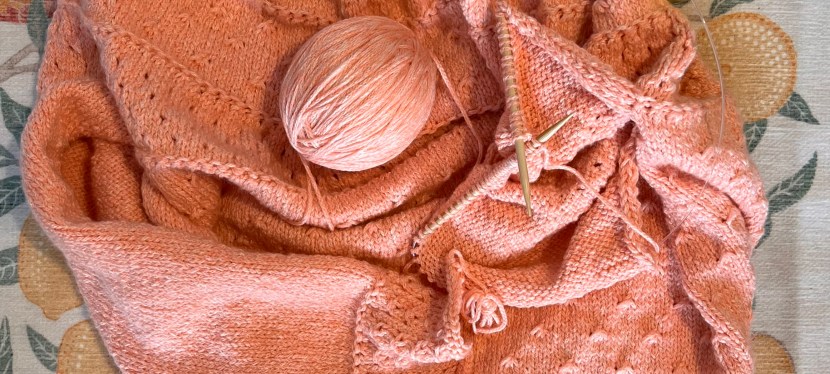
Creative Detours (and the next book in the Prayer Shawl Chronicles)

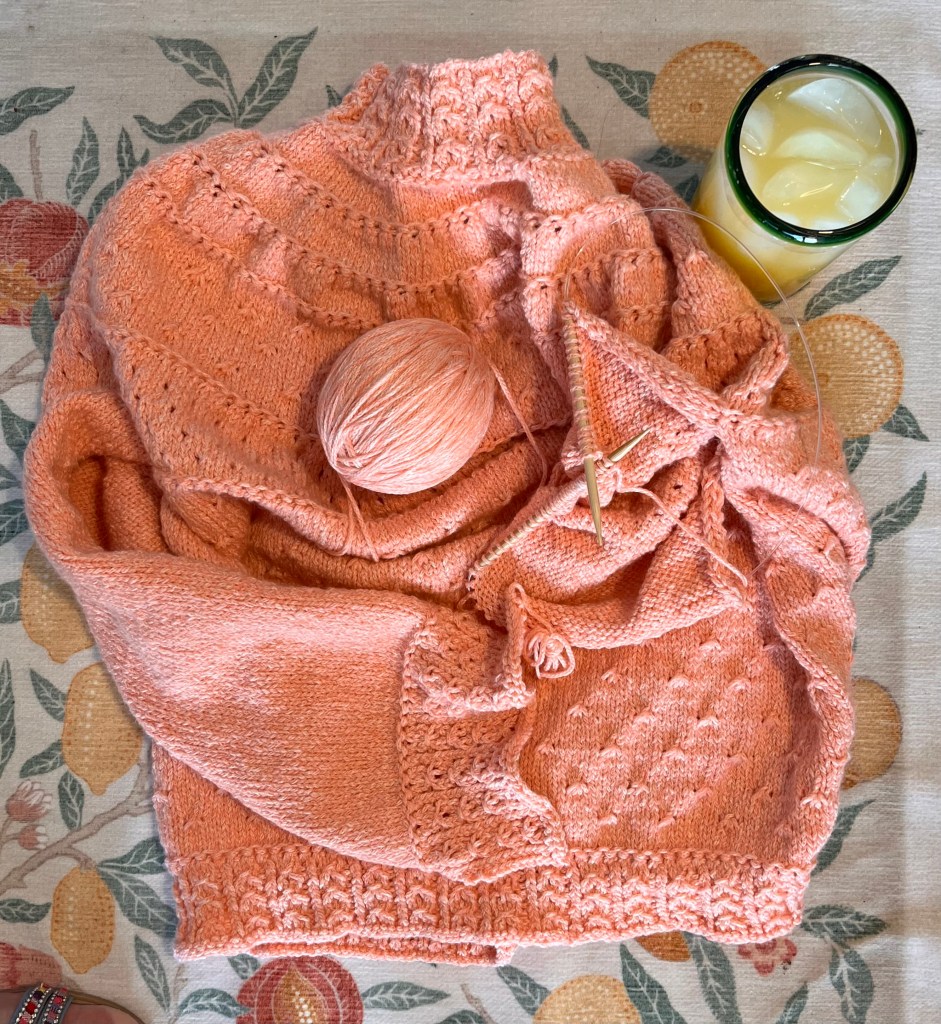
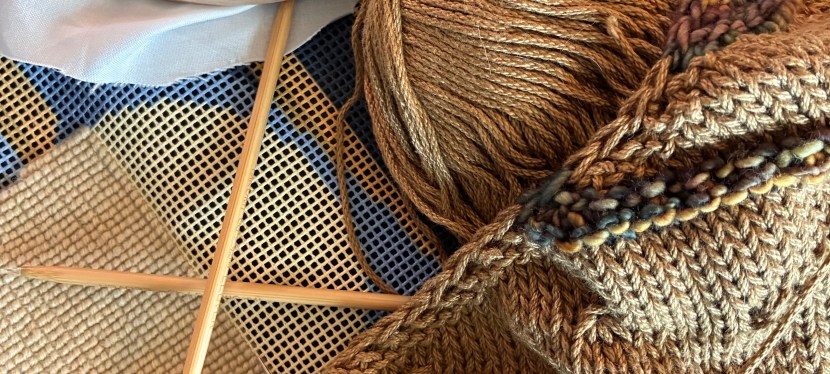
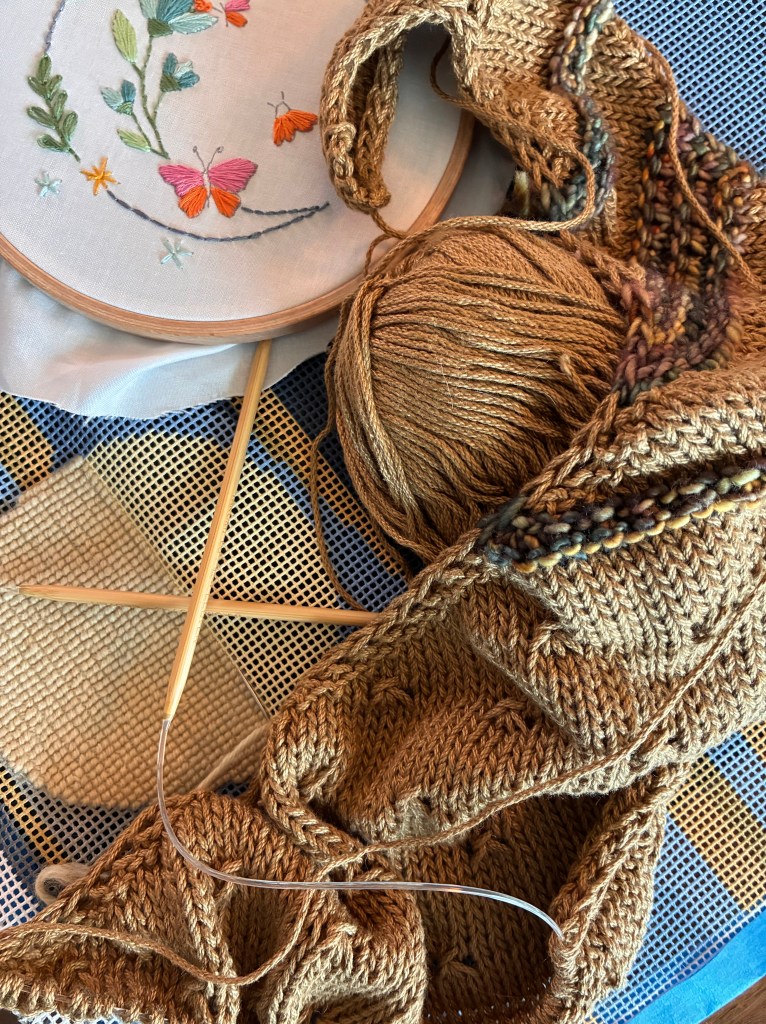
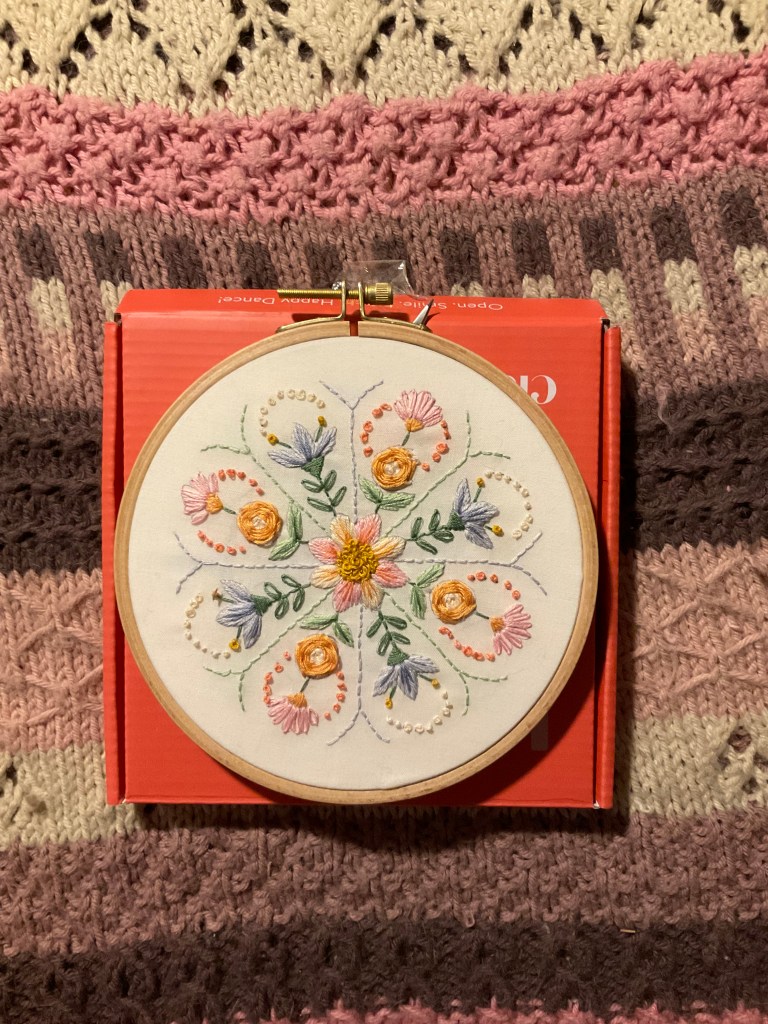
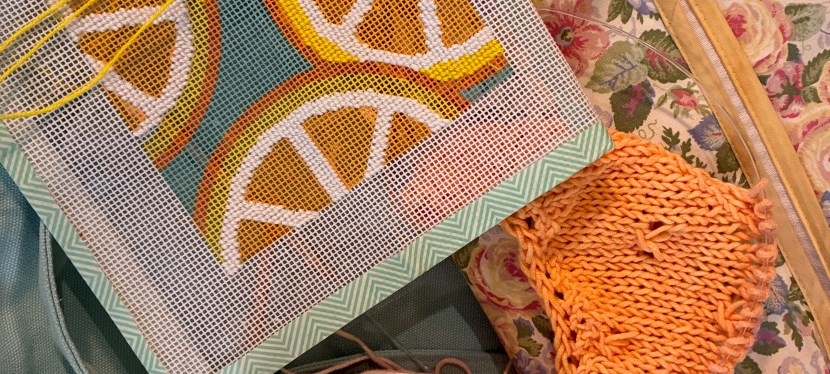
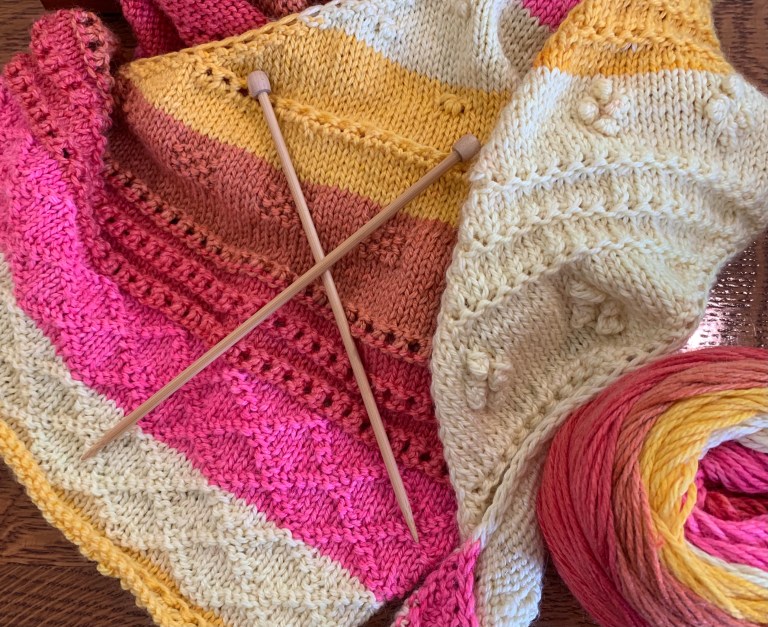
Sometimes even knitters need a break. I’ve set down my needles for a bit and picked up needlepoint — a portable, colorful craft that feels like fingerpainting with thread. After finishing the next-to-last draft of my new Prayer Shawl Chronicles novel, my brain needs a rest.

Do you ever get tired of knitting, even if it’s your primary hobby?

I’ve hit one of those times when I want to do “something else” for a little while — much like when I take a break from my beloved dance aerobics to do yoga, beach walks, or try something new. I always circle back to dance aerobics, and I always circle back to knitting.

Right now, though, I’m rediscovering needlepoint. It’s small, portable, and easy to do — almost like fingerpainting with thread and a needle. On a recent trip to Québec and Montréal, I tucked a little project into my bag and enjoyed the mindful rhythm of stitching in quiet moments. There’s something deeply satisfying about the relatively mindless rhythm of needlepoint: no designing, no choosing patterns, no counting stitches. Just color and thread.

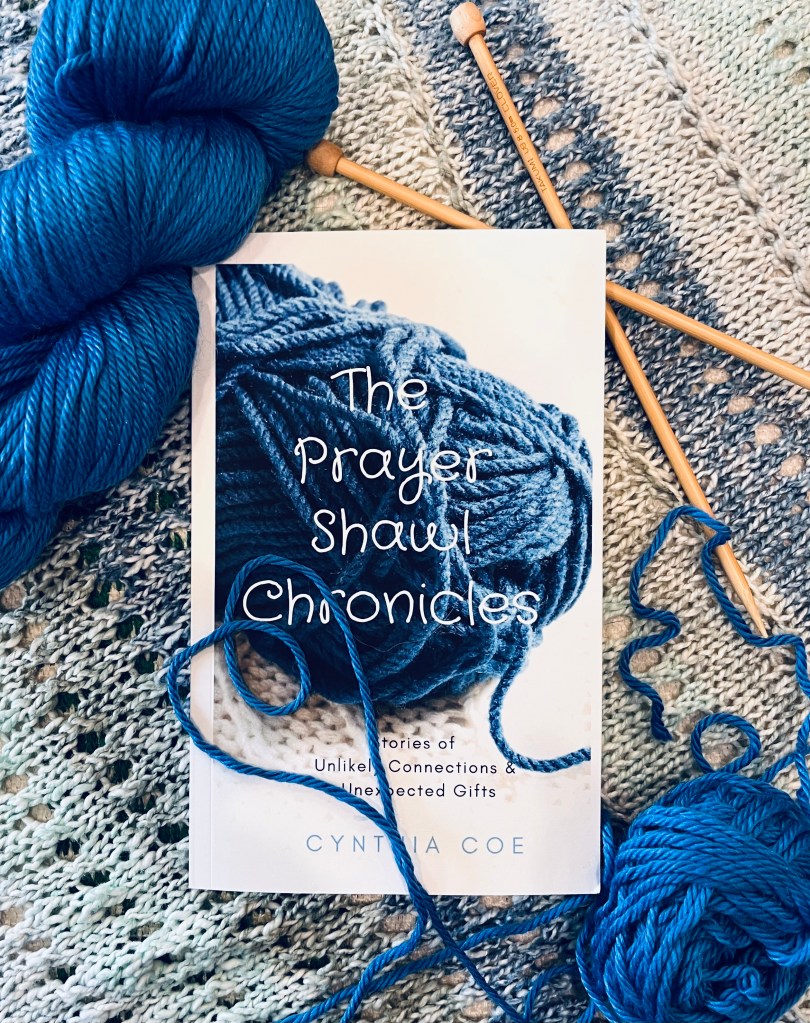
And here’s the real reason for this creative detour: my brain is fried. I’ve just finished the next-to-last draft of my new novel — the upcoming book in The Prayer Shawl Chronicles series. This story travels from Bruges to Sevilla, then across the ocean to Peru and Florida… and it has worn me out!

So for now, I’m resting my writer’s mind with a few easy stitches. But you know me — I’ll be back to knitting soon enough… 🧶…as soon as I finish the final draft of my new novel!

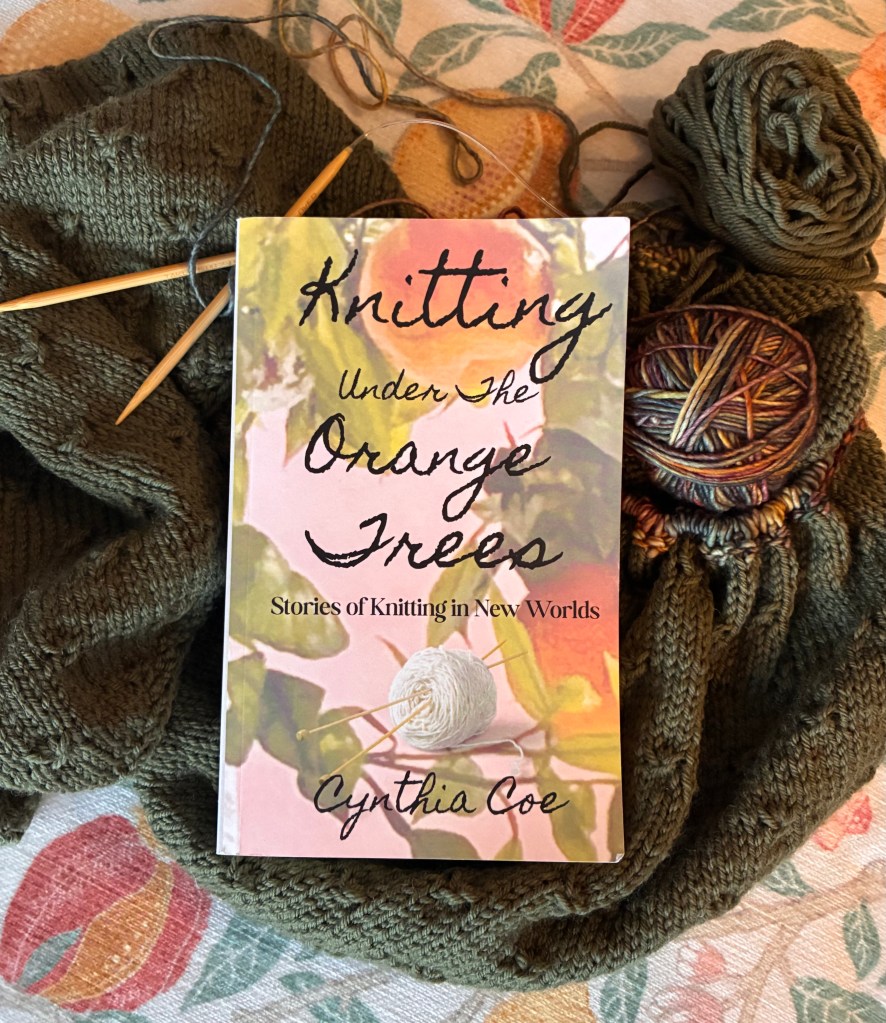
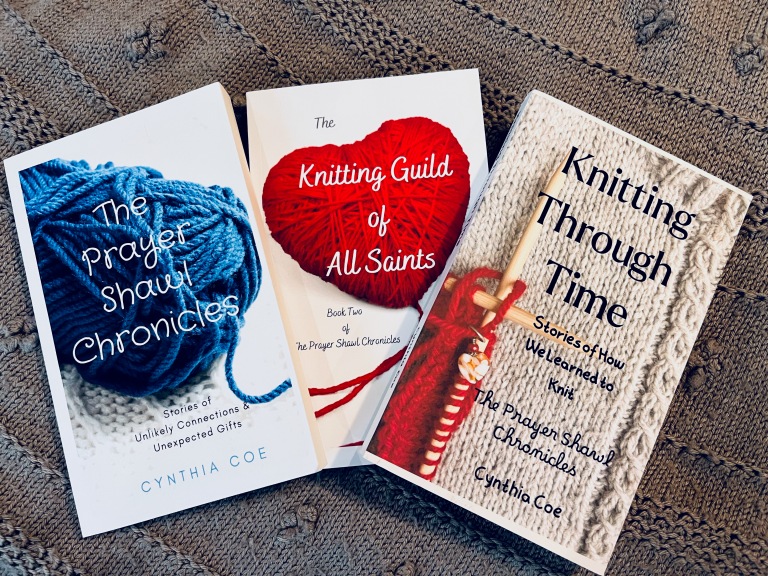
Cynthia Coe is the author of The Prayer Shawl Chronicles, a series of fictional stories woven together by the theme of human connections made through prayer shawls and the craft of knitting. Her newest book is her first historical novel, Knitting Through Time: Stories of How We Learned to Knit. Learn more by visiting her Author Page at this link

Why You Shouldn’t Be Embarrassed to Do “Granny Crafts”


If you’re a 20-something who knits, crochets, or embroiders—this is for you. Granny Crafts aren’t just for grannies. They’re quiet, powerful tools for stress relief, creativity, and deep comfort through every stage of life.

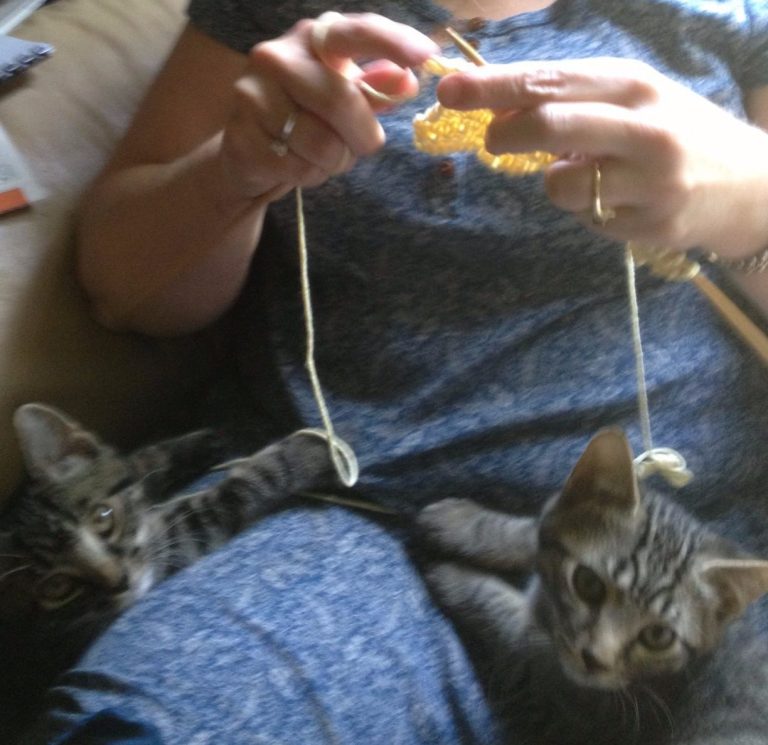
Cindy Knitting with Cats

Dear Young Crafty Kindred Spirit,

Lately, more and more people are talking about how young adults are embracing so-called “Granny Crafts”—and I love it.

If you’re here because you knit, crochet, embroider, or sew—or want to—you’re in good company. I’ve been knitting since I was a teenager myself. But it wasn’t until college, when stress started to weigh heavy on my shoulders, that I really picked it up as a coping mechanism. I’d sit in my dorm room or in a quiet corner of the student center, needles in hand, letting the rhythm of the yarn pull me back from the brink.

Some days, you just want everything—school, jobs, relationships, even the noise of the world—to go away for a while. I get it.

You were born into the digital age. My own kids got their first iPods in middle school and were among the first to start texting. Now, we all carry around little rectangles that buzz and ping and demand our attention 24/7. But here’s the secret: you can turn it off. Just for a few minutes. Really. The world won’t end.

And when you do? That’s when Granny Crafts work their quiet magic.

There’s no algorithm here. No pressure to go viral. No rush to the finish line. When you pick up a needle or a hook, it’s just you, your yarn, and your own rhythm. You can work slowly. Thoughtfully. Or set it down and pick it back up a month later. Granny Crafts are deeply human—analog, if you will. They exist on your terms, not someone else’s timeline.

You may not know it yet, but you’re building something far bigger than a handmade scarf. You’re building a lifelong tool for patience and comfort. Someday, you’ll find yourself stuck in medical waiting rooms. You’ll sit through school pickup lines or kids’ gymnastics practice. You’ll be at hospital bedsides or nursing homes, offering your presence when there’s nothing more you can do. Except this: stitch by stitch, you wait. You love. You breathe.

Granny Crafts give you something to hold on to when the rest of life feels uncertain. They will anchor you when stress comes crashing in, and they will accompany you through every phase of adulthood with grace and beauty.

Welcome to the circle. You’re not alone.

With love and yarn,
Cindy
Knitter, writer, and lifelong lover of “Granny Crafts”

If you’re looking for stories of other women—young, old, and in-between—who have walked that road, I invite you to follow my blog and check out my novels. I write about knitting, community, and faith in a world that is often spinning too fast. Sometimes, we need the quiet power of yarn and human connection to slow it down.

Cynthia Coe is the author of The Prayer Shawl Chronicles, a series of fictional stories woven together by the theme of human connections made through prayer shawls and the craft of knitting. Her newest book is her first historical novel, Knitting Through Time: Stories of How We Learned to Knit. Learn more by visiting her Author Page at this link

Your Crafting Supplier Goes Out of Business. What do you do?

Many of us have recently learned that a major crafting retailer is going out of business for good, nationwide. And many of us wonder, what to do? Here are tips.

Here we go again: another round of business closings, and this time it affects our beloved hobbies of knitting, sewing, crocheting, jewelry making, and many other crafts. Those of us using these hobbies to keep our sanity, calm down, express creativity, or just make something nice for ourselves or loved ones might wonder how we get the basic supplies for these crafts.

We’ve been here before. During the pandemic, ALL of the online retailers supplying my yarns for knitting eventually went out of business. And reader, I got some huge bargains on top quality yarns, which I’m still using and expect to use for many years to come. Here’s what I learned:

  • Don’t fret about where to buy your next yarn stashes just yet. Nature abhors a vacuum. Supply markets naturally fill gaps when they arise. If you don’t have a nice place to buy crafting materials in the near future, again, Patience! Work through your stash. If you have indeed bought plenty of yarns or other materials from the big going-out-of-business sales, you’ll have plenty to do. If you must, order online or visit a locally owned shop. At some point, if there’s demand, another business will snatch up the market for reasonably priced crafting materials!
  • Deep Clearance Sales WILL Happen. You’re about to scoop up some deals on crafting supplies, but you may need to be patient. Businesses handle these closure sales different ways. One retailer suddenly had huge sales BEFORE announcing a closure. If you see this, read the red flags and move! On the other hand, other businesses may keep trying to sell merchandise they think they can squeeze more money out of before they are finally forced to go to deep discounts. If you KNOW a business is closing and still has vast quantities of yarns or other craft supplies on hand, wait. Then, when those discounts finally happen, pounce!
  • Buy plenty of yarn or other supplies you absolutely know you will use. If you knit sweaters or blankets, there will be no way to get more skeins if you run out. Buy at least as much as you think you’ll need for a project, plus extra. (You can always make something small, like a cowl or coasters, with the spare materials after you finish your big project.)
  • On the other hand, DON’T buy yarn you know deep in your heart you’ll never use. Just because something is 90% off doesn’t mean it’s a great deal for you. Only buy yarns you would have bought or strongly considered buying if not on sale. If you see something at 75-90% off that you think you might want to try for a small project, go ahead if you have the spare cash. Otherwise, don’t buy something that will be sitting in a closet ten years from now.
  • Think about storage and future plans. During the pandemic, I bought huge amounts of all-wool yarns in my favorite colors and weights. I was also in the process of moving and downsizing. Given that I will (and already have) put these yarns to good use at some point, I ended up re-purposing a china cabinet for these yarns. I ditched a bunch of things that cabinet used to hold – items I never used. Before you buy huge amounts of yarn or other crafting supplies, think: where will I store it, what can I get rid of to free up storage, and do my future plans allow for this? (Pssst…you might get storage bins on sale, too, if you have room for them.)
  • If you’re buying wool yarns, think about preservation. Moths just love wool. They love to eat it, especially if hidden away in quiet, dark places. So if your yarn-buying spree involves wool or other such yarns, be prepared to seal up your purchases in large plastic bags. Save yourself future heartbreak.

In the meantime, happy retail therapy at bargain prices!!! Cindy

Cynthia Coe is the author of The Prayer Shawl Chronicles, a collection of interrelated short stories about knitters and those they meet through knitting and sharing prayer shawls. 

Be sure to check out my newly published A Prayer Shawl Handbook: Inspiration and Resources for Your Prayer Shawl Ministry, now available in paperback and e-book editions and included in Kindle Unlimited.

Cynthia Coe is a writer, book reviewer, and avid knitter. Her books and blog posts can be found on her Amazon Author Page

Christmas Crafting is the Opposite of Christmas Shopping

Click, it’s in your shopping basket. Click, you’ve paid for it. Your purchase will appear on your doorstep in two days without any further effort on your part. 

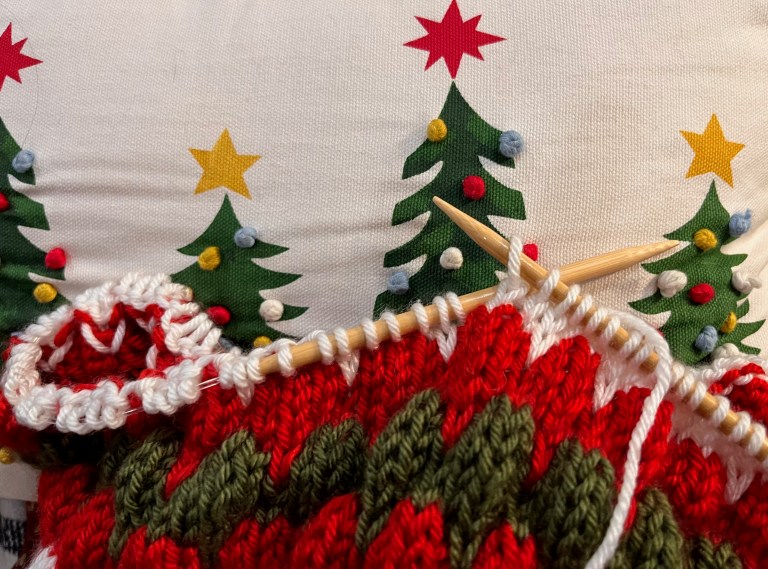
I bought a pair of shoes on deep discount this morning, at breakfast and as easy as pressing digital buttons on my phone while still half asleep. As I later picked up my knitting needles to work on a Christmas blanket project, I couldn’t help but think how my Christmas knitting differed so starkly from my Christmas shopping.

My Christmas knitting project will not be finished in two days. It will probably not be finished by Christmas, in fact. And that’s okay. It’s the slow, calming process that matters to me most. How many “clicks” will it take? Thousands, and that’s kinda the point, too. 

The clicking of my phone generally does nothing for me but momentarily serve my impulses to acquire yet another shiny new object I really don’t need. Am I calmer afterwards? Not really. I might get a temporary hit of joy for a minute or two, along with some satisfaction two days later when my item arrives. 

On the opposite end of the spectrum of satisfaction, the clicking of my knitting needles keeps me calmer and lowers my blood pressure for several hours, at least. After a half hour of crafting with real materials and with all my fingers (not just the right index finger), my mind is cleared to move on to creative work, planning, or just strategizing to get through the rest of the day. 

Crafting highs last much, much longer than online shopping highs. Shopping highs rank right up there with sugar highs for the rebound drops in any joy or satisfaction you got for your so-called efforts. But after crafting for a bit, the calm and satisfaction of actually making something stays with you for a good, long while. And if that satisfaction starts to flag, just pick up those knitting needles again and knit another row. Or just pick up your project and admire what you’ve done, all by yourself. Better yet, show your work to a friend and watch the utter amazement in someone else’s eyes, flabbergasted that you can turn skeins of yarn into a sweater just as nice as whatever they just paid for with their own meager clicking on their phone.

Slow down this Christmas and Advent season. Save your clicking for something that will last, something that will give you fulfillment, a sense of true peace, and maybe even a unique and meaningful gift for someone else. 

With blessings for peace and calm this holiday season, Cindy

Cynthia Coe is the author of The Prayer Shawl Chronicles, a series of fictional stories woven together by the theme of human connections made through prayer shawls and the craft of knitting. Her newest book is her first historical novel, Knitting Through Time: Stories of How We Learned to Knit. Learn more by visiting her Author Page at this link

Keep Knitting Fresh and Interesting – Learn New Skills

Feeling in a rut? Do you find yourself knitting the same patterns over and over again? It’s time to switch things up! 

If you’re like me, you have several “go to” patterns you can do in your sleep…or certainly while watching your favorite show on TV. You know exactly how many stitches to cast on, how much yarn the project will take, and which size needles to use. But you may also have umpteen of this finished project – with too many blankets, shawls, pullover sweaters, or whatever this “go to” project is – filling up closets or going unused. 

If this is you, it might be time to learn a new knitting skill. Yes, it will be hard at first. Yes, you will make mistakes and will likely have to frog the thing at least once. But the upside is that you’ll have a new technique in your toolkit of knitting designs and skills. You might even have a new favorite project on your hands.

The best way to learn a new project, at least for me, is to purchase a kit that includes an understandable pattern and exactly the amount and type of yarn you’ll need to complete the project. I had been reluctant to buy kits in the past, scarred by memories of paint-by-number art kits in childhood that never had enough paint to finish the project. But happily, the knitting projects I’ve bought in the last several years have had more than enough yarn to complete projects.  (And I’ve bought numerous knitting kits from a wide variety of companies, especially during the pandemic).

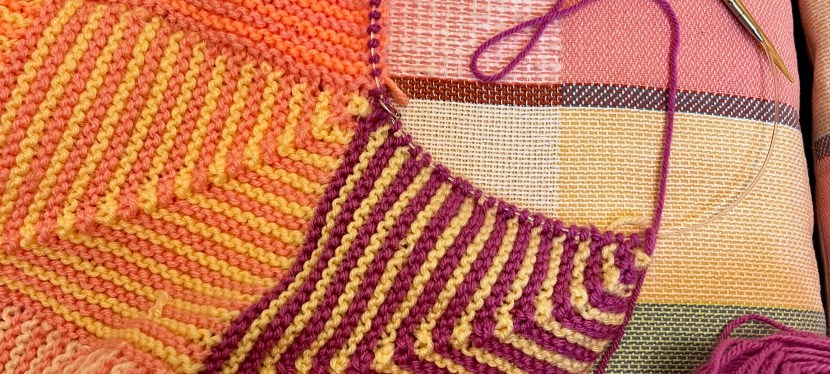
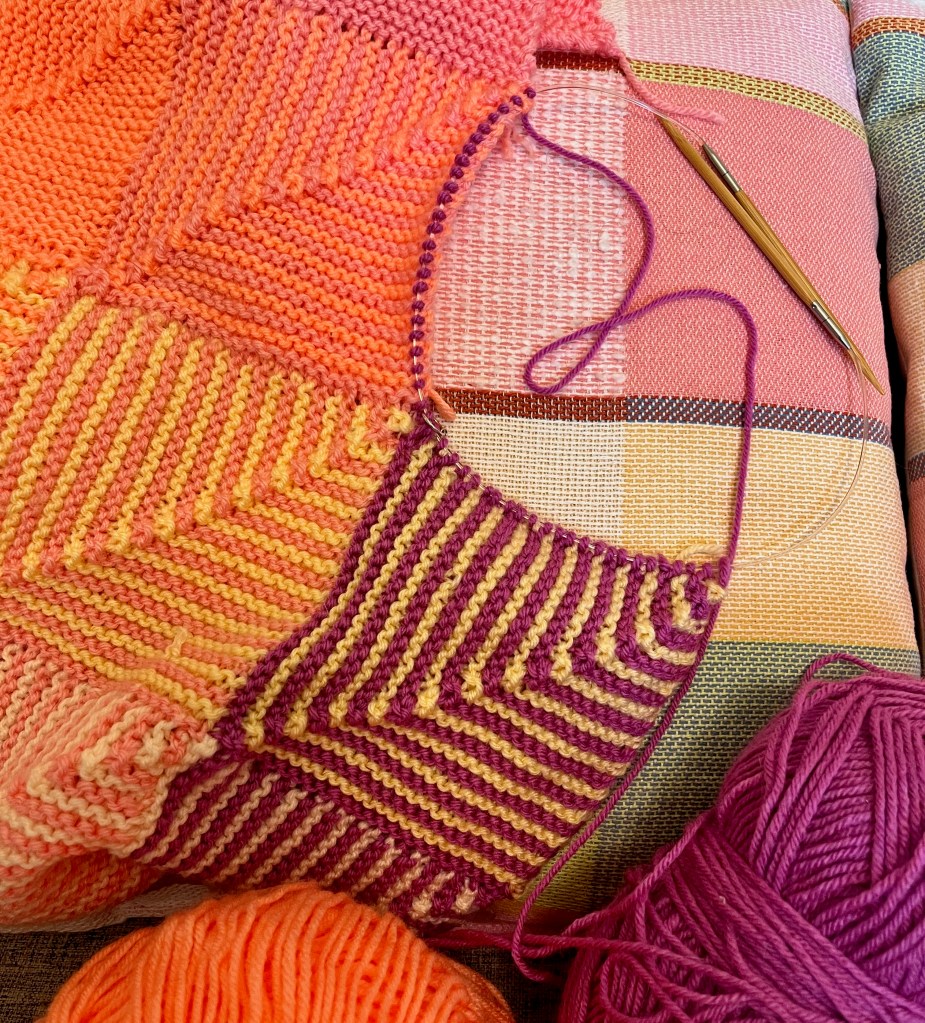
My latest new-to-me knitting skill is the mitered square technique. I found the technique a little trippy – you start with a straight line, and by decreasing in the middle of the row, you end up with a square. Who comes up with this stuff??? I’ve enjoyed making a blanket using this stitch, with some simple colorwork to mix it up as well. Yes, it took me a couple of tries to get it right, but I can now do it like a pro. I’ll definitely use the technique again to make placemats, bath rugs and other household items requiring a fairly sturdy fabric.

Of course, some kits I’ve tried have ended up as “never again” projects. One cardigan sweater kit I bought required me to flip the project around six times and use short rows for some purpose I could not discern. But even the “never again” projects keep knitting interesting and my brain continuing to learn. 

As much as I enjoy simple, meditative knitting projects, I always enjoy a new challenge, too. We all need to keep our minds and souls fresh, active, and open to new experiences!

Knitting Blessings, Cindy

Cynthia Coe is the author of The Prayer Shawl Chronicles, a series of fictional stories woven together by the theme of human connections made through prayer shawls and the craft of knitting. Her newest book is her first historical novel, Knitting Through Time: Stories of How We Learned to Knit. Learn more by visiting her Author Page at this link

What is Nalbinding, and What Does It Have to do with Knitting?

At some point in history, humans learned to make fabric by forming loops with yarn or whatever fiber they had on hand. But this wasn’t knitting; it wasn’t crochet. It was an ancient craft called nalbinding

Apparently, humans first learned to make fabric by sewing together animal hides, using crude needles made of wood or bone. For “thread,” they used animal fibers (wool) they rolled together to form a crude yarn. At some point, some clever person figured out how to make a stretchy fabric by winding loops of this yarn around her fingers, making a chain of loops with her bone or wood “needle.” That became the ancient craft of nalbinding. 

Nalbinding in one form or another was done by humans all over the world. Forms of nalbinding have been discovered in the Middle East, Europe, Africa, the Asian Pacific islands, and among the indigenous peoples of the Americas. Apparently, the urge and need to make fabric out of a bone or piece of wood with a hole in the end of it, using a length of string of some sort was once a basic means of providing warmth, décor, and protection to a woman’s loved ones.

But how did knitting come out of this long history of nalbinding? No one knows. In my new book, Knitting Through Time, I make a stab at suggesting how this might have happened. We know that knitting was first done in the Middle East, so I came up with a plausible story of how someone with lots of time on her hands came up with knitting out of necessity, then spread this new craft far and wide. Is this “true”? You’ll have to read the book and decide for yourself! 

However knitting came to be part of our cultures, I think we can assume that this craft was passed woman to woman, mother to daughter, friend to friend – just like many of us still learn to knit or learn more advanced knitting techniques. Last evening, in preparing to write this blog post, I sat down with a nalbinding needle, wool yarn, and numerous videos demonstrating the craft of nalbinding. Reader, I was an abject failure. Why? I needed a real person to show me how to hold the yarn, correct my obvious mistakes, and to guide my hopelessly untrained fingers. Sadly, I have no one to show me, in person, what I was doing wrong.

We pass on our cultures, our crafts, and the very essence of ourselves to our loved ones and to others in our communities through small moments of one-on-one demonstrations and conversations. I sincerely hope we all will keep knitting and other crafts alive through this long history of sharing our crafts, our knowledge, and our time.

Blessings, Cindy

Recommended Resources:

Nalbinding: What in the World is That? by Ulrike Classen-Buttner, available in English on Amazon at https://amzn.to/3Lkg3FT.

Bone Nalbinding Needle by Hearth and Bone, available at https://amzn.to/464uJCS.

Cynthia Coe is the author of The Prayer Shawl Chronicles, a series of fictional stories woven together by the theme of human connections made through prayer shawls and the craft of knitting. Her newest book is her first historical novel, Knitting Through Time: Stories of How We Learned to Knit. Learn more by visiting her Author Page at this link

Introducing “Knitting Through Time” – Book 3 of The Prayer Shawl Chronicles

How did human beings learn to knit? Historians have no idea! So I made up a whole book of stories -based on historical facts- to suggest how we as a civilization learned how to make fabric from two sticks and a ball of yarn.

Who invented knitting? No one has any idea. Knitting first appeared in Egypt, as far we can tell. It next showed up in Spain, then spread throughout western Europe and onto the Americas as Europeans settled and colonized the New World. But how exactly did all that happen? What’s the story?

Those are the questions I set about answering in my latest novel, Knitting Through Time. As a fan of early Christian history and of the “Desert Mothers,” I had to think these women could have had a hand in the development of knitting. After all, they lived in Egypt about the time knitting developed, had lots of time on their hands, and did in fact do a bit of crafting to support themselves. So of course, one of my main characters is an aristocratic woman from Rome, Seraphina, who goes out into the Egyptian desert (wearing a blue silk dress, servants in tow) and has a fortuitous accident that just might have invented our beloved craft of knitting. (She also grows spiritually by leaps and bounds and befriends one of the famous saints.)

The action of my novel also takes place in Toledo, Spain, as the Moorish invasion of this region almost certainly brings knitting to Europe. But how exactly did that happen? In my imagined version of history, a young Visigoth girl named Hilda learned about knitting after the Moors put her to work washing their socks. Her descendants then took knitting to Bruges, Belgium and beyond as the Spanish court set up shop in Northern Europe. From there, the Dutch knitters of the Netherlands may very well have taken knitting to New Amsterdam and the Americas. A storyline featuring Anna, a young widow begrudgingly living with a community of Beguines in Amsterdam, shows how she and her knitting needles ended up in what is now New York City. (Who are the Beguines? You’ll find out!)

And how is this all connected to the first two novels in the Prayer Shawl Chronicles? Remember Nan, the “Quiet One” in book one and a late addition to the Prayer Shawl Guild of All Saints Church in book two? She takes center stage in book 3 and tells us how she learned to knit at the famous Woodstock festival in 1969 and what happened next. She ends up in Amsterdam, Bruges, Paris, and Egypt, too! How? You’ll have to read the book. 

Tying all these stories together is a fun twist I wove throughout the book. You won’t know exactly what it is until the last couple of pages. So if you read something in the book and think, “that’s weird,” stay tuned! It will make sense at the end. (And…pssst!…if you read the thumbnail histories in the very back of the book, you MIGHT get a glimmer of this mysterious twist I put in the book.)

As a history major at the University of Tennessee a long, long time ago, I absolutely LOVED writing this book. With all the new online tools available now, I could research all kinds of obscure facts easy, peasy and within moments. I have actually visited almost all of the locations in this book (Toledo, Bruges, Amsterdam, New York, Paris), so it was a pleasure to write a book that tied together all these journeys made over a lifetime. 

I hope you enjoy reading my new book as much as I enjoyed writing it! If you’re part of a book club or church group, there’s Questions for Discussion at the end of the book. (I’m a former Christian education curriculum developer; it’s what I do.) If you’re a history buff, I’ve also included a section at the back of the book giving brief descriptions of what was going on at the times and places portrayed in the book, along with a discussion of the Desert Mothers and Fathers of Egypt and the Beguines of western Europe.

Happy Reading and Happy Knitting! Cindy

Cynthia Coe is the author of The Prayer Shawl Chronicles, a series of fictional stories woven together by the theme of human connections made through prayer shawls and the craft of knitting. Her newest book is her first historical novel, Knitting Through Time: Stories of How We Learned to Knit. Learn more by visiting her Author Page at this link

Women’s History and the History of Fabric-Making (Spoiler Alert: It’s the Same Thing)

Did you know that if you lived just a couple of hundred years ago – and any time before that – and you’re a woman, you would have spent much of your life making fabric? Yes, we as women still do much of the cooking and cleaning in our families, though the men in our lives and households do much, much more than they did prior to the 1970’s. We still cook, and some of us even enjoy it.

Many of us still enjoy making fabrics by knitting, crocheting, or weaving. We might enjoy sewing, making quits, or even making our own clothes. But up until recently in human history, the making of fabric was no hobby. It was work and important work at that. And if you were a woman, it would have been one of your primary occupations.

As I’ve researched the history of knitting for my next book in The Prayer Shawl Chronicles, I’ve discovered these truths, and it’s changed the way I look at fabrics. In our current culture, we barely give a thought to the fabrics we wear, use to bathe, sit upon, or trod upon. Yet someone made these fabrics. The raw materials came from some place, somewhere in the world. Someone – likely other women, working in not great conditions and for low wages – worked at the factories that turn out the cotton, synthetic, wool, silk, and all other fabrics we likely take for granted.

In my novels, you’ll see characters knitting for solace, for quiet time, and as an aid to spirituality. Yet in real life, women also knitted to survive the cold, to keep themselves and their families warm. I hope to convey this reality in my next novels, and I hope you’ll take a moment to appreciate all those mechanized and digitized looms, yarn spinners, and dying machines that means we as 21st century women get to simply knit…for fun. 

Interested in the history of fabric making? Here are my go-to recommendations: 

The History of Fabrics and Cloth Making

Women’s Work, The First 20,000 Years: Women, Cloth, and Society in Early Times by Elizabeth Wayland Barber (W.W. Norton & Company, Inc., 1995).

Fabric: The Hidden History of the Material World by Victoria Finlay (Pegasus Books, 2022).

The Fabric of Civilization: How Textiles Made the World by Virginia Postrel (Basic Books, 2020).

Worn: A People’s History of Clothing by Sofi Thanhauser (Vintage Books, 2022).

Happy Reading! Cindy

Follow this blog for impending news of a new novel in The Prayer Shawl Chronicles!

Cynthia Coe is the author of The Prayer Shawl Chronicles, a collection of interrelated short stories about knitters and those they meet through knitting and sharing prayer shawls. 

Be sure to check out my newly published A Prayer Shawl Handbook: Inspiration and Resources for Your Prayer Shawl Ministry, now available in paperback and e-book editions and included in Kindle Unlimited.

How Did You Learn to Knit? There’s a Story There

My own story of learning to knit is a story of learning a few basics from my mother, then learning so much more on my own and from other women.

How did you learn to knit? You likely could tell the story of a fundamental relationship in your life in answering this question. You may have learned from your mother, your grandmother, or another relative who took the time to spend with you, teaching something that stick with you the rest of your life. Or if you’re younger, this may be a story of finding yourself bored during the pandemic and using tech tools, like an online course, to teach yourself an ancient craft. In any case, as a novelist, I can assure there’s a rich story there.

My own story of learning to knit begins in Kingsport, Tennessee, as a teenager. I learned to cast on, knit, and cast off. She told me the story of making one and only one knitted blanket while my father had surgery on his lung, to remove inhaled debris from his childhood. I imagine her knitting away during the long hours of his surgery and recovery. 

My mother only knew the knit stitch, so I didn’t learn to purl until much later. My mother taught me what she knew, which she almost certainly learned from her own mother. I imagine this grandmother I never knew knitting to calm her fears while my grandfather, a doctor, served in a medical unit in Europe during World War II. 

I continued learning to knit as an undergraduate at the University of Tennessee. I struggled with anxiety and figured out that knitted helped to calm me. I sought out more advanced knitting skills from a local knit shop in Knoxville, The Knit Wits. There, two elderly women taught me how to purl, increase and decrease, and eventually to make an actual sweater. I never looked back. This was a story of finding myself and learning to seek out guidance and knowledge from those outside my own family, as I did elsewhere in my life during those college years. 

By my mid-twenties, I became fully autodidactic. I learned to learn all kinds of things all by myself. That’s one thing I learned in law school – if you’re trying a case on something you know nothing about (medical procedures, auto parts, you name it), you hit the books and figure it out. Knitting was no different. While snowed in from law school one winter, I figured out how to knit cables. I became a self-learning student for life.

What’s your knitting story? What does your story tell you about yourself? 

Stay tuned for my next book in The Prayer Shawl ChroniclesKnitting Through Time: Stories of How We Learned to Knit. In this novel, I imagine how we as a civilization learned to knit over the centuries. This is my first foray into historical fiction, and I’ve had a ball with it. I hope you’ll enjoy it, too! 

Blessings, Cindy

Cynthia Coe is the author of The Prayer Shawl Chronicles, interrelated short stories woven around those who make and receive handmade, prayerfully crafted gifts of prayer shawls. Click this link to order or for more information. 

Ten Reasons to Teach Knitting or Crochet in Summer Kids’ Programs

Those of you planning summer youth camps are undoubtedly thinking about what activities you’ll offer in your programs this year. You’ll want something fun and engaging, something parents will talk about favorably and youth will remember fondly. 

Why not teach life skills that will equip them to find their own sense of peace and calm in their lives, as well as serve as an outlet for personal expression? Why not teach crafts that have helped people make useful items for centuries? Here’s ten reasons to teach tried and true crafts – like knitting or crochet – this summer:

Ten Reasons To Teach Traditional Crafts To Young People This Summer

  1. You’re teaching something young people can practice and enjoy for the rest of their lives.
  2. You’re teaching “real” life skills, not an “arts & crafts” project they’ll trash as soon as they get home.
  3. Crafts help young people calm down and get away from their phones.
  4. It’s perfectly acceptable for both boys and girls to engage in crafts we previously thought of as “women’s” or “men’s” crafts. Boys can knit, and girls can do woodworking.
  5. Finishing a challenging craft project gives you a huge sense of accomplishment and self-esteem.
  6. You can make your own clothes, hats, scarves, and blankets, furniture, kitchen items, or other useful things you’ll treasure always.
  7. If you all-natural materials, you’re introducing a sustainability lesson, too.
  8. You can engage members of your community as teachers and create bonds between generations.
  9. Local crafters might donate a lot of the materials you need. All of us crafters have “stashes” of leftover and spare materials and tools we’d like to share. 
  10. Your young people will remember “the summer I learned to knit/whittle/basketweave/crochet” as one of their best memories of summer camp. 

Tips for Teaching Young People How to Knit:

  • Start Small: Go with a small piece of knitting or crochet for kids’ “First Project.” It can be a coaster or a “prayer patch.”
  • Consider casting on in advance for your students. Let kids get the feel for actual knitting before overwhelming them with too many skills to learn too soon.
  • Patience counts! Everyone’s first piece of knitting or crochet will likely look wonky. That’s fine.
  • Have plenty of volunteers available to help kids one-on-one.
  • Consider making short videos of your lessons, so kids can refer back to them later on their phones.

Need a pattern? My new book A Prayer Shawl Handbook has plenty of patterns for simple patterns for prayer shawls and small, quick prayer patches.

A Prayer Shawl Handbook,
available in paperback and e-book editions

Cynthia Coe is the author of The Prayer Shawl Chronicles, a collection of interrelated short stories about knitters and those they meet through knitting and sharing prayer shawls. 

Be sure to check out my newly published A Prayer Shawl Handbook: Inspiration and Resources for Your Prayer Shawl Ministry, now available in paperback and e-book editions and included in Kindle Unlimited.