By late February, I always find myself restless. It’s too late to cast on a heavy wool sweater — we know this hard winter won’t last forever. And yet it’s hard to feel inspired to knit airy spring tops when frost still rims the mornings.
It’s an in-between season.
The sparkle of Christmas is long gone. But we aren’t yet in the soft greens and open windows of spring. Lent quietly stretches across these weeks — reflective, slightly uncomfortable, asking us to sit still when we’d rather rush ahead.
Even our knitting reflects it.
We hesitate. Do we commit to something warm and weighty, knowing we may not need it for long? Or do we begin something light and hopeful, even while the wind still bites?
This middle space can feel awkward. Unsettled. A little gray around the edges.
And yet, there’s something honest about it.
Not every season is meant for grand beginnings or festive celebration. Some seasons are meant for waiting. For smaller stitches. For patience. For trusting that warmth will come again — slowly, quietly, right on time.
Perhaps that’s why I find myself drawn to warmer landscapes in my imagination this time of year. Places where sunlight lingers a little longer. Where blossoms promise what’s ahead.
In the meantime, we use our imaginations and our creativity to look towards a time and place where the sun will shine and warmth will envelope us.
Knitting didn’t arrive in the Americas by accident—it traveled hand to hand, carried by women across oceans and generations.
As knitters, we know that techniques don’t live in books alone. They live in muscle memory, in watching someone else’s hands, in doing the same small motions over and over until they become part of us. Long before knitting patterns were printed or standardized, knitting moved through the world the same way people did—by necessity, memory, and care.
The story imagines how knitting traveled from Europe to the Americas during the sixteenth century—not through official records or trade documents, but through the daily lives of women. Women who packed little more than what they could carry. Women who brought practical skills with them: how to make clothing, how to keep others warm, how to create something familiar in an unfamiliar place.
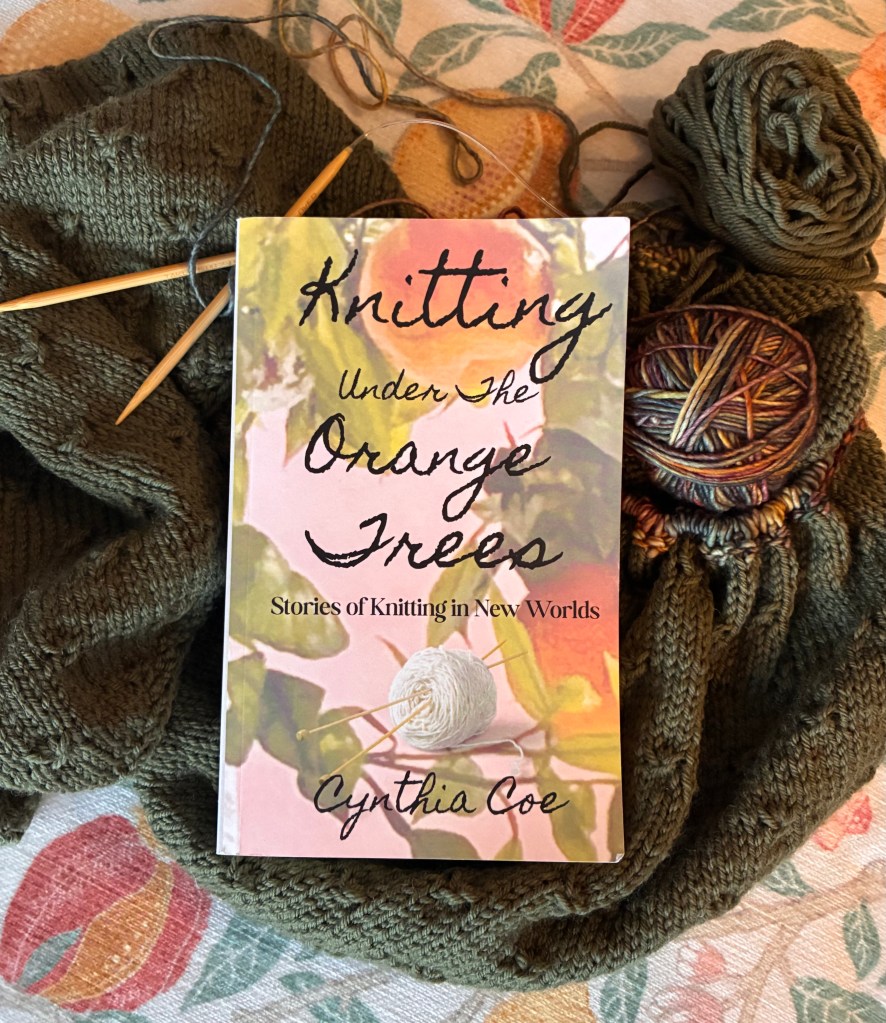
In Knitting Under the Orange Trees, knitting is not a hobby. It is essential work. It happens in homes, convents, on ships, and in new settlements where warmth and clothing could mean survival. The novel explores how textile knowledge—quiet, often overlooked—helped shape early communities in the New World.
If you’ve read Knitting Through Time, this novel continues that world and deepens its history. If you haven’t, you can enter the series here, just as you would a new project: by picking up the needles and beginning.
Knitting has always been more than yarn and stitches. It is a way women have cared for one another, preserved knowledge, and carried home with them—no matter how far they traveled.
I hope you enjoy this book! I truly LOVED writing it!
Blessings, Cindy
Cynthia Coe is an author, blogger, and avid knitter. Her books are available in paperback and e-reader edition on Amazon.com. Visit her Author page and follow this blog for more info and news.
Knitting is much more than crafting a beautiful piece of fabric. It’s about weaving together threads that, on their own, may seem ordinary, but when intertwined, form something greater—something full of meaning and purpose. That’s exactly how I view my series, The Prayer Shawl Chronicles.
While each book stands alone, much like individual strands of yarn, together they create a rich, interconnected story that spans generations, cultures, and the deep role of faith in our communities. My goal with this series has always been to show how knitting, community, and faith intertwine, much like the stitches of a prayer shawl, creating warmth and connection where it’s needed most.
In the first book, The Prayer Shawl Chronicles, we dive into the close-knit (pun intended!) relationships within a small church, where knitting isn’t just a craft—it’s a form of spiritual and emotional support. The women of the church use their knitting needles to form bonds, offer prayers, and express love.
The second book, The Knitting Guild of All Saints, broadens this view, taking readers deeper into the history of a community knit together by faith and a shared love of creating. The guild connects across time, showing how past and present come together to form a lasting legacy through their works of kindness, friendship, and artistry.
Finally, Knitting Through Time steps fully into historical fiction, weaving a tale that travels through different eras, illustrating how the act of knitting—and faith—has long been a thread that connects generations. It’s a tribute to those who came before us and the ways they influenced not just their world, but ours today.
I encourage you to read each of these books not only for their stand-alone stories but also to experience how they interlace into one powerful narrative of faith, knitting, and community. These are stories of people much like us, who find strength in faith and fellowship—and who just so happen to have a love for knitting along the way!
When you think of where knitting originated, you might guess the Netherlands, Norway, Scotland, or some other cold place. But Spain and Egypt? Really???
Where did the beloved craft of knitting get started? When I first picked up a history of knitting, I imagined knitting began somewhere around the North Atlantic, like the Scandinavian countries. The word “knitting” comes from the Old English word *cnyttan,* which means “to knot.” This term is derived from the Old Norse word *knúta,* meaning “knot” or “tie.” Over time, the term evolved into the modern English word “knitting.”
Does this mean the Old Norse developed knitting? Nope. Western Europe got its knitting from the Spanish. History Lesson! Through a whole bunch of royal marriages, Spain got control of Belgium and the Netherlands in the early 16th century. What does that have to do with knitting? The Spanish brought their culture – including knitting – to the low countries when they set up their courts and started a hearty trading economy between Spain and the low countries and the rest of the known world at that time. Spain ruled the waves during this time in history.
My book, Knitting Through Time, imagines how exactly all this knitting knowledge got from Egypt to Spain to Belgium to Britain to America. No one knows exactly how this happened, but yours truly used the power of historical fiction to take a stab at suggesting likely possibilities.
Where did the Spanish get knitting? History Lesson Number Two! The first evidence we have of knitting in human history was in Egypt, of all places. (Yes, it’s hot there, but they had wool and figured out how to make socks earlier than anyone else. Think “cold nights in the desert.”) And then…History Lesson Number Three!..in 711 A.D., the Moors of the Middle East and North Africa (including Egypt) invaded Spain. The Moors took their knitting with them and left a solid culture of knitting there with the Visigoths, eventually intermarrying with them to form the modern Spanish culture.
After writing this book, I felt I had left out a huge hole in the history of knitting that came from South America. Many of our luxury yarns now come from Peru, Uruguay, and other places in South America. Crafters in these countries have long, proud histories of gorgeous, advanced knitting techniques using high quality wool from sheep and alpaca they raise. So they likely developed their own knitting techniques, right? Nope. Spain again.
When the Spanish invaded South America (much like the Moors invaded Spain centuries before), they took their knitting with them. It’s likely that the Roman Catholic nuns who set up shop to teach the indigenous peoples European ways of doing things introduced the craft of knitting to South American peoples. While weaving with wool was widely practiced to make beautiful garments and household items in South America since the beginning of human history there, the knitting skills now widely practiced there came from the Spanish.
So the next time you think of knitting as a product of cold weather cultures – Norway, Scotland, Holland – think warm thoughts instead. The History of Knitting is all about Spain!
How did human beings learn to knit? Historians have no idea! So I made up a whole book of stories -based on historical facts- to suggest how we as a civilization learned how to make fabric from two sticks and a ball of yarn.
Who invented knitting? No one has any idea. Knitting first appeared in Egypt, as far we can tell. It next showed up in Spain, then spread throughout western Europe and onto the Americas as Europeans settled and colonized the New World. But how exactly did all that happen? What’s the story?
Those are the questions I set about answering in my latest novel, Knitting Through Time. As a fan of early Christian history and of the “Desert Mothers,” I had to think these women could have had a hand in the development of knitting. After all, they lived in Egypt about the time knitting developed, had lots of time on their hands, and did in fact do a bit of crafting to support themselves. So of course, one of my main characters is an aristocratic woman from Rome, Seraphina, who goes out into the Egyptian desert (wearing a blue silk dress, servants in tow) and has a fortuitous accident that just might have invented our beloved craft of knitting. (She also grows spiritually by leaps and bounds and befriends one of the famous saints.)
The action of my novel also takes place in Toledo, Spain, as the Moorish invasion of this region almost certainly brings knitting to Europe. But how exactly did that happen? In my imagined version of history, a young Visigoth girl named Hilda learned about knitting after the Moors put her to work washing their socks. Her descendants then took knitting to Bruges, Belgium and beyond as the Spanish court set up shop in Northern Europe. From there, the Dutch knitters of the Netherlands may very well have taken knitting to New Amsterdam and the Americas. A storyline featuring Anna, a young widow begrudgingly living with a community of Beguines in Amsterdam, shows how she and her knitting needles ended up in what is now New York City. (Who are the Beguines? You’ll find out!)
And how is this all connected to the first two novels in the Prayer Shawl Chronicles? Remember Nan, the “Quiet One” in book one and a late addition to the Prayer Shawl Guild of All Saints Church in book two? She takes center stage in book 3 and tells us how she learned to knit at the famous Woodstock festival in 1969 and what happened next. She ends up in Amsterdam, Bruges, Paris, and Egypt, too! How? You’ll have to read the book.
Tying all these stories together is a fun twist I wove throughout the book. You won’t know exactly what it is until the last couple of pages. So if you read something in the book and think, “that’s weird,” stay tuned! It will make sense at the end. (And…pssst!…if you read the thumbnail histories in the very back of the book, you MIGHT get a glimmer of this mysterious twist I put in the book.)
As a history major at the University of Tennessee a long, long time ago, I absolutely LOVED writing this book. With all the new online tools available now, I could research all kinds of obscure facts easy, peasy and within moments. I have actually visited almost all of the locations in this book (Toledo, Bruges, Amsterdam, New York, Paris), so it was a pleasure to write a book that tied together all these journeys made over a lifetime.
I hope you enjoy reading my new book as much as I enjoyed writing it! If you’re part of a book club or church group, there’s Questions for Discussion at the end of the book. (I’m a former Christian education curriculum developer; it’s what I do.) If you’re a history buff, I’ve also included a section at the back of the book giving brief descriptions of what was going on at the times and places portrayed in the book, along with a discussion of the Desert Mothers and Fathers of Egypt and the Beguines of western Europe.



 Sycamore Cove Knitting