Snow-Bound? Stranded? Time for Creative Yarn De-Stashing

I’ve found myself in Florida much longer than expected, and I’m a knitter stranded alone with a “mystery stash” of yarn. What to do???

It’s a great luxury to plan a project, decide exactly what yarn to use, and even mull over exactly what color you’ll use from a wide selection available. It’s nice to make a few swatches and decide which size knitting needles to use. 

But what if you can’t? 

I checked into a condo in Florida at the end of December, and I’m still here. With Tennessee closed for snow for the foreseeable future, I’ll be here for a while. Fortunately, I had ordered a “mystery stash” of clearance sale yarn shipped to me before I arrived, so I’m not exactly hurting for high quality yarn to knit with.

The problem is, I received 4 skeins of two different yarns from this mystery box – 4 skeins of a dark grey yarn, and 4 skeins of a bold pink and grey striped yarn. From past experience, I know it usually takes 5 skeins of these kinds of yarn to make a sweater (which I need; it’s 34 degrees here in paradise today). I puzzled over these yarns and made a swatch with the only needles I’ve got on hand. Mercifully, the needles will work with the yarn. But what to do with an underabundance of one or the other color of each yarn?

This is where necessity becomes creativity’s best friend. Like it or not, I’m looking at stripes. With the loud pink, I could end up with a sweater I wouldn’t be caught dead in. Or I could end up with a sweater I never would have planned but turns out better than expected. So I cast on and see how it goes.

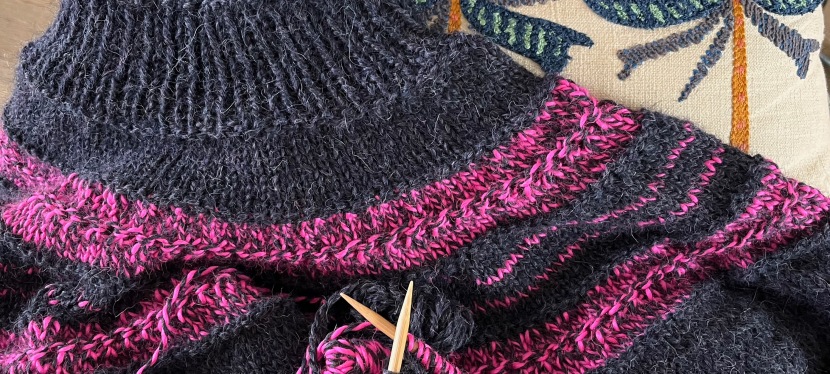
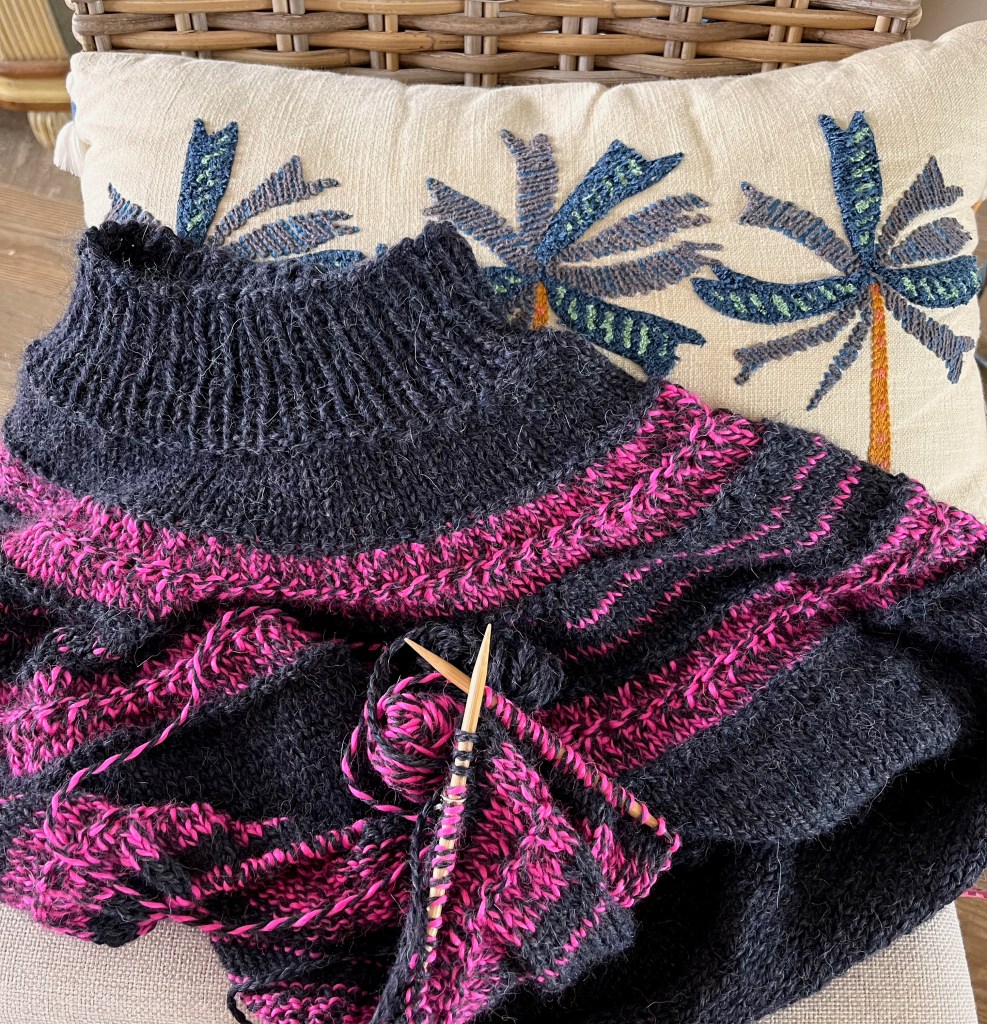
I’ve ended up with a sweater with more texture and interest than I would have designed if I’d had my pick of materials. It’s mostly dark grey, in a heavy wool and alpaca, with pink and grey stripes that pop…but not too much.  Heck, it might be one of my favorite sweaters!

And all because I’m stranded and used what I had. Sometimes maybe we need to look at what’s in front of us and work out a solution we wouldn’t have even considered otherwise. Maybe that’s what makes the best crafting – letting necessity befriend and collaborate with the creativity that needs a little shove before it kicks into action. 

Blessings to those who are snowed in or stranded this winter day!

Cindy

Cynthia Coe is the author of The Prayer Shawl Chronicles, interrelated short stories woven around those who make and receive handmade, prayerfully crafted gifts of prayer shawls. Click this link to order or for more information. 

Cynthia Coe is the author of The Prayer Shawl Chronicles, a collection of interrelated short stories about knitters and those they meet through knitting and sharing prayer shawls. 

Be sure to check out my newly published A Prayer Shawl Handbook: Inspiration and Resources for Your Prayer Shawl Ministry, now available in paperback and e-book editions and included in Kindle Unlimited.
What To Do with Leftover Luxury Yarn?

I don’t play yarn chicken. Life is too short for that kind of teeth grinding, blood pressure elevating stress in my life. If I’m knitting a nice sweater out of all-wool, cashmere, alpaca, or some other luxury yarn, I make sure I have enough yarn to make the best sweater I can make. 

That leaves a happier problem than running out of yarn (i.e., losing at yarn chicken – frantically trying to finish your project before you run out of yarn). You’re left with a skein or two of really nice yarn you don’t want to just toss in your stash.

What do you make out of just a small amount of luxury yarn? I usually make a simple scarf to go with my newly handknit sweater. A scarf makes a nice accessory for any outfit, and it gives a matching sweater that “wow” factor. Store-bought sweaters almost certainly do not come with matching scarves – only we hand knitters get these lux perks. If this scarf turns out a little short, no problem. Just stitch the ends together, and voila, you have a matching cowl instead. 

Here’s some other items I sometimes make with leftover luxury yarn:

  • Table runners
  • Coasters
  • Placemats or fabrics to place under plants or office items (pencil box, stapler, phone, etc.)
  • Bathmats 
  • For a larger amount of yarn, a shawl or throw blanket

I don’t overthink the design of these handknit extras. In fact, here’s my Go-To Pattern for scarves and any other rectangle-shaped small fabric:

The Five by Five – a Simple Checkerboard pattern, pictured in this blog post.

  • Cast on 20 stitches (for larger items, cast on additional sets of 8 stitches)
  • Row 1: (K4, P4) x 2, K4
  • Row 2: (P4, K4) x 2, P4 
  • Rows 3 & 4: Repeat rows 1 & 2.
  • Row 5: (P4, K4) x 2, P4
  • Row 6: (K4, P4) x 2, K4
  • Rows 7 & 8: Repeat rows 5 & 6. 
  • Continue these 8 rows until you run out of yarn, cast off. 

For more simple patterns, follow me for news of my upcoming book, A Prayer Shawl Handbook, to be published in early December! 

What do YOU do with leftover yarn? Feel free to join the discussion by commenting on this blog or on my Facebook page! Share your great ideas!

Blessings, Cindy

Cynthia Coe is the author of The Prayer Shawl Chronicles, interrelated stories about knitters and those for whom they knit and love. The sequel to this book, The Knitting Guild of All Saints, has been released! Available in paperback and on Kindle, included in Kindle Unlimited. 

Copyright Cynthia Coe 2023. All Rights Reserved.

Yarn – It’s Fundamental to Human Culture

We’ve all seen the memes. “My other hobby is buying yarn.” “My yarn stash exceeds my expected lifespan.” “Yarn is like chocolate; you can never have too much.” 

We treat yarn as if there’s an abundant worldwide stash ready for us to buy, in any amount. Craft stores literally stock enough yarn to reach the ceiling. You can obtain yarn for any project you have in mind with a couple of clicks on your phone.

This wasn’t always the case. In researching for my next book in The Prayer Shawl Chronicles, I’ve been shocked to learn how much time women have spent over the centuries making yarn and thread. Before industrialization, if you were a human being and a woman, you would spend a good part of your waking hours making yarn or thread. If you were a Neanderthal woman, you would have used fibers from the inner bark of conifer trees to make string for fishing lines and nets, to hang food to dry, to set traps for small animals, and to sew together animal hides for clothes and shelter. If you lived in Europe up until the industrial revolution, you would carry around a spindle and a fist full of wool, and you would make yarn while you watched the kids, walked, talked, and generally while you kept an eye on whatever else went on in your life. You would know how to work a spinning wheel as well as you knew how to cook. It’s what your family needed to survive.

Why don’t we study this in history class? Why don’t we see remnants of these time-consuming tasks featured in museums? Think about it – yarns, threads, and cloths eventually deteriorate and rot. These cushy, soft products don’t survive as long as items made of metal, stone, or even wood. So our foremothers’ efforts put into anything woven, knitted, or sewn have largely faded (or rotted) away from the saved artifacts of human culture.

The next time you pick up a skein of yarn to knit your next project, consider yourself blessed. Thanks to human ingenuity, all you had to do to get that yarn was click buttons on your phone or make a craft store run, which you probably enjoyed. Appreciate that you, as a 21st century woman, have the leisure to simply sit and knit for the sheer pleasure of it. 

Blessings, Cindy

Recommended Reading:

The Fabric of Civilization: How Textiles Made the World, by Virginia Postrel

Women’s Work: The First 20,000 Years, by Elizabeth Wayland Barber 

Cynthia Coe is the author of The Prayer Shawl Chronicles, interrelated stories about knitters and those for whom they knit and love. The sequel to this book, The Knitting Guild of All Saints, has been released! Available in paperback and on Kindle, included in Kindle Unlimited. 

As an Amazon Associate and Author, I provide links to products (including books I have written) and earn a very small fee if you click on the links and buy something. There is no additional charge to you!

RIP Knit Club Kits – But I’m Still Enjoying You Lots

Back in a different time and place  – 2018 – I discovered Knitting kits. These high quality knitting kits opened a whole new world of knitting for me. I started using real wool and other “luxury” all-natural fibers for the first time, and my knitting skill increased by leaps and bounds. 

My late husband gifted me my first kit for Christmas at the end of 2018 (after a helpful nudge from me, of course). I blogged about this kit in 2019, “Knitting Kits – Worth the Money?” I learned a new and previously-unknown-to-me technique, mosaic knitting, along with several other more advanced techniques.

Reader, I fell in love. I went on to purchase several more kits from Kitterly and learned to make Raglan sweaters, additional mosaic colorwork techniques, and even German short rows (gasp!). Having achieved at least an “advanced intermediate” level of knitting, I proceeded on, discovering kits and videos on Bluprint and monthly subscription kits with Knitcrate. Oh my, did my knitting skills level up! 

Then 2020 happened. The bottom fell out of all these lovely knitting kit companies. Kitterly quietly went out of business – or at least they quit sending out ads and emails. Bluprint’s more publicized demise suddenly put me in the position of “buy them now or not at all,” and I quickly purchased a number of high quality kits at pennies on the dollar. My stash went from one basket to three baskets to a situation of wondering where I would even store all these kits I knew I wouldn’t get to for a long time.

Knitcrate hung in until just last month. I think most of its customers saw the handwriting on the wall, with an astonishing 80% clearance sale in late 2022 signaling that the end was nigh. Like with Bluprint, I recognized this was crunch time. I could get terrific deals on gorgeous alpaca, wool, and even silk-blend yarns. Then, it would all be gone.

So here I am, in early 2023, finally getting to one of those Bluprint kits I bought for next-to-nothing over two years ago. I’m still learning lots and increasing my skills, making an oversized Raglan sweater with complicated cables and a shawl collar. It’s sad, seeing references to “online resources” through my former Bluprint account. Those online resources just aren’t there anymore. I’m really, really glad I bought so many kits when I did and even more glad I have the print copies of the patterns in my hands. 

Meanwhile, I’ve got an entire cabinet of yarns I’ve purchased through Knitcrate over the last couple of years. While those yarn purchases seemed extravagant at the time, I rationalized that I was getting high quality products at terrific deals. Yes, I was. That fact is truer now than when I made the purchases in the first place.

RIP Kitterly, Bluprint, and especially Knitcrate, with its monthly surprise packages and friendly online community of crafters. I’m still enjoying your kits. I’m still enjoying your yarns. And with a mammoth stash of clearance sale kits stocked up, I will continue to enjoy and learn from you for several years to come. 

Cynthia Coe is the author of The Prayer Shawl Chronicles, interrelated stories about knitters and those for whom they knit and love. The sequel to this book, The Knitting Guild of All Saints, has been released! Available in paperback and on Kindle, included in Kindle Unlimited. 

Are you using a kit subscription or other knitting kit you love? Feel free to give them a shout-out in the comments. I have no dog in the hunt, and I’m happy to help out knit companies who need the business! 

How the Pandemic Ended My Yarn Snobbery

I was a “yarn snob” for about two years. After discovering the joys of buying high quality wool, alpaca, and even silk yarns online, I gleefully knitted cardigan sweaters, pullovers, shawls, and small blankets out of the finest yarns on the planet. Of course, I also had to discover hand washing of all these lovely fibers. My crafting budget took a hit, too.

Then came the pandemic. Within a couple of months, supply lines to all these wonderful all-natural yarns came to a screeching halt. Two companies from which I had previously bought wool yarns closed or sold out. Another subscription service supplying all kinds of wonderfully squishy yarns struggled to get products out of South America. I bought up lots of yarn on clearance or going-out-of-business sales, but my days of buying wooly goodness in the form of knitting yarn were clearly over.

But my knitting was still in high gear. With reduced schedules and lots of free time around the house, I imagine I wasn’t the only one doing more knitting than usual this past year. I imagine many people took up knitting as beginners, too.

My own demand for readily available yarn quickly veered off towards good old-fashioned acrylic. Frustrated with shipping delays for the so-called “luxury yarns,” I found that I could click a couple of buttons or swing by the big box craft stores and get all the synthetic yarn I wanted. 

And is acrylic so bad, after all? I think not. It’s affordable. It’s durable. Projects I made from acrylic yarn twenty years ago still look great. And I can throw them in the washing machine AND dryer without experiencing total disasters. Yes, acrylic yarn is a by-product of the oil industry, but at least it’s used for a good purpose. Right? 

I still love to wear my warm wooly sweaters, especially during these Dogwood and Blackberry Winters of our Appalachian Spring here in Tennessee. I don’t enjoy hand washing the things. But I sure do like going out to the mailbox and getting new acrylic yarn just days after I order it!

Happy Knitting, Cindy

Cynthia Coe is the author of The Prayer Shawl Chronicles, a collection of interrelated short stories about knitters and those they meet through knitting and sharing prayer shawls. 

What to do With All That Clearance Yarn?

Tis the season when the Big Box stores run their yarn clearance sales. We’re all enticed with clearance sales notices popping up in our emails and texts, letting us know of the 70% off sales we likely won’t be able to resist.

So more than a few of us head off (or sneak off) to the yarn store and stock up. If we’re lucky, we pick up that yarn we found too pricey a couple of months ago and get to work on that sweater we envisioned. Or we might find some colors that will work for the fall and winter, and we happily get to work on Christmas gifts.

But what about that yarn at the unbelievable price, in bright summer colors? Well, some of us buy it anyway and figure out what to do with it later. If you’re like me, you can’t just pass it up.

You’ve got a problem on your hands: what to do with all that clearance yarn? I’ve found myself in this dilemma lately. In knitting through my stash, I’ve come up against a plethora of bright, happy colored yarns – bought on clearance in years past – and no discernable plan for any of it. Here’s what I’m doing with it:

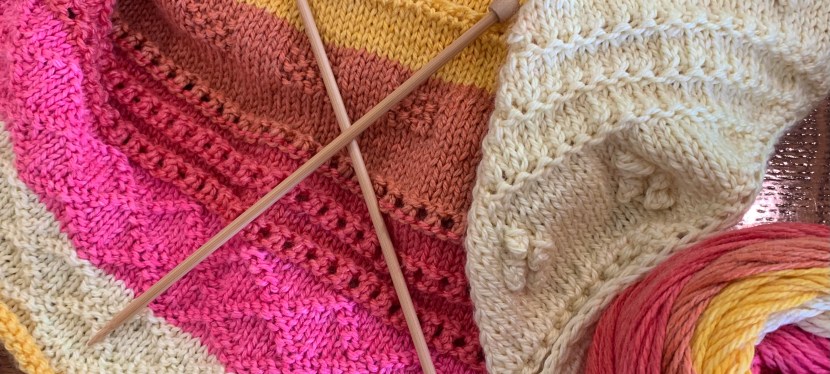
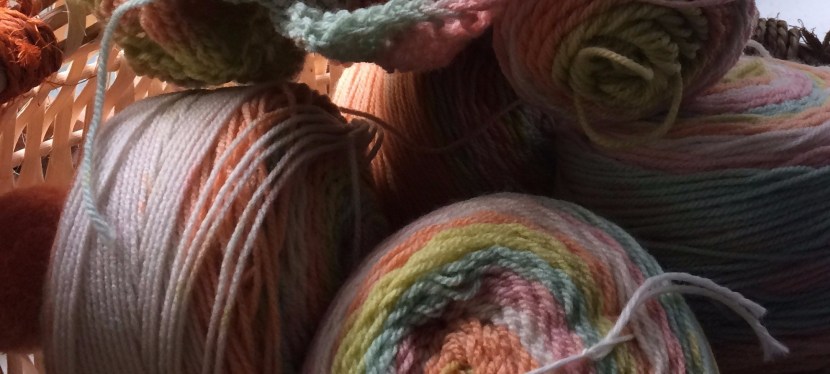
  • A Sampler Shawl. I’ve got six skeins of pastel colored cake-type yarn that looked good in the store but turned out scratchy and not-so-nice. I’m using it to try out some new stitches. This shawl may look okay when it’s finished; it might not. That’s okay.  I’ve tried out lots of new techniques and stitches I’ll use in other projects.
  • Mini Prayer Shawls. I’ve used up the Caron x Pantone mini-skeins to make small, coaster-sized squares to hand out as “thank you” gifts. I’ve been asked to speak at a local Book Club, and I’m planning to hand out these mini Prayer Shawls to those lovely ladies who bought and read my latest book. They could probably be used as coasters, phone charging pads, or some other household use.
  • Something wonderful and unexpected. Several years ago, I bought a huge plastic bag full of blue, green, and white yarn at a big box sale of manufacturer rejects and remainders. Just for kicks, I made a long and skinny shawl that’s become my favorite go-to early morning wrap. The yarn tuned out super soft, and the shawl is vibrant and looks terrific. Who knew?

I know you creative knitters will have many other uses for clearance yarn. Feel free to drop a comment to share your ideas with me and other readers!

Happy Knitting, Cindy

Cynthia Coe is the author of The Prayer Shawl Chronicles, a collection of interrelated short stories about knitters and those they meet through knitting and sharing prayer shawls. 

Psssst! The e-book edition of The Prayer Shawl Chronicles will soon be on sale! On Tuesday and Wednesday, August 13 & 14, The Prayer Shawl Chronicles will be on sale for only $1.99 at this link from 8 a.m. Eastern Time on Tuesday until 11 p.m. on Wednesday night. Give it a try and help me out by reviewing it on Amazon!

The Perils of Knitting the Stash

Some say buying yarn is as much of a hobby as actually knitting yarn. I’m guilty of that myself.

You go to the yarn store and see those lovely skeins calling your name. You only have a vague idea of what you will realistically do with that lovely yarn. You buy it on faith…or maybe hope…or maybe just sheer avarice. You take it home and maybe leave it in your “to do” basket of planned or unplanned knitting projects.

But there those lovely skeins of yarn sit for weeks. Or months. Or even years. 

My longest running member of my yarn stash is a bag of undyed cotton yarn I bought on vacation in Monserrat years ago. Who has yarn purchased on a Caribbean island?! I had to have it. I had misty plans of making a summer sweater from that yarn. After the island was nearly obliterated by a volcano, I kept that yarn around just to remember a wonderful place I had once visited. I now have a more solid plan to knit a shawl with it.  We’ll see.

The perils of keeping a stash is that you, ultimately and inevitably, have more yarn that you’ll probably use. If you completely knit through your stash on a regular basis, you’re a better person than I. But most of us over-buy yarn with nothing more than hopes and dreams. If we do use skeins from the stash, we often have too much yarn and skeins left over, too little to use for something else. Or worse, we haven’t bought enough for a project, finding that out long after the yarn is available. 

So what’s a knitter to do? Keep feeding the stash? Put yourself on a yarn diet? 

I’m challenging myself to donate unused yarn to schools or children’s summer programs. I’ve got a big bag for some lucky organization! But in the meantime, I’m eyeing that lovely new yarn I just spotted in the craft store….

Happy Knitting (and Stashing!), Cindy

Cynthia Coe is a writer, book reviewer, and avid knitter. Her books and blog posts can be found on her Amazon Author Page.