Creative Detours (and the next book in the Prayer Shawl Chronicles)

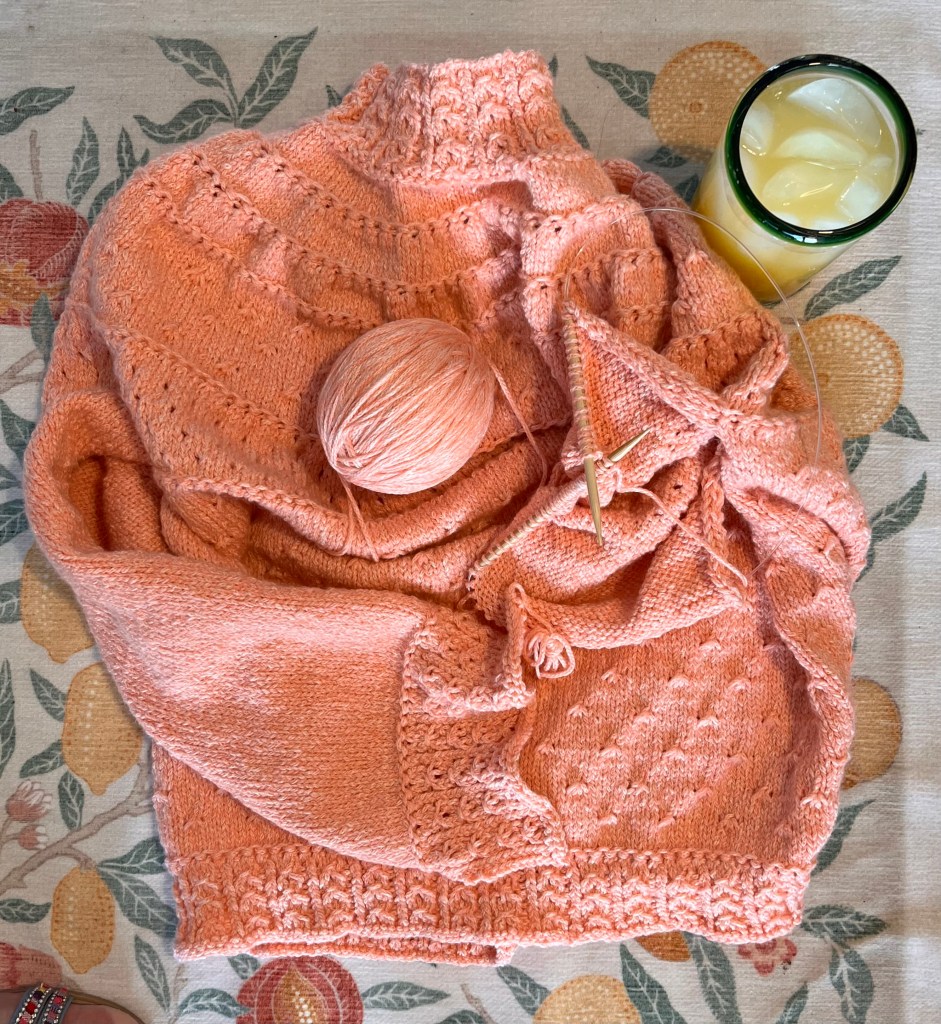
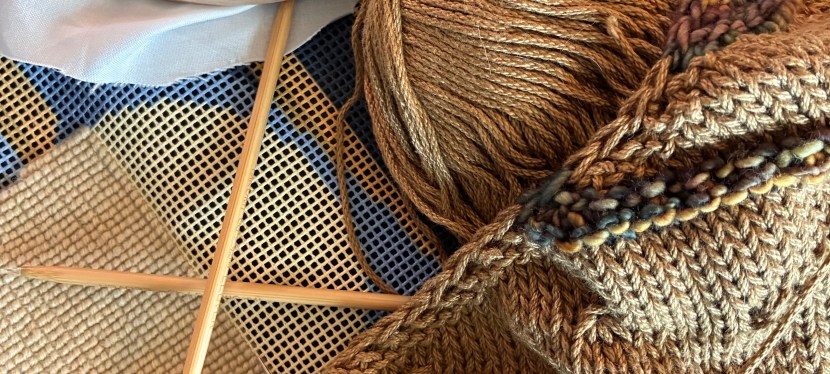
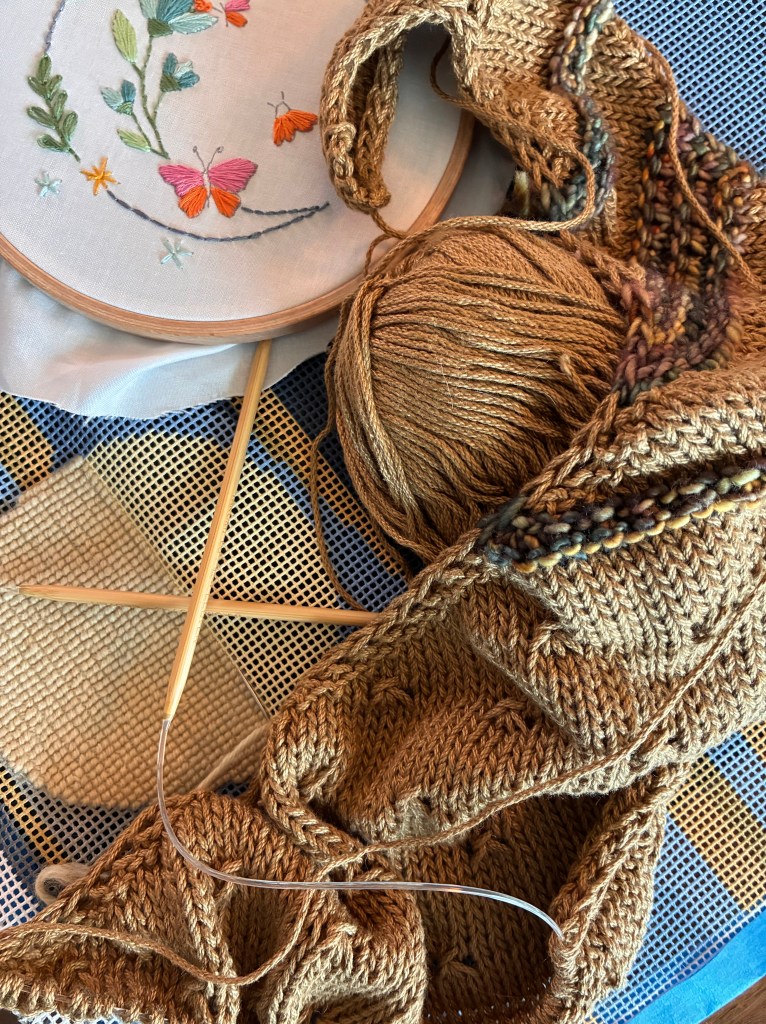
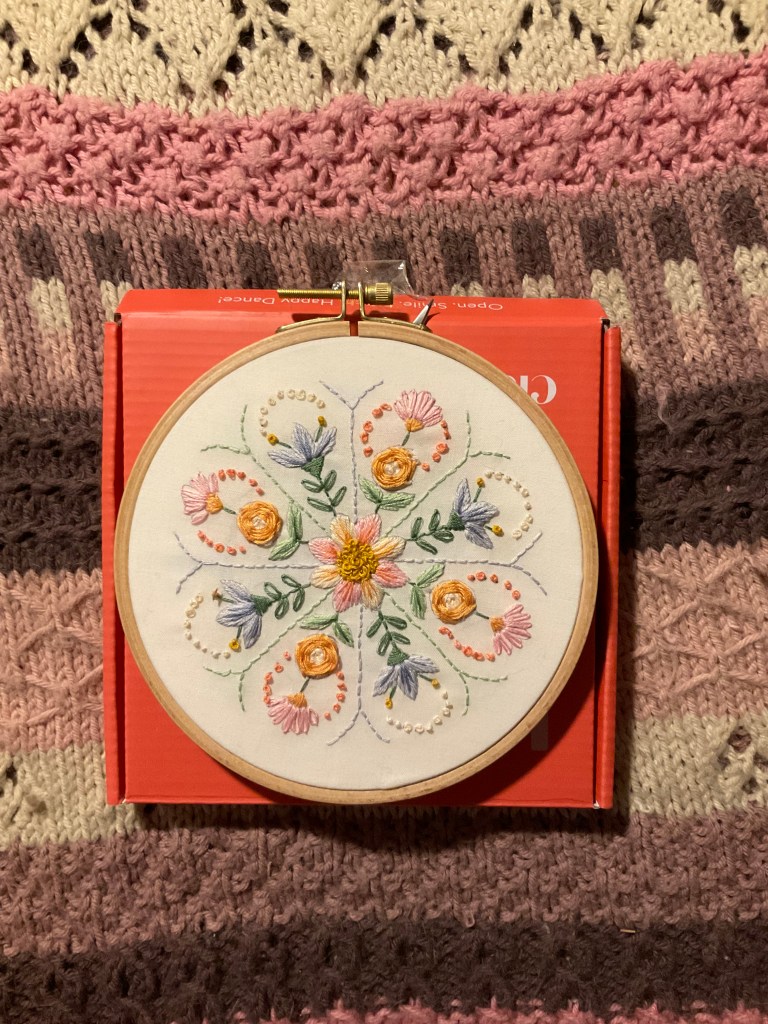
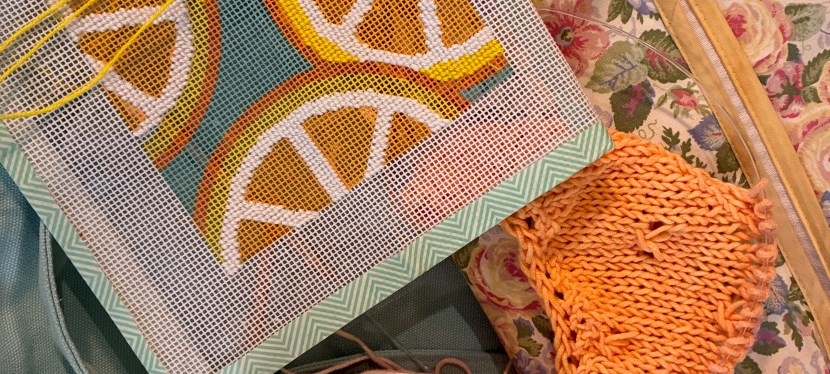
Sometimes even knitters need a break. I’ve set down my needles for a bit and picked up needlepoint — a portable, colorful craft that feels like fingerpainting with thread. After finishing the next-to-last draft of my new Prayer Shawl Chronicles novel, my brain needs a rest.

Do you ever get tired of knitting, even if it’s your primary hobby?

I’ve hit one of those times when I want to do “something else” for a little while — much like when I take a break from my beloved dance aerobics to do yoga, beach walks, or try something new. I always circle back to dance aerobics, and I always circle back to knitting.

Right now, though, I’m rediscovering needlepoint. It’s small, portable, and easy to do — almost like fingerpainting with thread and a needle. On a recent trip to Québec and Montréal, I tucked a little project into my bag and enjoyed the mindful rhythm of stitching in quiet moments. There’s something deeply satisfying about the relatively mindless rhythm of needlepoint: no designing, no choosing patterns, no counting stitches. Just color and thread.

And here’s the real reason for this creative detour: my brain is fried. I’ve just finished the next-to-last draft of my new novel — the upcoming book in The Prayer Shawl Chronicles series. This story travels from Bruges to Sevilla, then across the ocean to Peru and Florida… and it has worn me out!

So for now, I’m resting my writer’s mind with a few easy stitches. But you know me — I’ll be back to knitting soon enough… 🧶…as soon as I finish the final draft of my new novel!

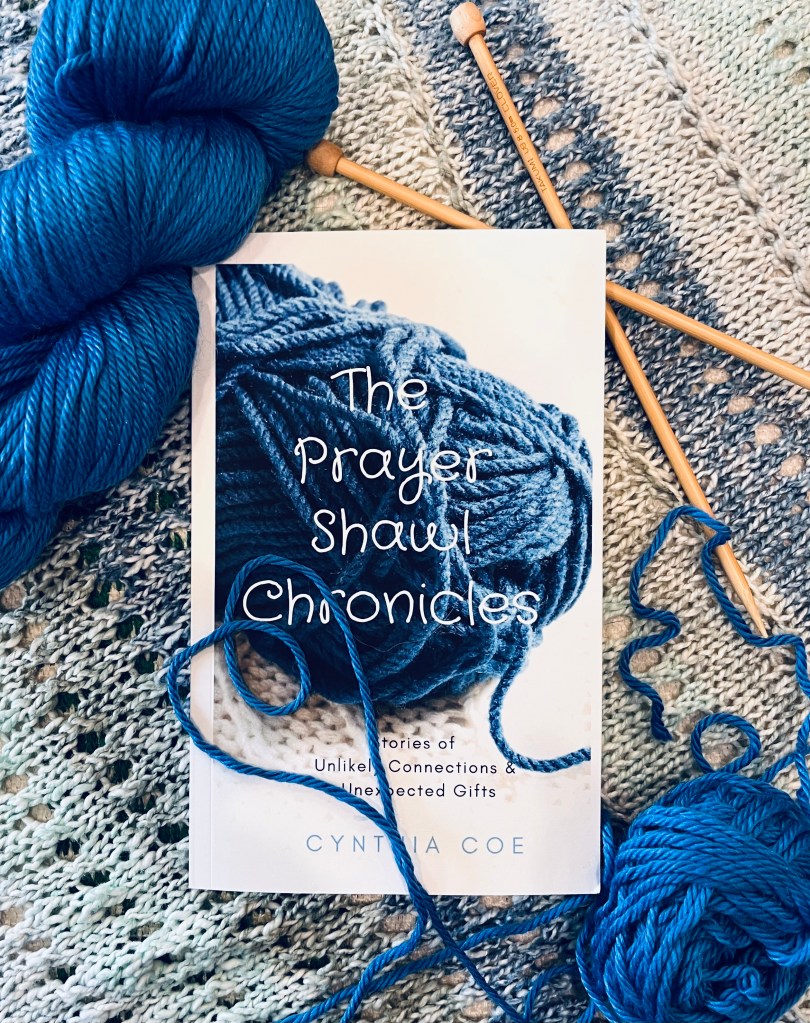
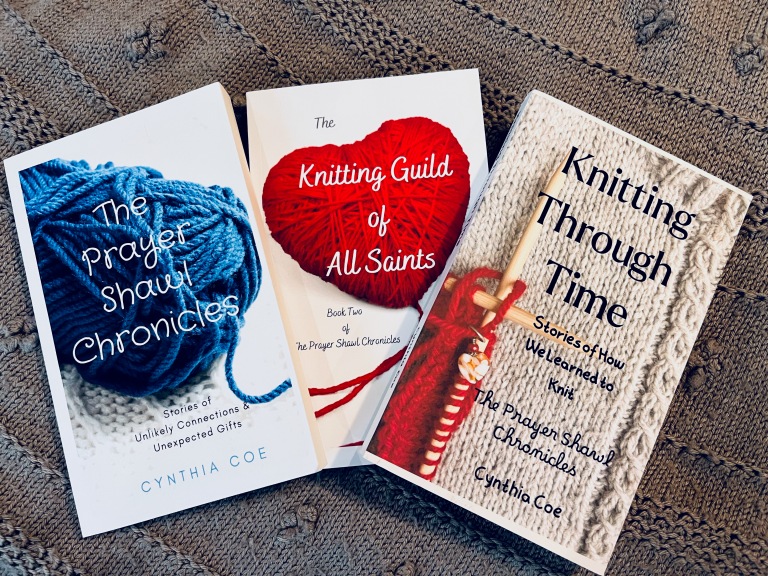
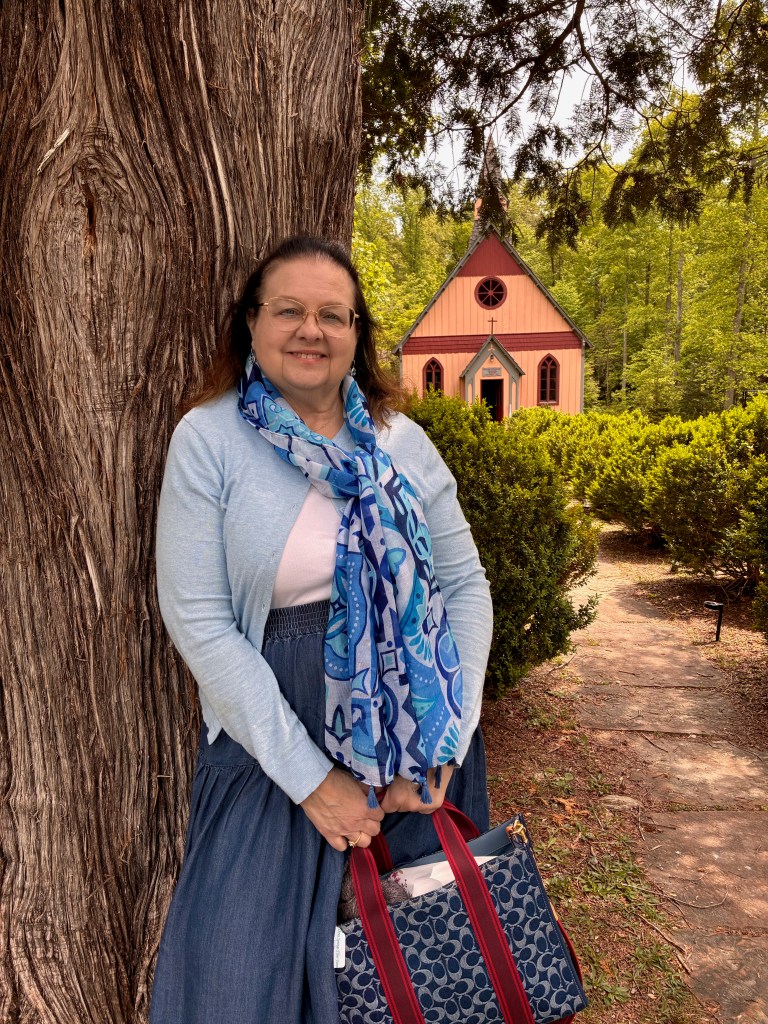
Cynthia Coe is the author of The Prayer Shawl Chronicles, a series of fictional stories woven together by the theme of human connections made through prayer shawls and the craft of knitting. Her newest book is her first historical novel, Knitting Through Time: Stories of How We Learned to Knit. Learn more by visiting her Author Page at this link

The History in Our Knitting Hands

Knitting isn’t just a craft — it’s a way of holding onto history, one stitch at a time.

When we think of “history,” our minds usually go to big things: wars, presidents, protests, politics. But I’ve always been drawn to another kind of history — the quiet kind. The kind that unfolds not in the headlines, but in our homes, in our habits, and in our hands.

This is the history of daily life — what historians sometimes call “social history.” It’s the way people cook, gather, raise children, earn a living, and yes, knit. These are the changes that truly shape how we live, and I believe they matter just as much (if not more) than what’s in the textbooks.

Take the pandemic. Almost overnight, we changed how we shop, work, and interact. We got used to takeout and tracked packages, remote work and video calls. But we also learned to treasure quiet, in-person moments — time with loved ones, and time with ourselves.

As a knitter, I couldn’t help but notice something else: people returned to crafts. Knitting, crocheting, sewing — all the “granny crafts” came back into fashion. These slow, thoughtful traditions gave us something tangible to hold onto in a world that felt unsteady.

That’s no accident. In every time of upheaval, people turn to the familiar. And handcrafts like knitting carry history with them — not the kind of history with dates and battles, but the kind that teaches patience, resilience, and care.

We’ve seen this before. When factories replaced handwork, when knitting mills replaced home spinners, when the internet replaced handwritten letters — we gained speed, but we lost something too. We lost the rhythm of slow work. The connection between hands and heart. The quiet pride of making something, stitch by stitch.

The history I care about most lives in everyday changes like these.
That’s why I write about them, and why I keep knitting through them.

So if you’re someone who’s ever picked up a pair of needles and felt like you were joining a long line of women (and men) who made beauty out of necessity — you’re not just crafting. You’re preserving a kind of history. And that’s something worth holding onto.

Cynthia Coe is the author of The Prayer Shawl Chronicles, a series of fictional stories woven together by the theme of human connections made through prayer shawls and the craft of knitting. Her newest book is her first historical novel, Knitting Through Time: Stories of How We Learned to Knit. Learn more by visiting her Author Page at this link

As an Amazon Associate and Author, I provide links to products (including books I have written) and earn a very small fee if you click on the links and buy something. There is no additional charge to you!

Why You Shouldn’t Be Embarrassed to Do “Granny Crafts”


If you’re a 20-something who knits, crochets, or embroiders—this is for you. Granny Crafts aren’t just for grannies. They’re quiet, powerful tools for stress relief, creativity, and deep comfort through every stage of life.

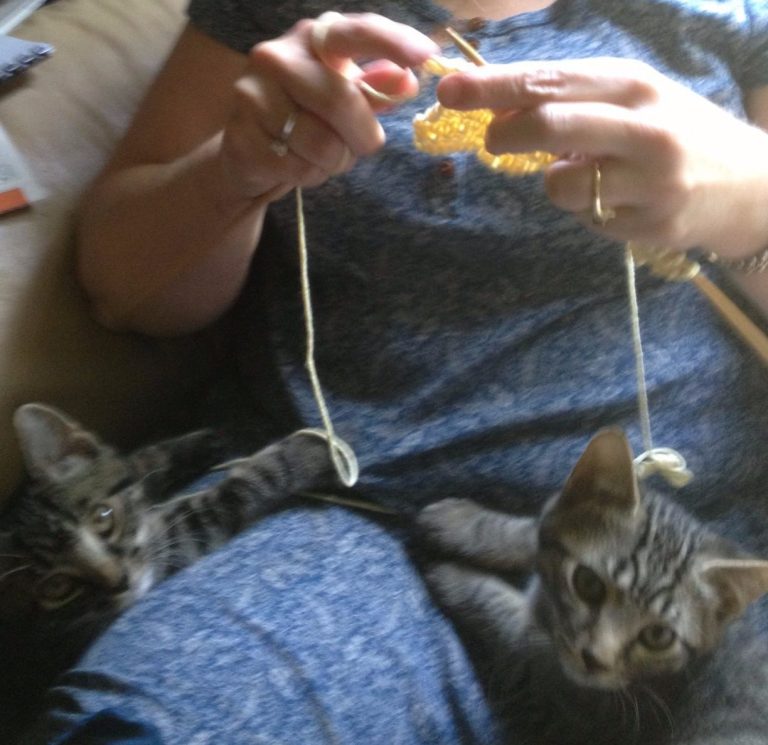
Cindy Knitting with Cats

Dear Young Crafty Kindred Spirit,

Lately, more and more people are talking about how young adults are embracing so-called “Granny Crafts”—and I love it.

If you’re here because you knit, crochet, embroider, or sew—or want to—you’re in good company. I’ve been knitting since I was a teenager myself. But it wasn’t until college, when stress started to weigh heavy on my shoulders, that I really picked it up as a coping mechanism. I’d sit in my dorm room or in a quiet corner of the student center, needles in hand, letting the rhythm of the yarn pull me back from the brink.

Some days, you just want everything—school, jobs, relationships, even the noise of the world—to go away for a while. I get it.

You were born into the digital age. My own kids got their first iPods in middle school and were among the first to start texting. Now, we all carry around little rectangles that buzz and ping and demand our attention 24/7. But here’s the secret: you can turn it off. Just for a few minutes. Really. The world won’t end.

And when you do? That’s when Granny Crafts work their quiet magic.

There’s no algorithm here. No pressure to go viral. No rush to the finish line. When you pick up a needle or a hook, it’s just you, your yarn, and your own rhythm. You can work slowly. Thoughtfully. Or set it down and pick it back up a month later. Granny Crafts are deeply human—analog, if you will. They exist on your terms, not someone else’s timeline.

You may not know it yet, but you’re building something far bigger than a handmade scarf. You’re building a lifelong tool for patience and comfort. Someday, you’ll find yourself stuck in medical waiting rooms. You’ll sit through school pickup lines or kids’ gymnastics practice. You’ll be at hospital bedsides or nursing homes, offering your presence when there’s nothing more you can do. Except this: stitch by stitch, you wait. You love. You breathe.

Granny Crafts give you something to hold on to when the rest of life feels uncertain. They will anchor you when stress comes crashing in, and they will accompany you through every phase of adulthood with grace and beauty.

Welcome to the circle. You’re not alone.

With love and yarn,
Cindy
Knitter, writer, and lifelong lover of “Granny Crafts”

If you’re looking for stories of other women—young, old, and in-between—who have walked that road, I invite you to follow my blog and check out my novels. I write about knitting, community, and faith in a world that is often spinning too fast. Sometimes, we need the quiet power of yarn and human connection to slow it down.

Cynthia Coe is the author of The Prayer Shawl Chronicles, a series of fictional stories woven together by the theme of human connections made through prayer shawls and the craft of knitting. Her newest book is her first historical novel, Knitting Through Time: Stories of How We Learned to Knit. Learn more by visiting her Author Page at this link

Creativity as a Spiritual Practice—Whether You Knit or Not

Whether you knit, write, bake, or daydream—your creative life might be more spiritual than you think.

In my life, creativity has always been more than a hobby. It’s a way of slowing down, listening deeply, and connecting with something greater than myself. Whether I’m holding knitting needles, writing a chapter, or just dreaming up new ideas, the creative process becomes, for me, a kind of prayer.

I’ve found that creativity invites us into stillness. Into presence. Into wonder. It doesn’t have to look like a finished project or a gallery-worthy painting. It can be quiet, even hidden—a moment of beauty in an ordinary day. Maybe it’s the way colors come together on your needles. Or the way a sentence finally says what your heart has been holding.

You don’t have to be a knitter to experience this. Whether you bake bread, write sermons, arrange flowers, doodle in the margins, or simply take time to notice the sacredness in the world around you—that’s creativity. And when we approach it with reverence, it becomes spiritual.

As a writer and lifelong maker, I often explore how creativity weaves its way through both daily life and sacred space. I reflect on themes of faith, prayer, and making meaning—on and off the page. Creativity, after all, isn’t about perfection. It’s about presence.

If that speaks to you, I invite you to follow more of my reflections at www.sycamorecove.org or on Facebook at www.Facebook.com/CynthiaCoeAuthor. I’d love to share this journey with you.


Cynthia Coe is the author of The Prayer Shawl Chronicles, a series of fictional stories woven together by the theme of human connections made through prayer shawls and the craft of knitting. Her newest book is her first historical novel, Knitting Through Time: Stories of How We Learned to Knit. Learn more by visiting her Author Page at this link

More Than Yarn and Needles

How every stitch—from cozy garments to prayer shawls—carries meaning in our culture

When we think of knitting today, we often think of coziness—warmth, comfort, and care woven into every stitch. In our 21st-century minds, knitting conjures images of home, love, and handmade gifts. But the symbolism of knitted items runs far deeper and more complex through human culture.

For years, knitting was stereotypically linked to elderly women in rocking chairs. While that image may feel quaint, it’s also dismissive—and increasingly outdated. Starting in the 1980s, knitting underwent a cultural revival. Young women reclaimed the craft through groups like Stitch ‘n Bitch, with bold new designs and creative freedom. Even celebrities like Julia Roberts and Patrick Stewart took up the needles, fueling a resurgence in quality yarns and artisan tools.

What sparked this return to slow, handmade work? In a fast-paced, high-tech world, many of us began craving simpler, tactile experiences. Knitting offered a chance to unplug, create with our hands, and make something uniquely our own. Whether it’s a simple scarf or an intricate lace shawl, every project becomes a kind of meditation—and a way to say, “I made this for you.”

Another beautiful expression of meaning through knitting is the prayer shawl movement. Beginning in 1997 as part of a seminary project, prayer shawls were envisioned as tangible signs of care and spiritual support. Without set patterns or specific religious rules, these shawls quickly found their way into churches, hospitals, and homes of every faith. Each one is as unique as the person who knits it—and the one who receives it.

From cozy comfort to quiet spiritual presence, knitted items continue to speak—sometimes loudly, sometimes softly—but always with meaning.

Happy Knitting! Cindy

Cynthia Coe is the author of The Prayer Shawl Chronicles, a series of fictional stories woven together by the theme of human connections made through prayer shawls and the craft of knitting. Her newest book is her first historical novel, Knitting Through Time: Stories of How We Learned to Knit. Learn more by visiting her Author Page at this link

Your Crafting Supplier Goes Out of Business. What do you do?

Many of us have recently learned that a major crafting retailer is going out of business for good, nationwide. And many of us wonder, what to do? Here are tips.

Here we go again: another round of business closings, and this time it affects our beloved hobbies of knitting, sewing, crocheting, jewelry making, and many other crafts. Those of us using these hobbies to keep our sanity, calm down, express creativity, or just make something nice for ourselves or loved ones might wonder how we get the basic supplies for these crafts.

We’ve been here before. During the pandemic, ALL of the online retailers supplying my yarns for knitting eventually went out of business. And reader, I got some huge bargains on top quality yarns, which I’m still using and expect to use for many years to come. Here’s what I learned:

  • Don’t fret about where to buy your next yarn stashes just yet. Nature abhors a vacuum. Supply markets naturally fill gaps when they arise. If you don’t have a nice place to buy crafting materials in the near future, again, Patience! Work through your stash. If you have indeed bought plenty of yarns or other materials from the big going-out-of-business sales, you’ll have plenty to do. If you must, order online or visit a locally owned shop. At some point, if there’s demand, another business will snatch up the market for reasonably priced crafting materials!
  • Deep Clearance Sales WILL Happen. You’re about to scoop up some deals on crafting supplies, but you may need to be patient. Businesses handle these closure sales different ways. One retailer suddenly had huge sales BEFORE announcing a closure. If you see this, read the red flags and move! On the other hand, other businesses may keep trying to sell merchandise they think they can squeeze more money out of before they are finally forced to go to deep discounts. If you KNOW a business is closing and still has vast quantities of yarns or other craft supplies on hand, wait. Then, when those discounts finally happen, pounce!
  • Buy plenty of yarn or other supplies you absolutely know you will use. If you knit sweaters or blankets, there will be no way to get more skeins if you run out. Buy at least as much as you think you’ll need for a project, plus extra. (You can always make something small, like a cowl or coasters, with the spare materials after you finish your big project.)
  • On the other hand, DON’T buy yarn you know deep in your heart you’ll never use. Just because something is 90% off doesn’t mean it’s a great deal for you. Only buy yarns you would have bought or strongly considered buying if not on sale. If you see something at 75-90% off that you think you might want to try for a small project, go ahead if you have the spare cash. Otherwise, don’t buy something that will be sitting in a closet ten years from now.
  • Think about storage and future plans. During the pandemic, I bought huge amounts of all-wool yarns in my favorite colors and weights. I was also in the process of moving and downsizing. Given that I will (and already have) put these yarns to good use at some point, I ended up re-purposing a china cabinet for these yarns. I ditched a bunch of things that cabinet used to hold – items I never used. Before you buy huge amounts of yarn or other crafting supplies, think: where will I store it, what can I get rid of to free up storage, and do my future plans allow for this? (Pssst…you might get storage bins on sale, too, if you have room for them.)
  • If you’re buying wool yarns, think about preservation. Moths just love wool. They love to eat it, especially if hidden away in quiet, dark places. So if your yarn-buying spree involves wool or other such yarns, be prepared to seal up your purchases in large plastic bags. Save yourself future heartbreak.

In the meantime, happy retail therapy at bargain prices!!! Cindy

Cynthia Coe is the author of The Prayer Shawl Chronicles, a collection of interrelated short stories about knitters and those they meet through knitting and sharing prayer shawls. 

Be sure to check out my newly published A Prayer Shawl Handbook: Inspiration and Resources for Your Prayer Shawl Ministry, now available in paperback and e-book editions and included in Kindle Unlimited.

Cynthia Coe is a writer, book reviewer, and avid knitter. Her books and blog posts can be found on her Amazon Author Page

Knitting and the Spontaneity and Relaxation of Travel

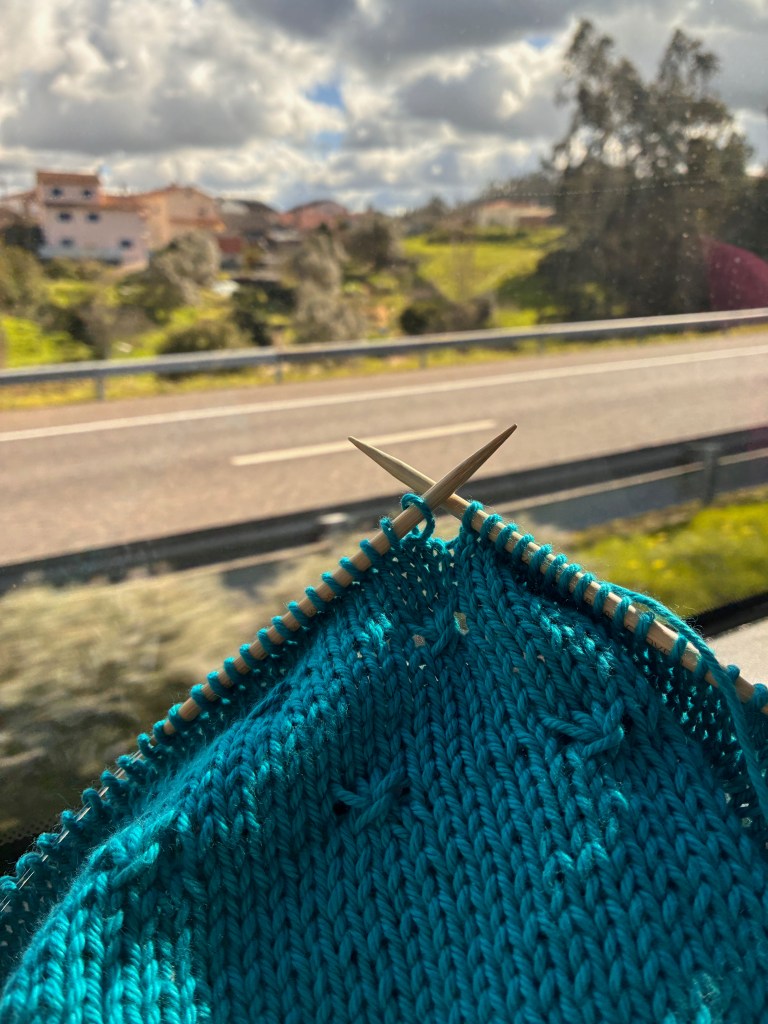
I just returned from a vacation tour of Portugal. Some of my most relaxing moments involved sitting on the bus, knitting and watching the budding vineyards and olive orchards of the Portuguese countryside go by.

This was my first big trip overseas by myself. I had gone with school groups, with family, and with my husband, but never alone. And I loved it.

I found a tour company that offered “solo” tours for those of us who are widowed, divorced, or traveling alone for any reason. I eagerly booked a trip to Portugal, a place I had never been. That was part of the fun, discovering and exploring a country I knew little about and making memories solely mine.

As a knitter, I naturally researched and found yarn shops in Porto and Lisbon, thinking I’d pay them a visit and maybe blog and post photos of these new-to-me shops. However, that didn’t happen. My tour kept me on my feet and exploring all kinds of sights, sounds, and activities I would never have discovered on my own. I took naps during the few hours of downtime in those cities, never getting around to finding those yarn stores.

Yet I found a wonderful yarn store without any planning or looking at all. While walking around a lovely pedestrian street in the old part of Coimbra, an ancient university town, I happened to find one right smack in front of me. I stepped in to find two entire walls of the shop stuffed with bins of brightly colored Portuguese wool, available for far less than I would have paid in the US. I eagerly purchased three skeins of wool yarn in a mustard yellow color, the same used to decorate tiles and houses in this town and in many other parts of Portugal. I learned that the use of this yellow color was introduced by the Moors centuries ago to symbolize happiness and sunshine – just the color to symbolize my adventure here, too.

Why only three skeins? I wanted a project just for this trip. I wanted a small, manageable knitting project I could work on in the bus, as I relaxed at the hotel before going to bed, and maybe even on the long plane ride going home. And that it was. I made a shawl, using a memorized pattern and favorite stitch combinations, constructing my own personal souvenir of a green and pleasant land feeding me with healthy and delicious food, green wines, and the charm of centuries past.

I will have this shawl for the rest of my life, the sunny yellow of the wool reminding me of a perfect day in Coimbra, eating pastel de nata (custard pastries!) and milky coffee for lunch, strolling the streets with new friends and happening upon a yarn shop, walking down cobblestone streets to visit a cathedral I swear I’d already seen while writing a scene in a novel under construction.

I’ll remember quiet drives on that big comfortable bus with a seat to myself, calming and pleasantly knitting that yellow shawl, glancing up now and then to see the vineyards budding in the springtime, my mind forgetting anything anywhere else.

With blessings for calm, quiet knitting…wherever you may find yourself, Cindy


Cynthia Coe is the author of The Prayer Shawl Chronicles, a series of fictional stories woven together by the theme of human connections made through prayer shawls and the craft of knitting. Her newest book is her first historical novel, Knitting Through Time: Stories of How We Learned to Knit. Learn more by visiting her Author Page at this link

Christmas Crafting is the Opposite of Christmas Shopping

Click, it’s in your shopping basket. Click, you’ve paid for it. Your purchase will appear on your doorstep in two days without any further effort on your part. 

I bought a pair of shoes on deep discount this morning, at breakfast and as easy as pressing digital buttons on my phone while still half asleep. As I later picked up my knitting needles to work on a Christmas blanket project, I couldn’t help but think how my Christmas knitting differed so starkly from my Christmas shopping.

My Christmas knitting project will not be finished in two days. It will probably not be finished by Christmas, in fact. And that’s okay. It’s the slow, calming process that matters to me most. How many “clicks” will it take? Thousands, and that’s kinda the point, too. 

The clicking of my phone generally does nothing for me but momentarily serve my impulses to acquire yet another shiny new object I really don’t need. Am I calmer afterwards? Not really. I might get a temporary hit of joy for a minute or two, along with some satisfaction two days later when my item arrives. 

On the opposite end of the spectrum of satisfaction, the clicking of my knitting needles keeps me calmer and lowers my blood pressure for several hours, at least. After a half hour of crafting with real materials and with all my fingers (not just the right index finger), my mind is cleared to move on to creative work, planning, or just strategizing to get through the rest of the day. 

Crafting highs last much, much longer than online shopping highs. Shopping highs rank right up there with sugar highs for the rebound drops in any joy or satisfaction you got for your so-called efforts. But after crafting for a bit, the calm and satisfaction of actually making something stays with you for a good, long while. And if that satisfaction starts to flag, just pick up those knitting needles again and knit another row. Or just pick up your project and admire what you’ve done, all by yourself. Better yet, show your work to a friend and watch the utter amazement in someone else’s eyes, flabbergasted that you can turn skeins of yarn into a sweater just as nice as whatever they just paid for with their own meager clicking on their phone.

Slow down this Christmas and Advent season. Save your clicking for something that will last, something that will give you fulfillment, a sense of true peace, and maybe even a unique and meaningful gift for someone else. 

With blessings for peace and calm this holiday season, Cindy

Cynthia Coe is the author of The Prayer Shawl Chronicles, a series of fictional stories woven together by the theme of human connections made through prayer shawls and the craft of knitting. Her newest book is her first historical novel, Knitting Through Time: Stories of How We Learned to Knit. Learn more by visiting her Author Page at this link

How Did Knitting Become A Worldwide Craft? Quick and Fun History Lessons on How We All Learned to Knit

When you think of where knitting originated, you might guess the Netherlands, Norway, Scotland, or some other cold place. But Spain and Egypt? Really???

Where did the beloved craft of knitting get started? When I first picked up a history of knitting, I imagined knitting began somewhere around the North Atlantic, like the Scandinavian countries. The word “knitting” comes from the Old English word *cnyttan,* which means “to knot.” This term is derived from the Old Norse word *knúta,* meaning “knot” or “tie.” Over time, the term evolved into the modern English word “knitting.”

Does this mean the Old Norse developed knitting? Nope. Western Europe got its knitting from the Spanish. History Lesson! Through a whole bunch of royal marriages, Spain got control of Belgium and the Netherlands in the early 16th century. What does that have to do with knitting? The Spanish brought their culture – including knitting – to the low countries when they set up their courts and started a hearty trading economy between Spain and the low countries and the rest of the known world at that time. Spain ruled the waves during this time in history.

My book, Knitting Through Time, imagines how exactly all this knitting knowledge got from Egypt to Spain to Belgium to Britain to America. No one knows exactly how this happened, but yours truly used the power of historical fiction to take a stab at suggesting likely possibilities. 

Where did the Spanish get knitting? History Lesson Number Two! The first evidence we have of knitting in human history was in Egypt, of all places. (Yes, it’s hot there, but they had wool and figured out how to make socks earlier than anyone else. Think “cold nights in the desert.”) And then…History Lesson Number Three!..in 711 A.D., the Moors of the Middle East and North Africa (including Egypt) invaded Spain. The Moors took their knitting with them and left a solid culture of knitting there with the Visigoths, eventually intermarrying with them to form the modern Spanish culture. 

After writing this book, I felt I had left out a huge hole in the history of knitting that came from South America. Many of our luxury yarns now come from Peru, Uruguay, and other places in South America. Crafters in these countries have long, proud histories of gorgeous, advanced knitting techniques using high quality wool from sheep and alpaca they raise. So they likely developed their own knitting techniques, right? Nope. Spain again. 

When the Spanish invaded South America (much like the Moors invaded Spain centuries before), they took their knitting with them. It’s likely that the Roman Catholic nuns who set up shop to teach the indigenous peoples European ways of doing things introduced the craft of knitting to South American peoples. While weaving with wool was widely practiced to make beautiful garments and household items in South America since the beginning of human history there, the knitting skills now widely practiced there came from the Spanish. 

So the next time you think of knitting as a product of cold weather cultures – Norway, Scotland, Holland – think warm thoughts instead. The History of Knitting is all about Spain! 

Happy Knitting Through History! Cindy

Cynthia Coe is the author of The Prayer Shawl Chronicles, a series of fictional stories woven together by the theme of human connections made through prayer shawls and the craft of knitting. Her newest book is her first historical novel, Knitting Through Time: Stories of How We Learned to Knit. Learn more by visiting her Author Page at this link

Keep Knitting Fresh and Interesting – Learn New Skills

Feeling in a rut? Do you find yourself knitting the same patterns over and over again? It’s time to switch things up! 

If you’re like me, you have several “go to” patterns you can do in your sleep…or certainly while watching your favorite show on TV. You know exactly how many stitches to cast on, how much yarn the project will take, and which size needles to use. But you may also have umpteen of this finished project – with too many blankets, shawls, pullover sweaters, or whatever this “go to” project is – filling up closets or going unused. 

If this is you, it might be time to learn a new knitting skill. Yes, it will be hard at first. Yes, you will make mistakes and will likely have to frog the thing at least once. But the upside is that you’ll have a new technique in your toolkit of knitting designs and skills. You might even have a new favorite project on your hands.

The best way to learn a new project, at least for me, is to purchase a kit that includes an understandable pattern and exactly the amount and type of yarn you’ll need to complete the project. I had been reluctant to buy kits in the past, scarred by memories of paint-by-number art kits in childhood that never had enough paint to finish the project. But happily, the knitting projects I’ve bought in the last several years have had more than enough yarn to complete projects.  (And I’ve bought numerous knitting kits from a wide variety of companies, especially during the pandemic).

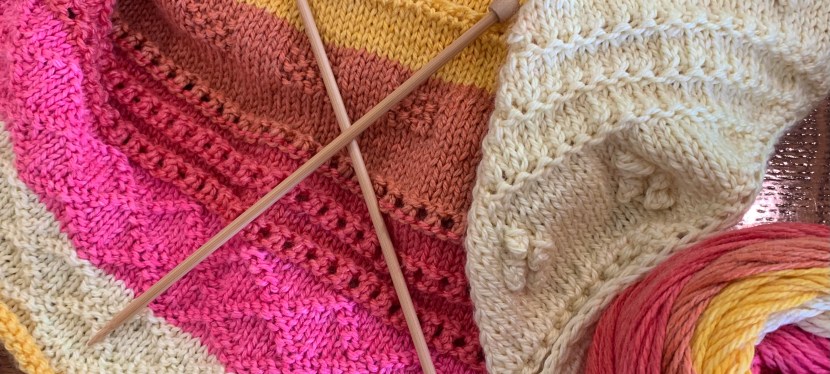
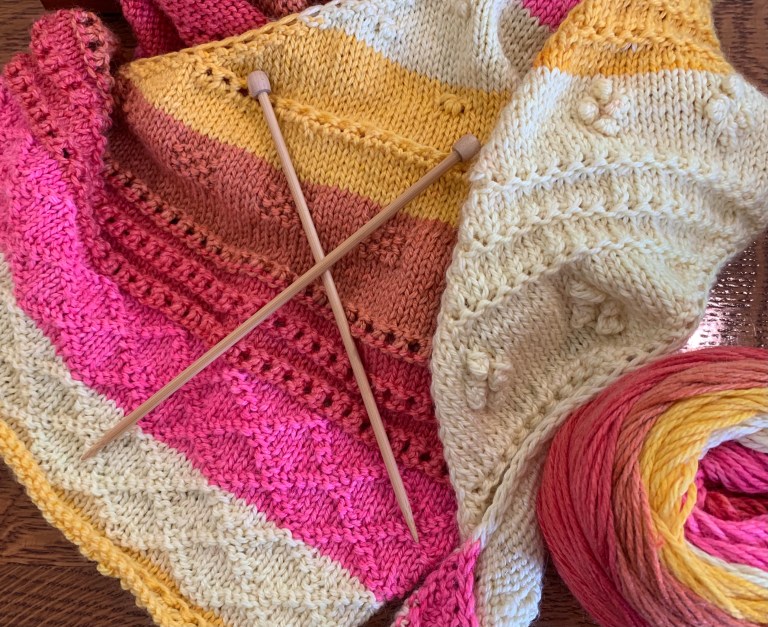
My latest new-to-me knitting skill is the mitered square technique. I found the technique a little trippy – you start with a straight line, and by decreasing in the middle of the row, you end up with a square. Who comes up with this stuff??? I’ve enjoyed making a blanket using this stitch, with some simple colorwork to mix it up as well. Yes, it took me a couple of tries to get it right, but I can now do it like a pro. I’ll definitely use the technique again to make placemats, bath rugs and other household items requiring a fairly sturdy fabric.

Of course, some kits I’ve tried have ended up as “never again” projects. One cardigan sweater kit I bought required me to flip the project around six times and use short rows for some purpose I could not discern. But even the “never again” projects keep knitting interesting and my brain continuing to learn. 

As much as I enjoy simple, meditative knitting projects, I always enjoy a new challenge, too. We all need to keep our minds and souls fresh, active, and open to new experiences!

Knitting Blessings, Cindy

Cynthia Coe is the author of The Prayer Shawl Chronicles, a series of fictional stories woven together by the theme of human connections made through prayer shawls and the craft of knitting. Her newest book is her first historical novel, Knitting Through Time: Stories of How We Learned to Knit. Learn more by visiting her Author Page at this link