How Knitting Traveled to the Americas (and Inspired My New Novel)

Knitting didn’t arrive in the Americas by accident—it traveled hand to hand, carried by women across oceans and generations.

As knitters, we know that techniques don’t live in books alone. They live in muscle memory, in watching someone else’s hands, in doing the same small motions over and over until they become part of us. Long before knitting patterns were printed or standardized, knitting moved through the world the same way people did—by necessity, memory, and care.
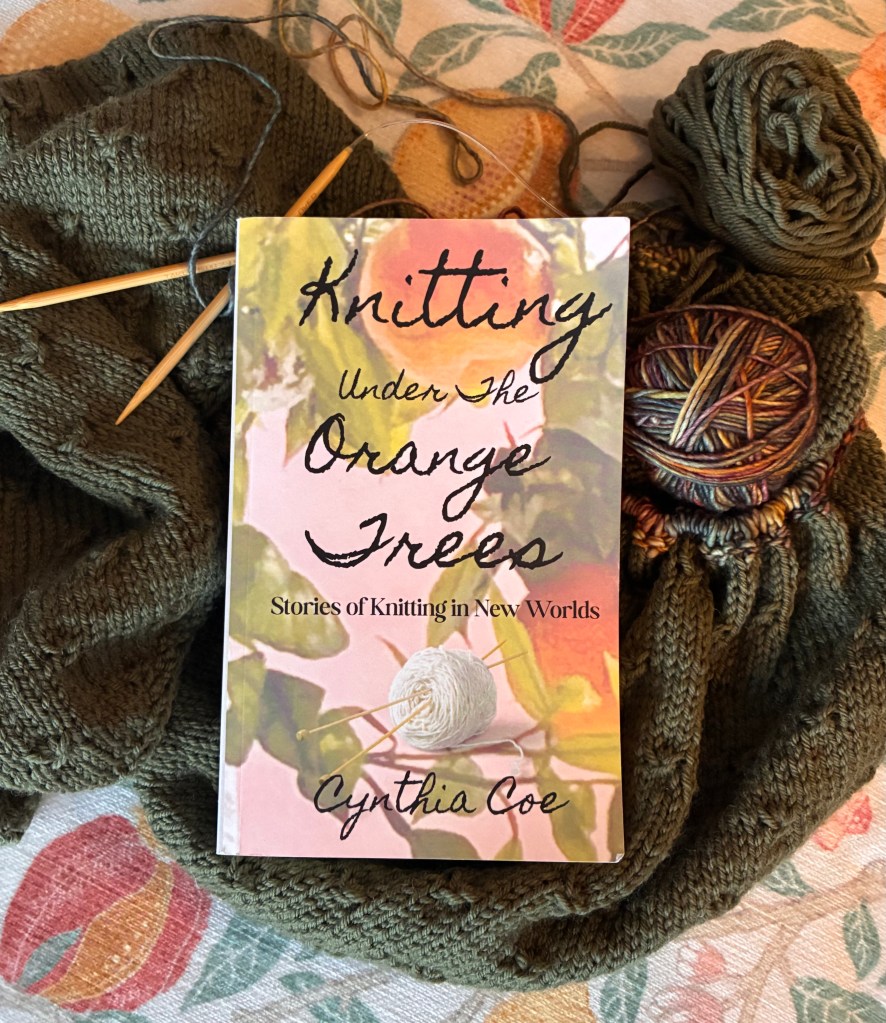
That history is what inspired my newest historical novel, Knitting Under the Orange Trees.

The story imagines how knitting traveled from Europe to the Americas during the sixteenth century—not through official records or trade documents, but through the daily lives of women. Women who packed little more than what they could carry. Women who brought practical skills with them: how to make clothing, how to keep others warm, how to create something familiar in an unfamiliar place.

In Knitting Under the Orange Trees, knitting is not a hobby. It is essential work. It happens in homes, convents, on ships, and in new settlements where warmth and clothing could mean survival. The novel explores how textile knowledge—quiet, often overlooked—helped shape early communities in the New World.

If you’ve read Knitting Through Time, this novel continues that world and deepens its history. If you haven’t, you can enter the series here, just as you would a new project: by picking up the needles and beginning.

Knitting has always been more than yarn and stitches. It is a way women have cared for one another, preserved knowledge, and carried home with them—no matter how far they traveled.

🧶✨ Knitting Under the Orange Trees is now available in paperback and e-book editions at this link. It is also included in Kindle Unlimited.

You can explore Knitting Under the Orange Trees and the full Knitting Through Time series at this link.  ✨🧶

I hope you enjoy this book! I truly LOVED writing it!

Blessings, Cindy

Cynthia Coe is an author, blogger, and avid knitter. Her books are available in paperback and e-reader edition on Amazon.com. Visit her Author page and follow this blog for more info and news.

The History in Our Knitting Hands

Knitting isn’t just a craft — it’s a way of holding onto history, one stitch at a time.

When we think of “history,” our minds usually go to big things: wars, presidents, protests, politics. But I’ve always been drawn to another kind of history — the quiet kind. The kind that unfolds not in the headlines, but in our homes, in our habits, and in our hands.

This is the history of daily life — what historians sometimes call “social history.” It’s the way people cook, gather, raise children, earn a living, and yes, knit. These are the changes that truly shape how we live, and I believe they matter just as much (if not more) than what’s in the textbooks.

Take the pandemic. Almost overnight, we changed how we shop, work, and interact. We got used to takeout and tracked packages, remote work and video calls. But we also learned to treasure quiet, in-person moments — time with loved ones, and time with ourselves.

As a knitter, I couldn’t help but notice something else: people returned to crafts. Knitting, crocheting, sewing — all the “granny crafts” came back into fashion. These slow, thoughtful traditions gave us something tangible to hold onto in a world that felt unsteady.

That’s no accident. In every time of upheaval, people turn to the familiar. And handcrafts like knitting carry history with them — not the kind of history with dates and battles, but the kind that teaches patience, resilience, and care.

We’ve seen this before. When factories replaced handwork, when knitting mills replaced home spinners, when the internet replaced handwritten letters — we gained speed, but we lost something too. We lost the rhythm of slow work. The connection between hands and heart. The quiet pride of making something, stitch by stitch.

The history I care about most lives in everyday changes like these.
That’s why I write about them, and why I keep knitting through them.

So if you’re someone who’s ever picked up a pair of needles and felt like you were joining a long line of women (and men) who made beauty out of necessity — you’re not just crafting. You’re preserving a kind of history. And that’s something worth holding onto.

Cynthia Coe is the author of The Prayer Shawl Chronicles, a series of fictional stories woven together by the theme of human connections made through prayer shawls and the craft of knitting. Her newest book is her first historical novel, Knitting Through Time: Stories of How We Learned to Knit. Learn more by visiting her Author Page at this link

As an Amazon Associate and Author, I provide links to products (including books I have written) and earn a very small fee if you click on the links and buy something. There is no additional charge to you!

More Than Yarn and Needles

How every stitch—from cozy garments to prayer shawls—carries meaning in our culture

When we think of knitting today, we often think of coziness—warmth, comfort, and care woven into every stitch. In our 21st-century minds, knitting conjures images of home, love, and handmade gifts. But the symbolism of knitted items runs far deeper and more complex through human culture.

For years, knitting was stereotypically linked to elderly women in rocking chairs. While that image may feel quaint, it’s also dismissive—and increasingly outdated. Starting in the 1980s, knitting underwent a cultural revival. Young women reclaimed the craft through groups like Stitch ‘n Bitch, with bold new designs and creative freedom. Even celebrities like Julia Roberts and Patrick Stewart took up the needles, fueling a resurgence in quality yarns and artisan tools.

What sparked this return to slow, handmade work? In a fast-paced, high-tech world, many of us began craving simpler, tactile experiences. Knitting offered a chance to unplug, create with our hands, and make something uniquely our own. Whether it’s a simple scarf or an intricate lace shawl, every project becomes a kind of meditation—and a way to say, “I made this for you.”

Another beautiful expression of meaning through knitting is the prayer shawl movement. Beginning in 1997 as part of a seminary project, prayer shawls were envisioned as tangible signs of care and spiritual support. Without set patterns or specific religious rules, these shawls quickly found their way into churches, hospitals, and homes of every faith. Each one is as unique as the person who knits it—and the one who receives it.

From cozy comfort to quiet spiritual presence, knitted items continue to speak—sometimes loudly, sometimes softly—but always with meaning.

Happy Knitting! Cindy

Cynthia Coe is the author of The Prayer Shawl Chronicles, a series of fictional stories woven together by the theme of human connections made through prayer shawls and the craft of knitting. Her newest book is her first historical novel, Knitting Through Time: Stories of How We Learned to Knit. Learn more by visiting her Author Page at this link

Knitting Together Faith, History, and Community: The Prayer Shawl Chronicles Series

Knitting is much more than crafting a beautiful piece of fabric. It’s about weaving together threads that, on their own, may seem ordinary, but when intertwined, form something greater—something full of meaning and purpose. That’s exactly how I view my series, The Prayer Shawl Chronicles.

While each book stands alone, much like individual strands of yarn, together they create a rich, interconnected story that spans generations, cultures, and the deep role of faith in our communities. My goal with this series has always been to show how knitting, community, and faith intertwine, much like the stitches of a prayer shawl, creating warmth and connection where it’s needed most.

In the first book, The Prayer Shawl Chronicles, we dive into the close-knit (pun intended!) relationships within a small church, where knitting isn’t just a craft—it’s a form of spiritual and emotional support. The women of the church use their knitting needles to form bonds, offer prayers, and express love.

The second book, The Knitting Guild of All Saints, broadens this view, taking readers deeper into the history of a community knit together by faith and a shared love of creating. The guild connects across time, showing how past and present come together to form a lasting legacy through their works of kindness, friendship, and artistry.

Finally, Knitting Through Time steps fully into historical fiction, weaving a tale that travels through different eras, illustrating how the act of knitting—and faith—has long been a thread that connects generations. It’s a tribute to those who came before us and the ways they influenced not just their world, but ours today.

I encourage you to read each of these books not only for their stand-alone stories but also to experience how they interlace into one powerful narrative of faith, knitting, and community. These are stories of people much like us, who find strength in faith and fellowship—and who just so happen to have a love for knitting along the way!

Happy reading, and as always, happy knitting!

Cindy

Cynthia Coe is the author of The Prayer Shawl Chronicles, a series of fictional stories woven together by the theme of human connections made through prayer shawls and the craft of knitting. Her newest book is her first historical novel, Knitting Through Time: Stories of How We Learned to Knit. Learn more by visiting her Author Page at this link

How Did Knitting Become A Worldwide Craft? Quick and Fun History Lessons on How We All Learned to Knit

When you think of where knitting originated, you might guess the Netherlands, Norway, Scotland, or some other cold place. But Spain and Egypt? Really???

Where did the beloved craft of knitting get started? When I first picked up a history of knitting, I imagined knitting began somewhere around the North Atlantic, like the Scandinavian countries. The word “knitting” comes from the Old English word *cnyttan,* which means “to knot.” This term is derived from the Old Norse word *knúta,* meaning “knot” or “tie.” Over time, the term evolved into the modern English word “knitting.”

Does this mean the Old Norse developed knitting? Nope. Western Europe got its knitting from the Spanish. History Lesson! Through a whole bunch of royal marriages, Spain got control of Belgium and the Netherlands in the early 16th century. What does that have to do with knitting? The Spanish brought their culture – including knitting – to the low countries when they set up their courts and started a hearty trading economy between Spain and the low countries and the rest of the known world at that time. Spain ruled the waves during this time in history.

My book, Knitting Through Time, imagines how exactly all this knitting knowledge got from Egypt to Spain to Belgium to Britain to America. No one knows exactly how this happened, but yours truly used the power of historical fiction to take a stab at suggesting likely possibilities. 

Where did the Spanish get knitting? History Lesson Number Two! The first evidence we have of knitting in human history was in Egypt, of all places. (Yes, it’s hot there, but they had wool and figured out how to make socks earlier than anyone else. Think “cold nights in the desert.”) And then…History Lesson Number Three!..in 711 A.D., the Moors of the Middle East and North Africa (including Egypt) invaded Spain. The Moors took their knitting with them and left a solid culture of knitting there with the Visigoths, eventually intermarrying with them to form the modern Spanish culture. 

After writing this book, I felt I had left out a huge hole in the history of knitting that came from South America. Many of our luxury yarns now come from Peru, Uruguay, and other places in South America. Crafters in these countries have long, proud histories of gorgeous, advanced knitting techniques using high quality wool from sheep and alpaca they raise. So they likely developed their own knitting techniques, right? Nope. Spain again. 

When the Spanish invaded South America (much like the Moors invaded Spain centuries before), they took their knitting with them. It’s likely that the Roman Catholic nuns who set up shop to teach the indigenous peoples European ways of doing things introduced the craft of knitting to South American peoples. While weaving with wool was widely practiced to make beautiful garments and household items in South America since the beginning of human history there, the knitting skills now widely practiced there came from the Spanish. 

So the next time you think of knitting as a product of cold weather cultures – Norway, Scotland, Holland – think warm thoughts instead. The History of Knitting is all about Spain! 

Happy Knitting Through History! Cindy

Cynthia Coe is the author of The Prayer Shawl Chronicles, a series of fictional stories woven together by the theme of human connections made through prayer shawls and the craft of knitting. Her newest book is her first historical novel, Knitting Through Time: Stories of How We Learned to Knit. Learn more by visiting her Author Page at this link

What is Nalbinding, and What Does It Have to do with Knitting?

At some point in history, humans learned to make fabric by forming loops with yarn or whatever fiber they had on hand. But this wasn’t knitting; it wasn’t crochet. It was an ancient craft called nalbinding

Apparently, humans first learned to make fabric by sewing together animal hides, using crude needles made of wood or bone. For “thread,” they used animal fibers (wool) they rolled together to form a crude yarn. At some point, some clever person figured out how to make a stretchy fabric by winding loops of this yarn around her fingers, making a chain of loops with her bone or wood “needle.” That became the ancient craft of nalbinding. 

Nalbinding in one form or another was done by humans all over the world. Forms of nalbinding have been discovered in the Middle East, Europe, Africa, the Asian Pacific islands, and among the indigenous peoples of the Americas. Apparently, the urge and need to make fabric out of a bone or piece of wood with a hole in the end of it, using a length of string of some sort was once a basic means of providing warmth, décor, and protection to a woman’s loved ones.

But how did knitting come out of this long history of nalbinding? No one knows. In my new book, Knitting Through Time, I make a stab at suggesting how this might have happened. We know that knitting was first done in the Middle East, so I came up with a plausible story of how someone with lots of time on her hands came up with knitting out of necessity, then spread this new craft far and wide. Is this “true”? You’ll have to read the book and decide for yourself! 

However knitting came to be part of our cultures, I think we can assume that this craft was passed woman to woman, mother to daughter, friend to friend – just like many of us still learn to knit or learn more advanced knitting techniques. Last evening, in preparing to write this blog post, I sat down with a nalbinding needle, wool yarn, and numerous videos demonstrating the craft of nalbinding. Reader, I was an abject failure. Why? I needed a real person to show me how to hold the yarn, correct my obvious mistakes, and to guide my hopelessly untrained fingers. Sadly, I have no one to show me, in person, what I was doing wrong.

We pass on our cultures, our crafts, and the very essence of ourselves to our loved ones and to others in our communities through small moments of one-on-one demonstrations and conversations. I sincerely hope we all will keep knitting and other crafts alive through this long history of sharing our crafts, our knowledge, and our time.

Blessings, Cindy

Recommended Resources:

Nalbinding: What in the World is That? by Ulrike Classen-Buttner, available in English on Amazon at https://amzn.to/3Lkg3FT.

Bone Nalbinding Needle by Hearth and Bone, available at https://amzn.to/464uJCS.

Cynthia Coe is the author of The Prayer Shawl Chronicles, a series of fictional stories woven together by the theme of human connections made through prayer shawls and the craft of knitting. Her newest book is her first historical novel, Knitting Through Time: Stories of How We Learned to Knit. Learn more by visiting her Author Page at this link

Introducing “Knitting Through Time” – Book 3 of The Prayer Shawl Chronicles

How did human beings learn to knit? Historians have no idea! So I made up a whole book of stories -based on historical facts- to suggest how we as a civilization learned how to make fabric from two sticks and a ball of yarn.

Who invented knitting? No one has any idea. Knitting first appeared in Egypt, as far we can tell. It next showed up in Spain, then spread throughout western Europe and onto the Americas as Europeans settled and colonized the New World. But how exactly did all that happen? What’s the story?

Those are the questions I set about answering in my latest novel, Knitting Through Time. As a fan of early Christian history and of the “Desert Mothers,” I had to think these women could have had a hand in the development of knitting. After all, they lived in Egypt about the time knitting developed, had lots of time on their hands, and did in fact do a bit of crafting to support themselves. So of course, one of my main characters is an aristocratic woman from Rome, Seraphina, who goes out into the Egyptian desert (wearing a blue silk dress, servants in tow) and has a fortuitous accident that just might have invented our beloved craft of knitting. (She also grows spiritually by leaps and bounds and befriends one of the famous saints.)

The action of my novel also takes place in Toledo, Spain, as the Moorish invasion of this region almost certainly brings knitting to Europe. But how exactly did that happen? In my imagined version of history, a young Visigoth girl named Hilda learned about knitting after the Moors put her to work washing their socks. Her descendants then took knitting to Bruges, Belgium and beyond as the Spanish court set up shop in Northern Europe. From there, the Dutch knitters of the Netherlands may very well have taken knitting to New Amsterdam and the Americas. A storyline featuring Anna, a young widow begrudgingly living with a community of Beguines in Amsterdam, shows how she and her knitting needles ended up in what is now New York City. (Who are the Beguines? You’ll find out!)

And how is this all connected to the first two novels in the Prayer Shawl Chronicles? Remember Nan, the “Quiet One” in book one and a late addition to the Prayer Shawl Guild of All Saints Church in book two? She takes center stage in book 3 and tells us how she learned to knit at the famous Woodstock festival in 1969 and what happened next. She ends up in Amsterdam, Bruges, Paris, and Egypt, too! How? You’ll have to read the book. 

Tying all these stories together is a fun twist I wove throughout the book. You won’t know exactly what it is until the last couple of pages. So if you read something in the book and think, “that’s weird,” stay tuned! It will make sense at the end. (And…pssst!…if you read the thumbnail histories in the very back of the book, you MIGHT get a glimmer of this mysterious twist I put in the book.)

As a history major at the University of Tennessee a long, long time ago, I absolutely LOVED writing this book. With all the new online tools available now, I could research all kinds of obscure facts easy, peasy and within moments. I have actually visited almost all of the locations in this book (Toledo, Bruges, Amsterdam, New York, Paris), so it was a pleasure to write a book that tied together all these journeys made over a lifetime. 

I hope you enjoy reading my new book as much as I enjoyed writing it! If you’re part of a book club or church group, there’s Questions for Discussion at the end of the book. (I’m a former Christian education curriculum developer; it’s what I do.) If you’re a history buff, I’ve also included a section at the back of the book giving brief descriptions of what was going on at the times and places portrayed in the book, along with a discussion of the Desert Mothers and Fathers of Egypt and the Beguines of western Europe.

Happy Reading and Happy Knitting! Cindy

Cynthia Coe is the author of The Prayer Shawl Chronicles, a series of fictional stories woven together by the theme of human connections made through prayer shawls and the craft of knitting. Her newest book is her first historical novel, Knitting Through Time: Stories of How We Learned to Knit. Learn more by visiting her Author Page at this link

Women’s History and the History of Fabric-Making (Spoiler Alert: It’s the Same Thing)

Did you know that if you lived just a couple of hundred years ago – and any time before that – and you’re a woman, you would have spent much of your life making fabric? Yes, we as women still do much of the cooking and cleaning in our families, though the men in our lives and households do much, much more than they did prior to the 1970’s. We still cook, and some of us even enjoy it.

Many of us still enjoy making fabrics by knitting, crocheting, or weaving. We might enjoy sewing, making quits, or even making our own clothes. But up until recently in human history, the making of fabric was no hobby. It was work and important work at that. And if you were a woman, it would have been one of your primary occupations.

As I’ve researched the history of knitting for my next book in The Prayer Shawl Chronicles, I’ve discovered these truths, and it’s changed the way I look at fabrics. In our current culture, we barely give a thought to the fabrics we wear, use to bathe, sit upon, or trod upon. Yet someone made these fabrics. The raw materials came from some place, somewhere in the world. Someone – likely other women, working in not great conditions and for low wages – worked at the factories that turn out the cotton, synthetic, wool, silk, and all other fabrics we likely take for granted.

In my novels, you’ll see characters knitting for solace, for quiet time, and as an aid to spirituality. Yet in real life, women also knitted to survive the cold, to keep themselves and their families warm. I hope to convey this reality in my next novels, and I hope you’ll take a moment to appreciate all those mechanized and digitized looms, yarn spinners, and dying machines that means we as 21st century women get to simply knit…for fun. 

Interested in the history of fabric making? Here are my go-to recommendations: 

The History of Fabrics and Cloth Making

Women’s Work, The First 20,000 Years: Women, Cloth, and Society in Early Times by Elizabeth Wayland Barber (W.W. Norton & Company, Inc., 1995).

Fabric: The Hidden History of the Material World by Victoria Finlay (Pegasus Books, 2022).

The Fabric of Civilization: How Textiles Made the World by Virginia Postrel (Basic Books, 2020).

Worn: A People’s History of Clothing by Sofi Thanhauser (Vintage Books, 2022).

Happy Reading! Cindy

Follow this blog for impending news of a new novel in The Prayer Shawl Chronicles!

Cynthia Coe is the author of The Prayer Shawl Chronicles, a collection of interrelated short stories about knitters and those they meet through knitting and sharing prayer shawls. 

Be sure to check out my newly published A Prayer Shawl Handbook: Inspiration and Resources for Your Prayer Shawl Ministry, now available in paperback and e-book editions and included in Kindle Unlimited.

How Did You Learn to Knit? There’s a Story There

My own story of learning to knit is a story of learning a few basics from my mother, then learning so much more on my own and from other women.

How did you learn to knit? You likely could tell the story of a fundamental relationship in your life in answering this question. You may have learned from your mother, your grandmother, or another relative who took the time to spend with you, teaching something that stick with you the rest of your life. Or if you’re younger, this may be a story of finding yourself bored during the pandemic and using tech tools, like an online course, to teach yourself an ancient craft. In any case, as a novelist, I can assure there’s a rich story there.

My own story of learning to knit begins in Kingsport, Tennessee, as a teenager. I learned to cast on, knit, and cast off. She told me the story of making one and only one knitted blanket while my father had surgery on his lung, to remove inhaled debris from his childhood. I imagine her knitting away during the long hours of his surgery and recovery. 

My mother only knew the knit stitch, so I didn’t learn to purl until much later. My mother taught me what she knew, which she almost certainly learned from her own mother. I imagine this grandmother I never knew knitting to calm her fears while my grandfather, a doctor, served in a medical unit in Europe during World War II. 

I continued learning to knit as an undergraduate at the University of Tennessee. I struggled with anxiety and figured out that knitted helped to calm me. I sought out more advanced knitting skills from a local knit shop in Knoxville, The Knit Wits. There, two elderly women taught me how to purl, increase and decrease, and eventually to make an actual sweater. I never looked back. This was a story of finding myself and learning to seek out guidance and knowledge from those outside my own family, as I did elsewhere in my life during those college years. 

By my mid-twenties, I became fully autodidactic. I learned to learn all kinds of things all by myself. That’s one thing I learned in law school – if you’re trying a case on something you know nothing about (medical procedures, auto parts, you name it), you hit the books and figure it out. Knitting was no different. While snowed in from law school one winter, I figured out how to knit cables. I became a self-learning student for life.

What’s your knitting story? What does your story tell you about yourself? 

Stay tuned for my next book in The Prayer Shawl ChroniclesKnitting Through Time: Stories of How We Learned to Knit. In this novel, I imagine how we as a civilization learned to knit over the centuries. This is my first foray into historical fiction, and I’ve had a ball with it. I hope you’ll enjoy it, too! 

Blessings, Cindy

Cynthia Coe is the author of The Prayer Shawl Chronicles, interrelated short stories woven around those who make and receive handmade, prayerfully crafted gifts of prayer shawls. Click this link to order or for more information. 

Yarn – It’s Fundamental to Human Culture

We’ve all seen the memes. “My other hobby is buying yarn.” “My yarn stash exceeds my expected lifespan.” “Yarn is like chocolate; you can never have too much.” 

We treat yarn as if there’s an abundant worldwide stash ready for us to buy, in any amount. Craft stores literally stock enough yarn to reach the ceiling. You can obtain yarn for any project you have in mind with a couple of clicks on your phone.

This wasn’t always the case. In researching for my next book in The Prayer Shawl Chronicles, I’ve been shocked to learn how much time women have spent over the centuries making yarn and thread. Before industrialization, if you were a human being and a woman, you would spend a good part of your waking hours making yarn or thread. If you were a Neanderthal woman, you would have used fibers from the inner bark of conifer trees to make string for fishing lines and nets, to hang food to dry, to set traps for small animals, and to sew together animal hides for clothes and shelter. If you lived in Europe up until the industrial revolution, you would carry around a spindle and a fist full of wool, and you would make yarn while you watched the kids, walked, talked, and generally while you kept an eye on whatever else went on in your life. You would know how to work a spinning wheel as well as you knew how to cook. It’s what your family needed to survive.

Why don’t we study this in history class? Why don’t we see remnants of these time-consuming tasks featured in museums? Think about it – yarns, threads, and cloths eventually deteriorate and rot. These cushy, soft products don’t survive as long as items made of metal, stone, or even wood. So our foremothers’ efforts put into anything woven, knitted, or sewn have largely faded (or rotted) away from the saved artifacts of human culture.

The next time you pick up a skein of yarn to knit your next project, consider yourself blessed. Thanks to human ingenuity, all you had to do to get that yarn was click buttons on your phone or make a craft store run, which you probably enjoyed. Appreciate that you, as a 21st century woman, have the leisure to simply sit and knit for the sheer pleasure of it. 

Blessings, Cindy

Recommended Reading:

The Fabric of Civilization: How Textiles Made the World, by Virginia Postrel

Women’s Work: The First 20,000 Years, by Elizabeth Wayland Barber 

Cynthia Coe is the author of The Prayer Shawl Chronicles, interrelated stories about knitters and those for whom they knit and love. The sequel to this book, The Knitting Guild of All Saints, has been released! Available in paperback and on Kindle, included in Kindle Unlimited. 

As an Amazon Associate and Author, I provide links to products (including books I have written) and earn a very small fee if you click on the links and buy something. There is no additional charge to you!